abstract
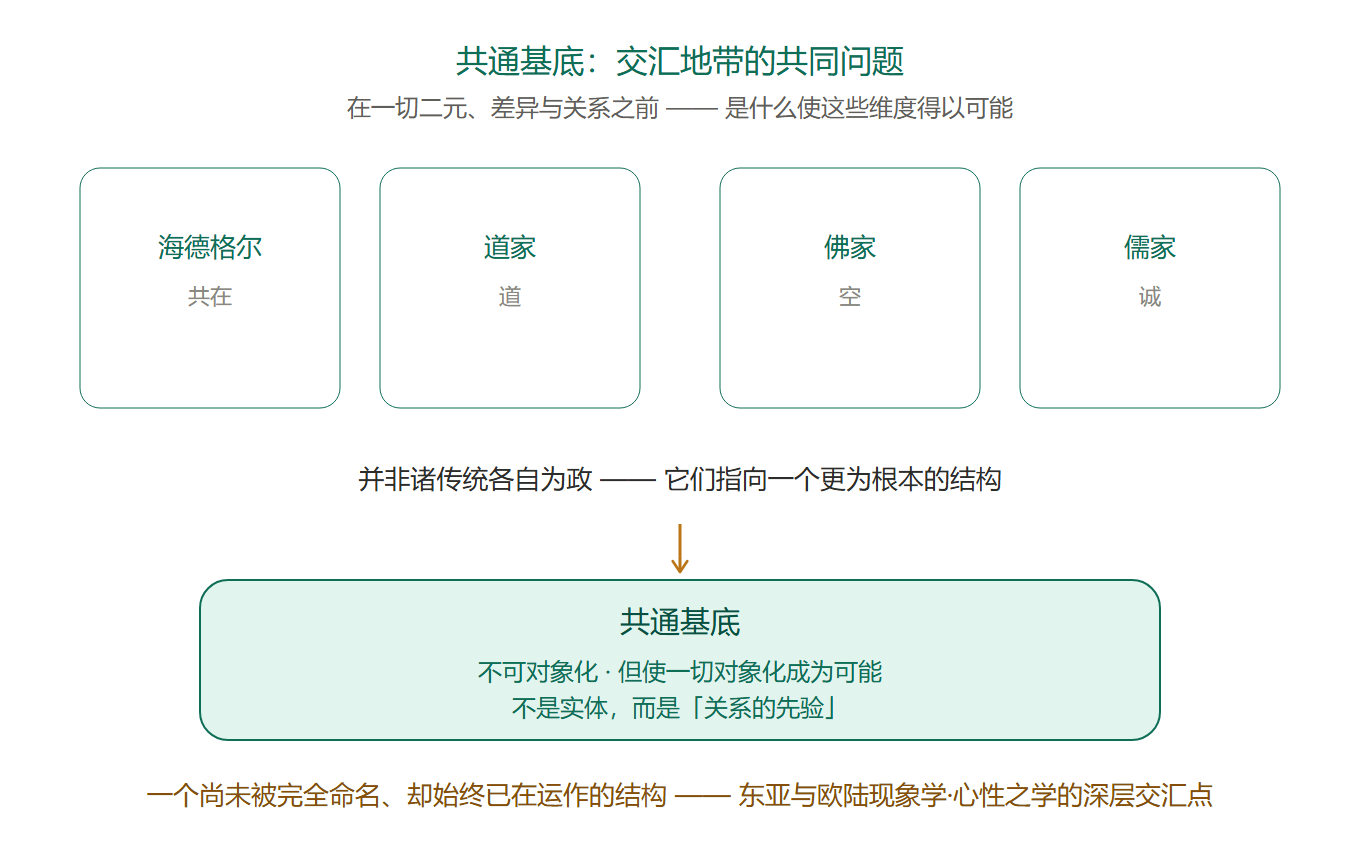
At the intersection of Western philosophy, Indian philosophy, and China philosophy, there is a class of concepts that always surrounds the same question: Before all dualism, differences, and relationships, what makes these dimensions possible. Heidegger calls it "Gong-Being", Taoism calls it "Tao", Buddhism calls it "emptiness", and Confucianism calls it "sincerity", but this is not because traditions are divided into their own affairs. Instead, they all point to a more fundamental structure: a common basis that cannot be objectified but makes all objects possible. It is not the highest being or the beginning of all things, but the condition that allows the highest being and the beginning of existence to appear. The common basis is not an entity, but a "transcendental of relations": without it, there would be no distinction between direction and content, self and other, individual and community, nor would there be any tension and movement generated by this distinction. This paper attempts to demonstrate that the common foundation is the deep intersection of phenomenology and the study of mind and mind in East Asia and Europe. It is a structure that has not yet been fully named but has always been in operation.
1. Introduction: The absence of a common base
From the perspective of modern division of disciplines, concepts such as "existence","co-existence","Tao","emptiness" and "relationship" belong to different systems. But if we dive deep into these concepts, we find a strange repetition: every great tradition houses something that cannot be objectified at its secret core. It is not God, it is not a rational form, it is not a substance, it is not the beginning, but the prerequisite that makes all this possible.
The first question that philosophy needs to deal with is not "what is the world?" but "why is there a world, not just that there is nothing." The common basis is the initial response to this question.
2. The apriori nature of the common basis
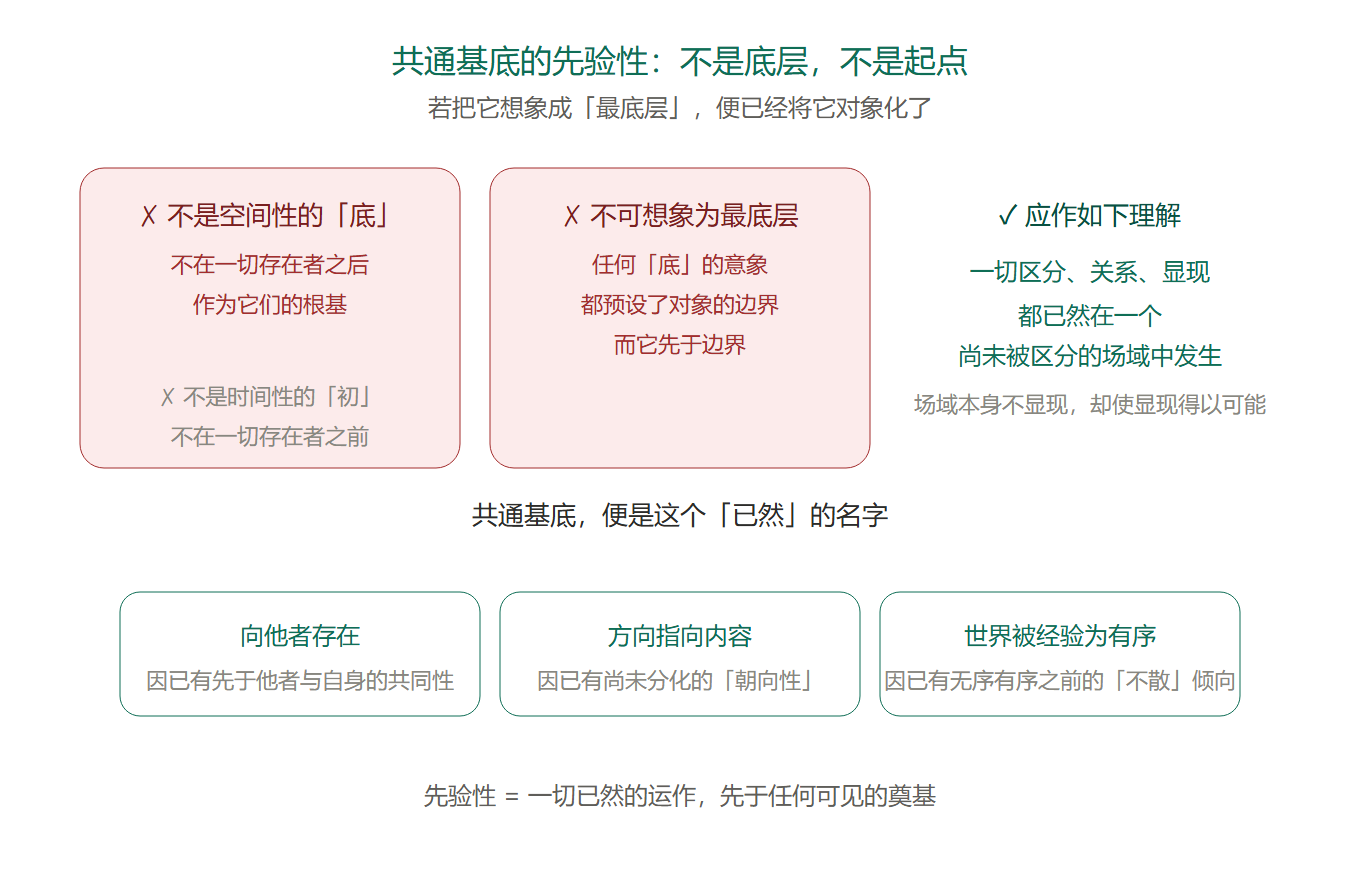
The common foundation is not the spatial "bottom" nor the temporal "beginning". It is not after all beings as their foundation; nor is it before all beings as their starting point. If you think of it as a "bottom-level", you have objectified it.
The transcendental nature of a common basis should be understood as follows: all distinctions, all relationships, and all manifestations have already occurred in an undifferentiated field. This field does not manifest itself, but makes all manifest possible.
Dasein can exist towards the Other because there is already a commonality that precedes the Other and itself; direction can point to content because there is already a kind of "orientation" that has not yet been differentiated; the world can be experienced as orderly because there is already a tendency to "persist" before disorder and order.
The common foundation is the name of this "already".
3. The relationship between common foundation and common existence and root
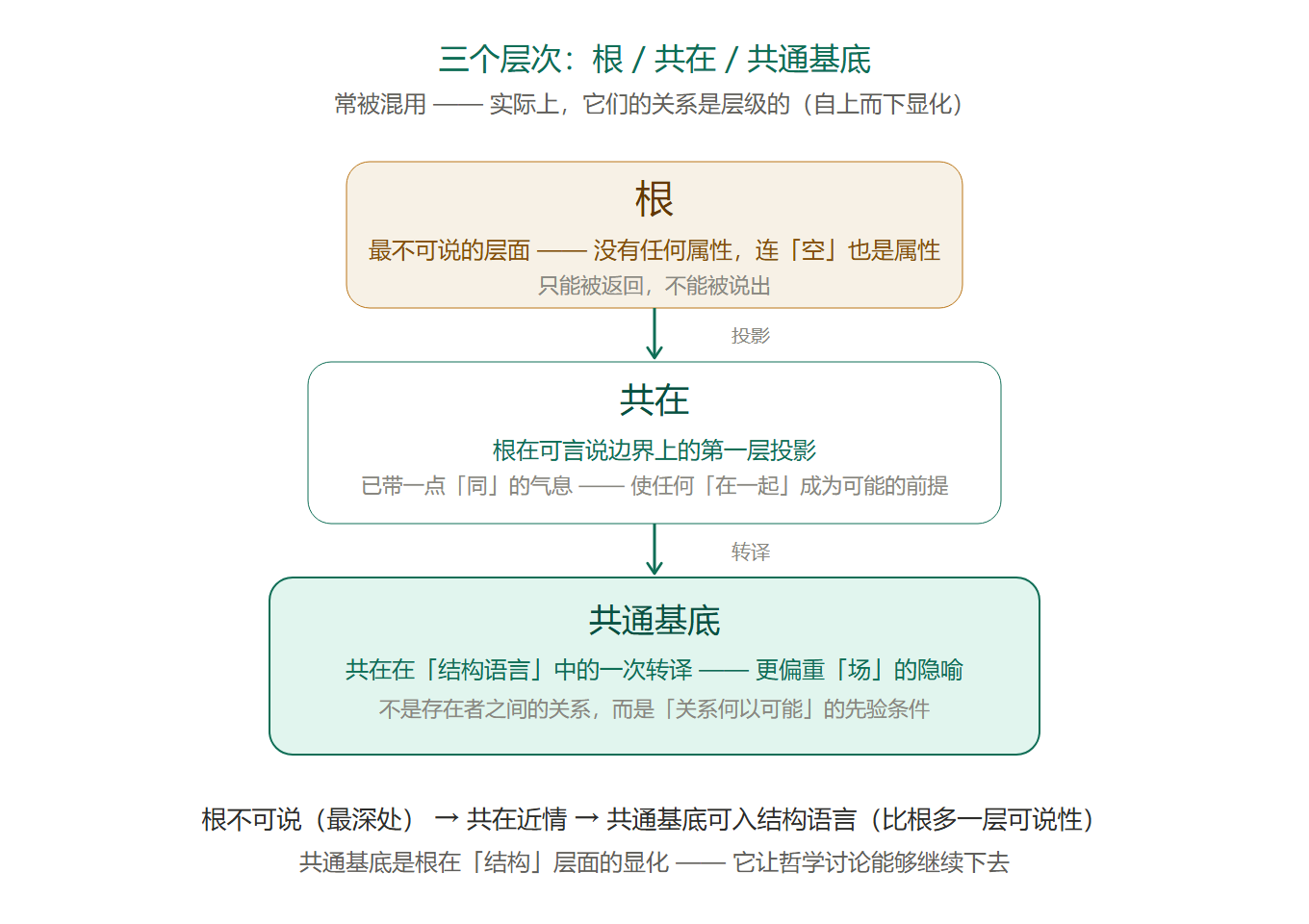
In many discourses, common foundations are shared and roots are often mixed. In fact, their relationship is hierarchical.
1. root
Root is the most unspeakable level of the common foundation. It has no attributes. You can't even say it is "empty" because "empty" is also an attribute. Roots can only be returned, not spoken.
2. total of
Coexistence is the first projection rooted on the speakable boundary. It already has a bit of "sameness": the kind of "together" that precedes the relationship between humans, between humans and things, and between beings. It is not a state of being "together", but a prerequisite that makes any "together" possible.
3. common basis
The common basis is a translation shared in the "structural language". It focuses more on the metaphor of a "field" than coexistence: it is not about the relationship between beings, but about the transcendental conditions of "how relationships are possible." It has a layer of more tellability than roots, but less emotional than coexistence.
If you put the three into one model:
text
Root (unspeakable)
── Coexistence (transcendental "sameness" of relationships)
── Common basis (translation in structural language)
The common foundation is the manifestation rooted in the "structural" level. It allows philosophical discussions to continue.
4. A common foundation is not something
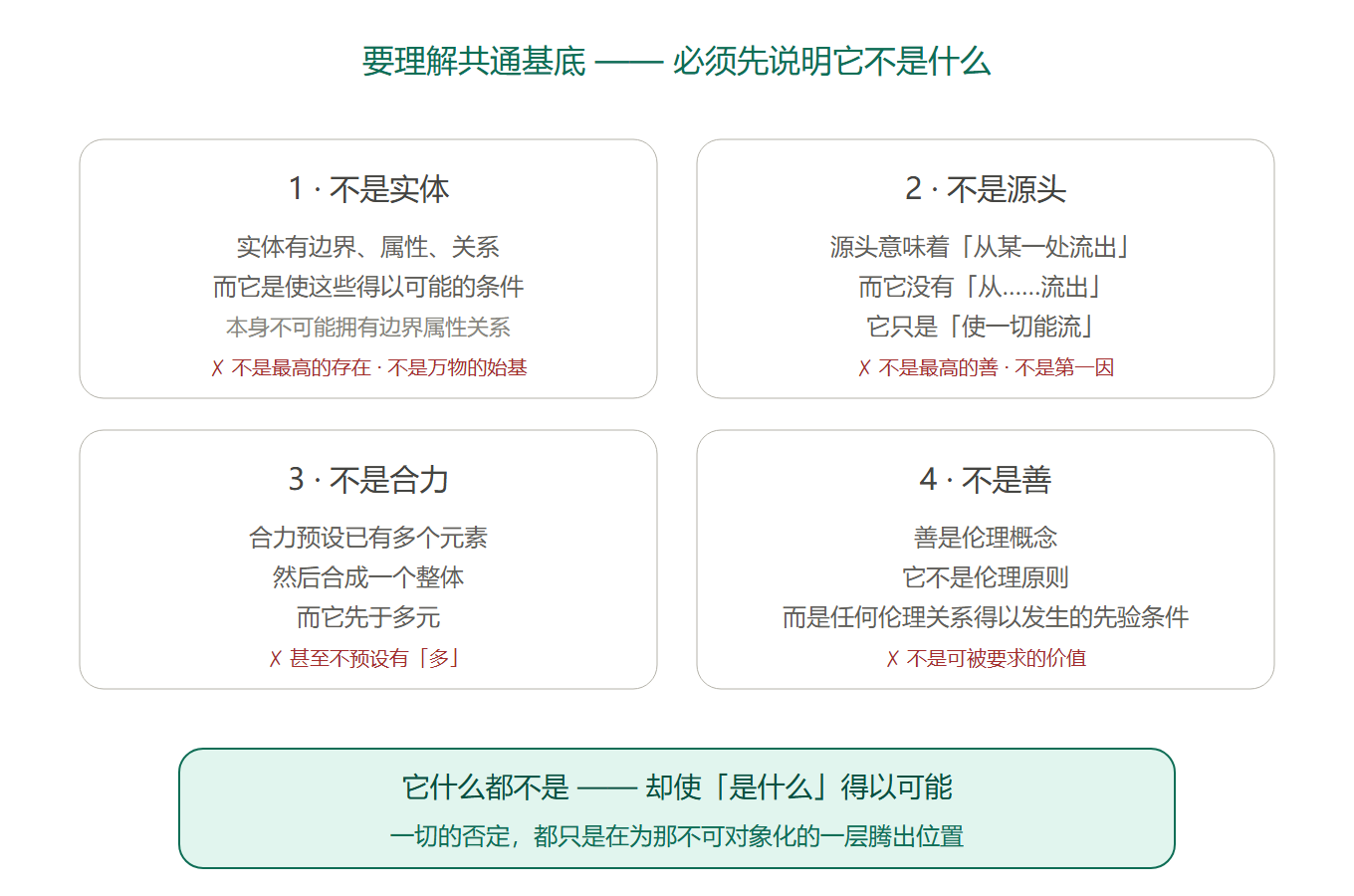
To understand the common basis, we must also explain what it is not.
1. It is not an entity
Any entity has boundaries, attributes, and relationships. The common foundation is the condition that makes boundaries, attributes, and relationships possible, and it is impossible to have these in itself.
2. It's not the source
Source means flowing out from somewhere. The common foundation does not "flow out", it just "makes everything flow."
3. It's not a joint force
The image of synergy still presupposes that there are multiple elements that then merge into a whole. The common foundation precedes diversity. It doesn't even presuppose that there is "much".
4. It is not good
Good is an ethical concept. The common foundation is not an ethical principle, but a priori condition for any ethical relationship to take place.
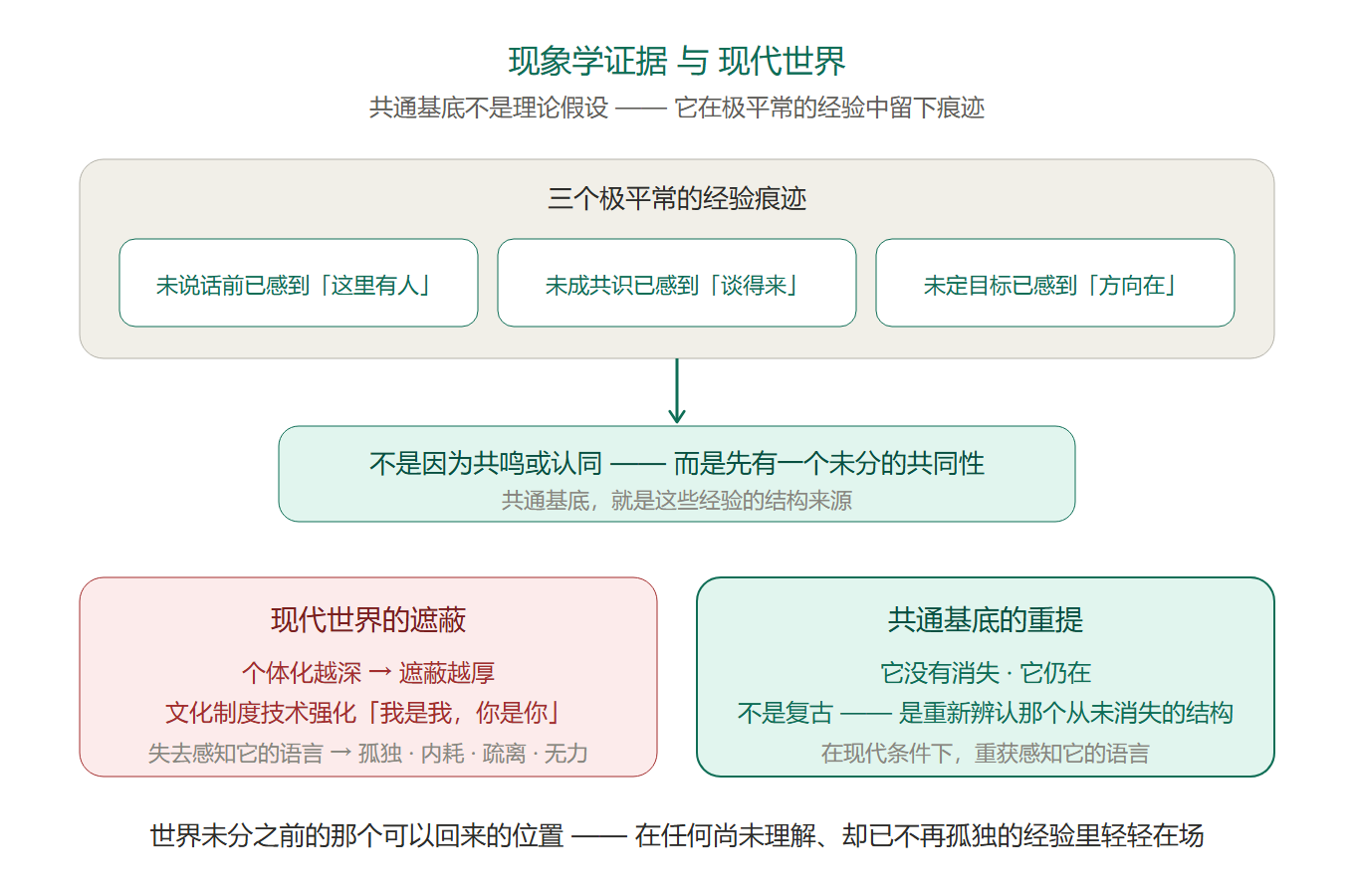
5. Phenomenological evidence for a common basis
The common basis is not just a theoretical assumption. It leaves its mark in some very ordinary experiences.
Before a person can speak, you already feel that "there is someone here".
Before a dialogue reaches a consensus, you already feel that "we can talk."
Before a team has a clear goal, you already feel that "the direction is here."
These experiences are not psychological resonance or reasoning recognition. They are possible because there is an undivided commonality under all specific relationships.
The common foundation is the structural source of these experiences.
6. The common foundation and the modern world
The deepest trouble in the modern world is not "I am not free", but "I cannot find a common place to return to." The deeper the individualization, the thicker the common base is concealed.
When culture, systems, and technology continue to strengthen "I am me, you are you", the common foundation has not disappeared. It's still there. It's just that we lose the language to perceive it. Therefore, people call that kind of loss as loneliness, internal friction, alienation, and powerlessness.
The revival of the common foundation is not for the purpose of retroactivity, but to re-identify the structure that has never disappeared under modern conditions.
7. Conclusion
A common foundation is a structure that has not yet been fully named. It spans east and west, not a compromise, but a real intersection of problem fields.
The roots cannot be said, but the common foundation is the part that can enter the structure and language. It allows us to see that all relationships are possible not because the individual existed first, but because before the individual, there is a kind of "identity" that precedes separation.
This "unity" is not a lost past or a distant ideal. It is gently present in any experience that has not yet begun to understand but is no longer lonely.
The common foundation is the position before the world was divided to where you could return.