1. Inner clues
The entire logic of Root Thought has actually reserved a place for the Book of Changes.
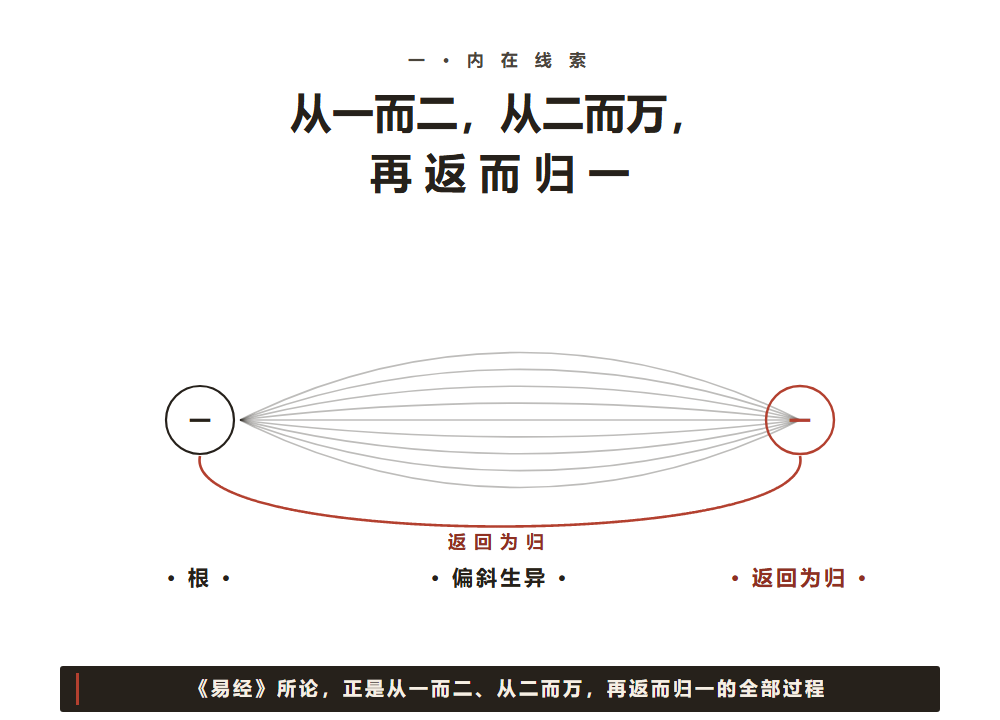
The roots cannot be said; the common existence is not divided; the deviation produces differences; the direction is made manifest; the return is the return. What the Book of Changes discusses is the entire process from one to two, from two to ten thousand, and then back to one.
The Book of Changes is not an arbitrary doctrine or a revelation from a god, but a highly sophisticated manifestation model. It uses a minimalist structure to describe how all things differ from "undivided" and how they maintain recoverability amid change.
Using root thinking to perspective the Book of Changes is not to translate the Book of Changes into a modern framework, but to use this "unbroken thread" to re-see the extreme depth where the Book of Changes came from and returned.
2. The "Yi" of the Book of Changes has three meanings
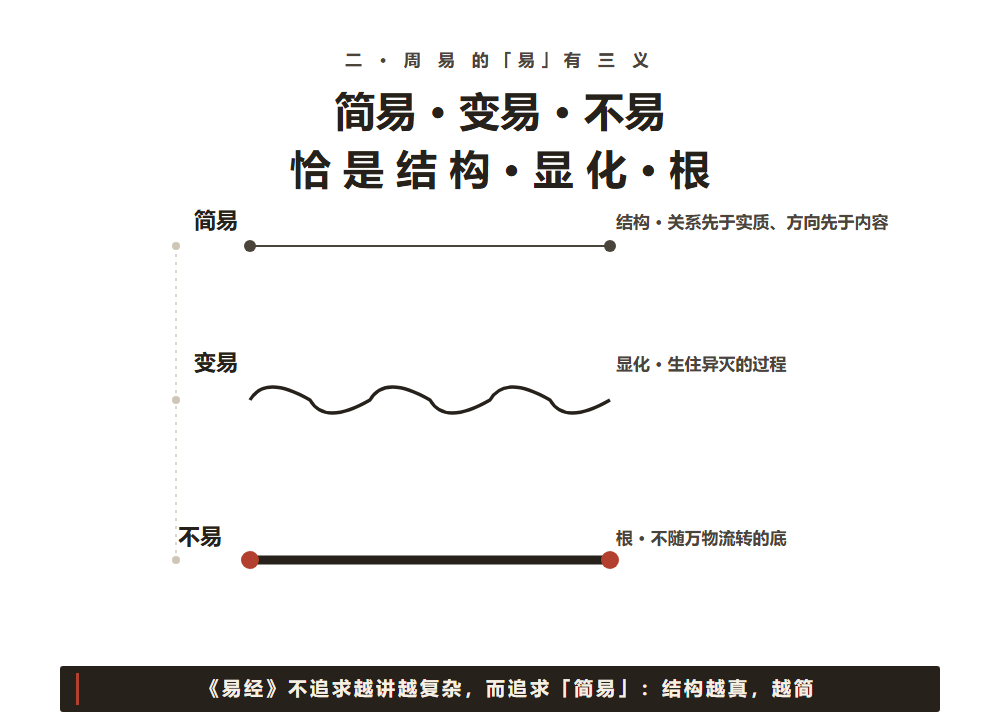
The ancients often said: "easy has three meanings: simple, variable, not easy."
These three meanings exactly correspond to the three-layered structure of root thought:
not easy, is the root. It is the bottom of change that does not flow with all things.
variation, is manifestation. It is the process in which all things are born, lived, changed and died.
simple, is structure. It is the kind of minimalist discernment in which relationship precedes essence and direction precedes content.
The most astonishing thing about the Book of Changes is that it does not pursue more complexity, but pursues "simplicity". This simplicity is not that it is lazy, but that the structure has been deep enough to return to simplicity. The more real the structure, the simpler it is. The more obvious the roots are, the fewer the words are.
3. From Tai Chi to Yao
"Xi Ci" said:
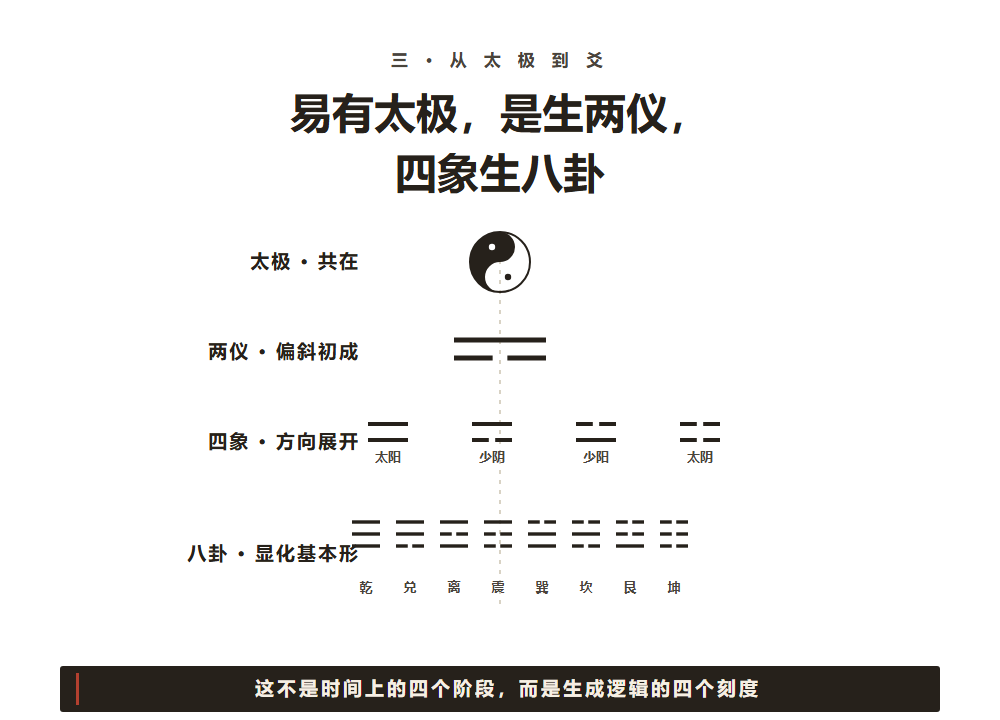
Yi has Tai Chi, which produces the Two Elements, the Two Elements produces the Four Elephants, and the Four Elephants produces the Eight Trigrams.
This can be said to be completely isomorphic to the root idea.
Tai Chi: It is to be together. It is the same that has not yet been divided or separated.
yin and yang: It is the first formation of deflection. Yin and Yang arise from this.
fourlike: It is the initial development of direction in time and space.
gossip: is the basic form of explicit structure. The beginning of everything.
These four levels are not four stages in time. They are the four scales of generative logic. From inexpressible to speakable; from indivisible to divisible; from coexisting to difference; from root to manifest.
After the "Eight Trigrams", the Eight Trigrams were regrouped into sixty-four hexagrams, so all the changes in them. This is the complete interpretation of "three things".
4. Line position and direction
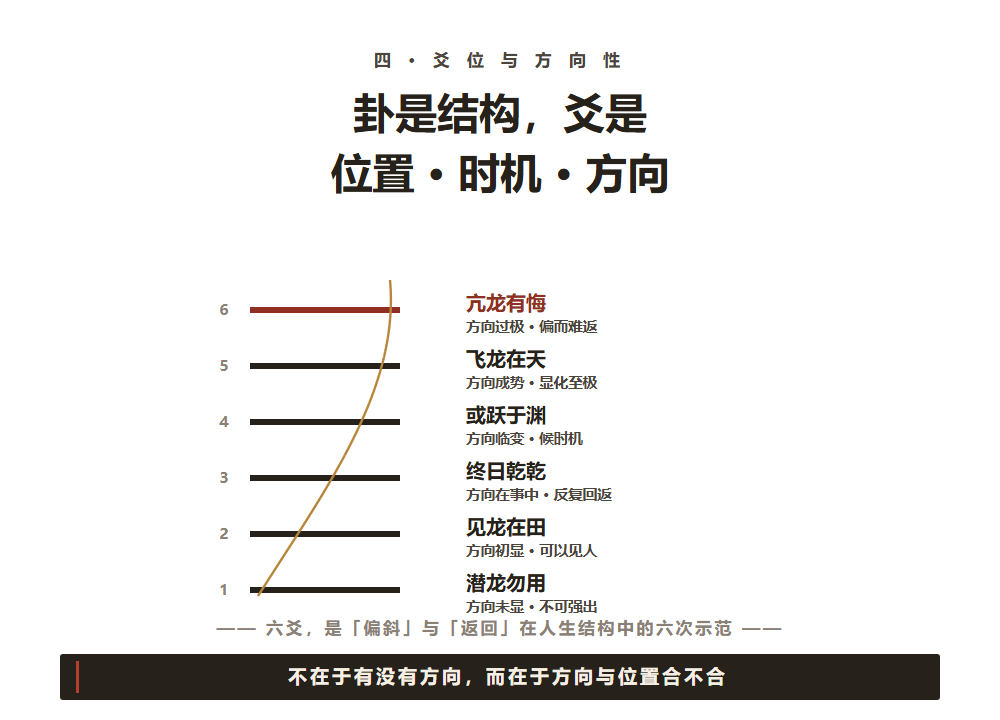
The sharpest thing in the Book of Changes is not the hexagram, but the line lines.
Diagrams are structure. Lines are position, opportunity, and direction. Every line tells you: What position is this position at this time, what direction is this position, and what success is this direction.
This is close to what the root system says:
It is not whether there is a direction, but whether the direction and position are consistent.
The good and bad luck in the Book of Changes are not subjective good and evil, but whether the "potential" matches. Whether you are suitable for this position determines whether you are on the auspicious path or the evil path.
This is an extremely fundamental point.
The Book of Changes does not start from "good and evil of people", but starts from "whether the direction and position in the structure are consistent." It looks not only at what you "want to do", but also at "where you are standing."
Therefore, the root system talks about "direction comes before content", and the Book of Changes implements it in every specific position in life:
Don't use hidden dragons, because the direction is not shown, so you can't force it.
Seeing the dragon in the field is the first time the direction appears and you can see people.
Working all day long is the direction in the matter and must return repeatedly.
Or leap into the abyss, the direction is about to change, and the opportunity is needed.
Flying dragons in the sky are the direction that becomes the momentum and becomes the extreme.
The arrogant dragon has regrets, because the direction is too extreme and it is difficult to return.
The six lines are six demonstrations of the "deflection" and "return" of the root system in the structure of life.
5. Regret for good or bad luck: Returning to the language of the system
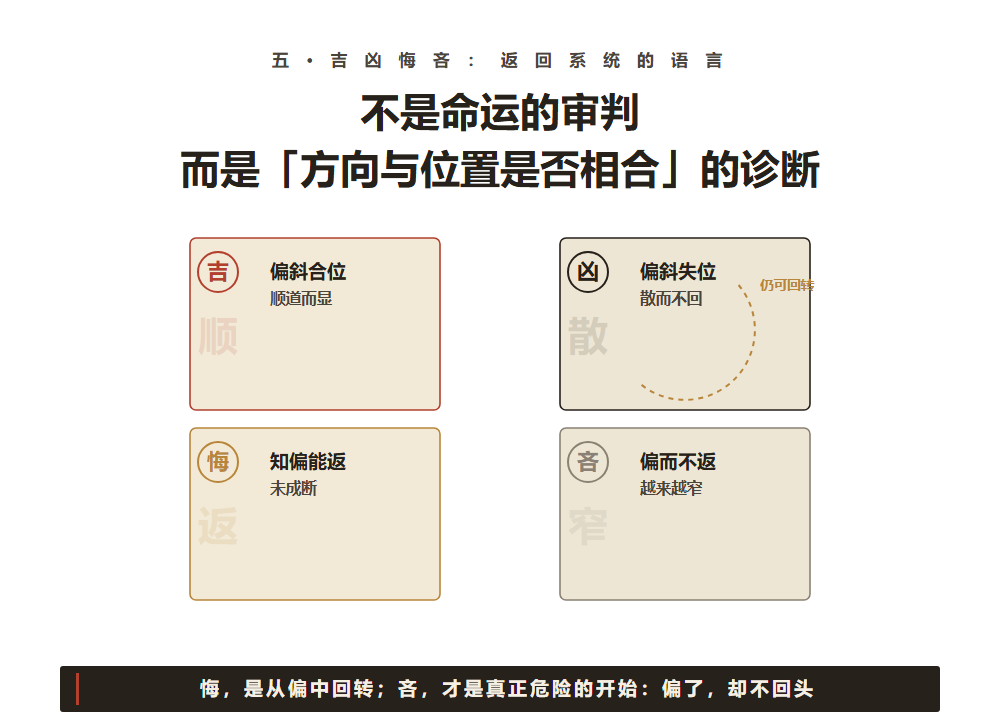
The root system talks about "drift","not dispersion" and "return". The Book of Changes talks about "regrets for good or bad luck."
Ji: Deflect and align, and show it along the way.
fierce: Deflection and loss of position, dispersion and failure to return.
regret: Knowing the deviation, you can return, but there is no conclusion.
stingy: It is biased and never returns, becoming narrower and narrower.
This is not a judgment of fate. This is a diagnosis of whether the direction and position match.
The deepest wisdom of the Book of Changes is not that it can predict good or bad luck, but that when it looks at good or bad luck, it always returns to the same line:Are you still on the road or have you left the road?
Therefore, the word "regret" is extremely important. Regret is not self-punishment. Regret is "turning back from deviation". And "stingy" is the beginning of the real danger: you have deviated, but you have not turned back yet.
If the root system wants to use one word to explain the operation of the Book of Changes, it is:
The Book of Changes is a set of manifest structures centered on return.
6. Zhongzheng: The manifestation of roots in the line position
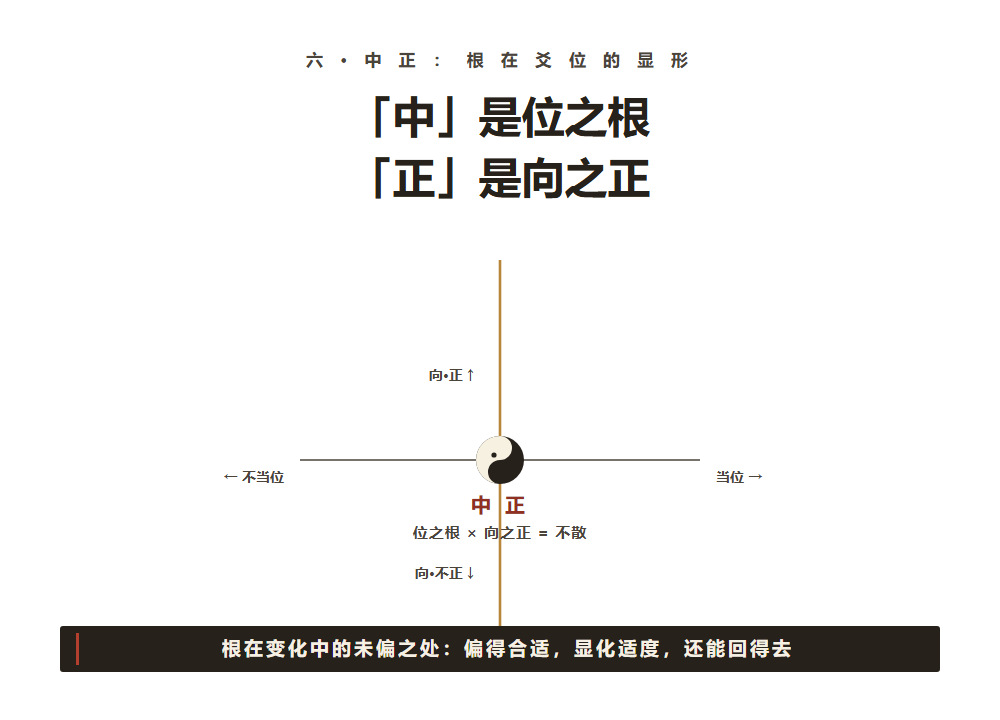
The Book of Changes places great emphasis on "middle" and "right".
"Zhong" is the root of position, and "Zheng" is the right direction. In short, you have neither left your place nor deviated from your direction.
This is what the root system calls "never breaking up."
A "upright" person is not necessarily a secular success. But in that position, he will not disperse. If he is suitable, if he embodies moderately, he can still go back.
Confucianism originated from the Book of Changes and finally fell into the "middle of the times". Buddhism originated from its origin and finally fell into the "empty destiny". Taoism originated from Tao and finally fell into "guarding the center". The three deepest places all have this "middle".
"Medium" is not an average or a compromise. It is rooted in the unbiased aspect of change. It is the unbroken line, a perceptible landing point at a specific time and location.
7. Diagrams and Manifestations
Diagrams are not symbols used to calculate destiny, but pictograms that manifest their structure.
Qian: Pure Yang, the direction is extremely outward, the most partial and farthest.
kun: Pure Yin, the direction is extremely inward, the most tolerant and convergent.
tai: Up and down traffic, manifest and smooth.
no: If the upper and lower levels are not in harmony, they will manifest and close.
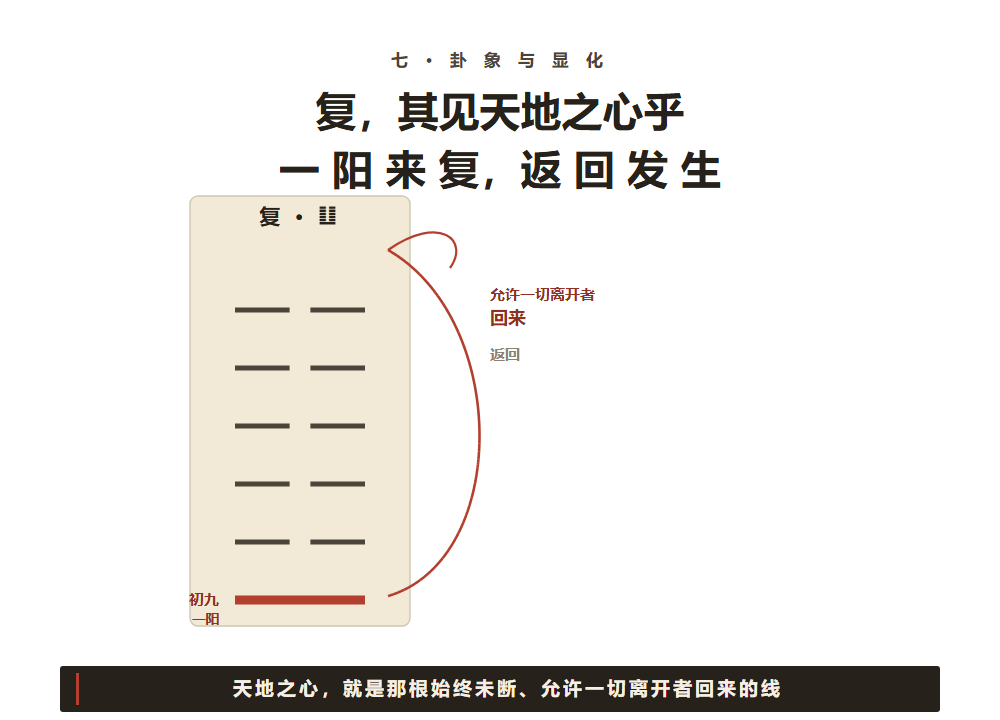
complex: When the sun comes and returns, the return occurs.
In particular, the "recovery of hexagram" is exactly the same as the "return" of the root system.
"" says:
Again, do you see the heart of heaven and earth?
The heart of heaven and earth is nothing else but the thread that has never been broken and allows all who have left to return. Recovery means "coming back".
8. Looking at the limits of "Yi" through root thinking
But the Book of Changes is still a manifest system. It is extremely deep, but it still does not touch the root body.
It talks about Yi, Tao, and Tai Chi, but not about the "unspeakable itself". It hides the root at the bottom of all hexagram lines, but does not directly talk about the root.
This is precisely its wisdom: it knows that once the root is regarded as a supreme concept, it becomes rigid "not easy" and loses "variation."
Therefore, when we look at the Book of Changes with Root Thought, we do not read the Book of Changes as root studies, but see:
"Yi" has long been the oldest, most complete, and most manifest structure in the root system.
It doesn't say "root". It just allows the roots to reveal themselves in every line, every hexagram, and every change.
9. The root meaning of joining the WTO with the Book of Changes
In the end, the biggest revelation of the Book of Changes to Root Thought is not "change" or "occupation", but:
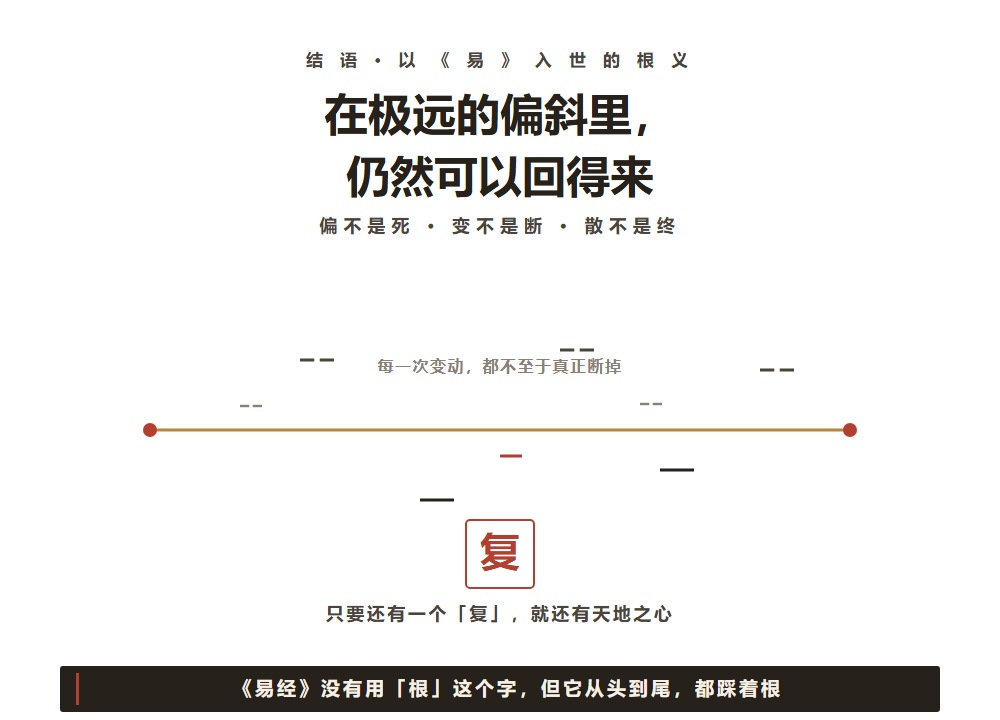
In the extreme deflection, you can still come back.
Life cannot be impartial. Manifestations cannot remain unchanged. Everything cannot stay together.
But the entire book of "Changes" talks about the same thing: it is not death, change is not break, and dispersion is not the end. As long as there is a "recovery", there will be the heart of heaven and earth.
Therefore, the Book of Changes is a book that "allows people to come back".
Its deepest resonance with the root system lies in this word:
Reply.
conclusion
Looking at the Book of Changes from the perspective of roots, we will find:
Simplicity is the root of structure.
Change is a manifestation of deviation.
It is not easy, but it is an unbroken end.
Line position is the judgment of direction and position.
Regret is the language of return and drift.
Zhongzheng is an everlasting manifestation.
Recovery is the breath of the roots.
The Book of Changes does not use the word "root". But it was rooted from beginning to end.
And Root has never left "Yi". It just quietly, under the sixty-four hexagrams, so that every change would not really break.
This is the deepest unbroken line of The Changes.