abstract
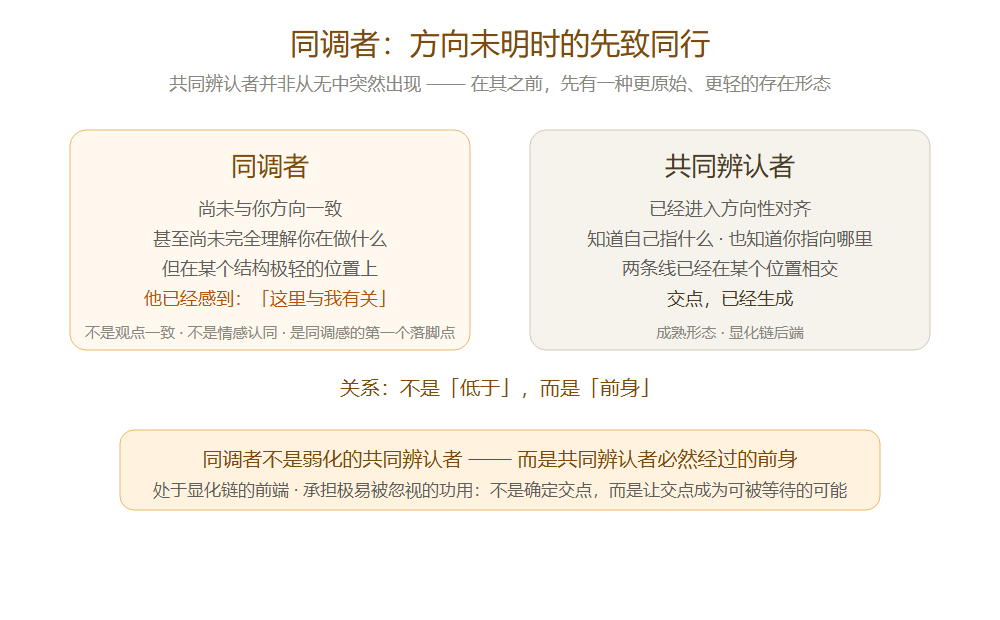
Co-recognizers do not appear out of nowhere. Before it became a co-recognizer, there was a more primitive and lighter form of existence: the harmonizer. The homophones are not yet in line with you, or even fully understand what you are doing. But in a certain position with extremely light structure, he already felt that "this is about me." This relationship is not a consensus of views or emotional identification, but the first foothold that a sense of harmony finds in a specific person. This article attempts to illustrate that the same person is not a weakened co-identifier, but the inevitable predecessor of the co-identifier. They are at the front end of the manifest chain and perform a function that is extremely easily ignored: not to determine the intersection, but to make the intersection a possibility that can be waited for. Starting from the relationship between co-ordinators and co-recognizers, this article analyzes their phenomenological characteristics and structural positions, and discusses its significance to the entry of ideas into the world, public generation and the initial formation of teams.
1. Who are the co-authors
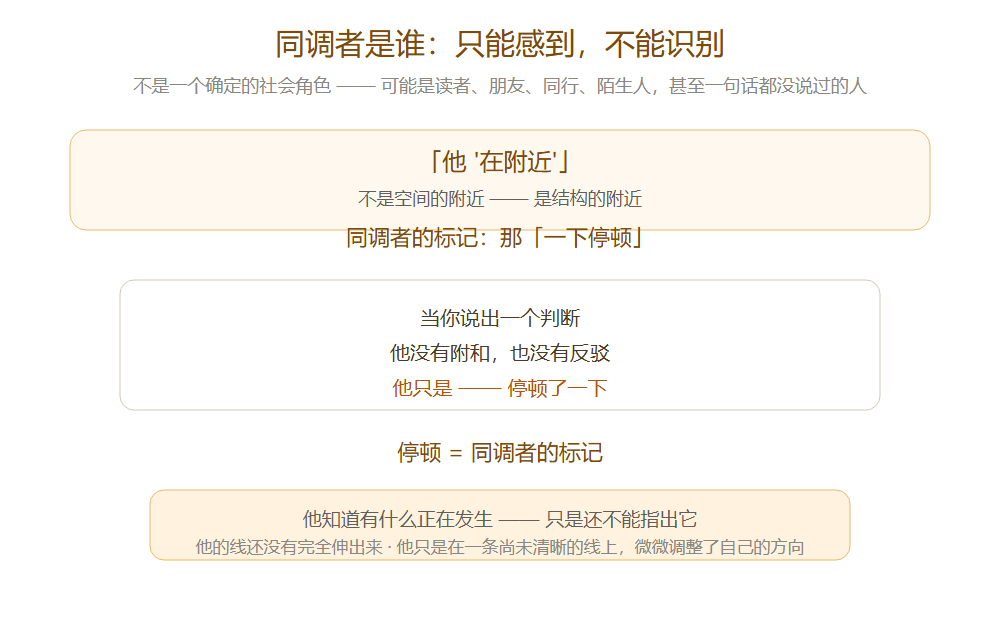
A harmonist is not a definite social role. He may be a reader, a friend, a colleague, a stranger, or even someone who has never said a word. You cannot recognize him, you can only feel him.
He is "nearby". Not near space, near structure.
When you make a judgment, he does not echo it or refute it. He just paused. This pause is a sign of a harmonist.
He knew what was happening, but just couldn't point it out yet.
2. The difference between co-ordinators and co-recognizers
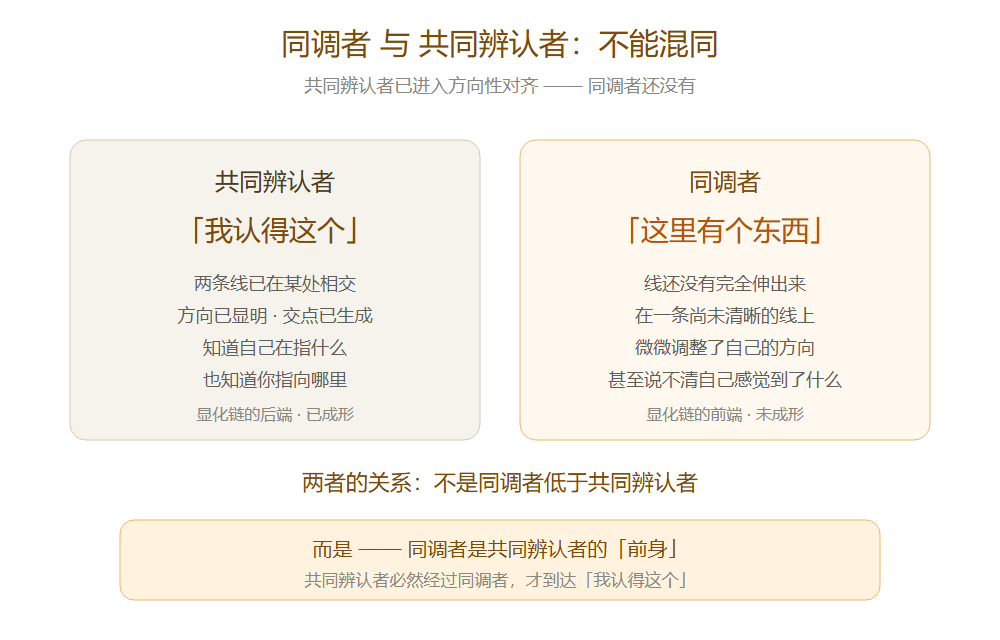
Those who share the same tone and those who identify the same tone cannot be confused.
The co-recognizers have entered directional alignment. He knows what he is pointing at and where you are pointing. Two lines have already crossed at a certain location, and the intersection point has been generated.
No collaborators yet. His line has not yet been fully extended. He only slightly adjusted his direction on a line that was not yet clear. He couldn't even tell what he felt. He may have left a seemingly irrelevant sentence under your article, may have suddenly quieted down during a conversation, or may have just memorized a certain sentence of yours in his heart.
The symbol of the co-identifier is "I recognize this".
The sign of a homophor is "there's something here."
The relationship between the two is not that the homophones are lower than the co-recognizers, but that the homophones are the predecessors of the co-recognizers.
3. How to find the same person
The sense of harmony is not created or pursued. It is the earliest timing, a weak induction in the air caused by two unfinished lines.
A homophor is the person who is touched by this induction.
He will have a less clear but lingering feeling: this thing seems to have something to do with me. Not resonance, not recognition, but a kind of "what do I see in it". He may not like this thing, may not understand it, and may even think it is problematic. But he didn't leave.
This is what makes harmonists most difficult to design: they are not persuaded, but attracted by something they cannot express.
4. The structural position of the same person
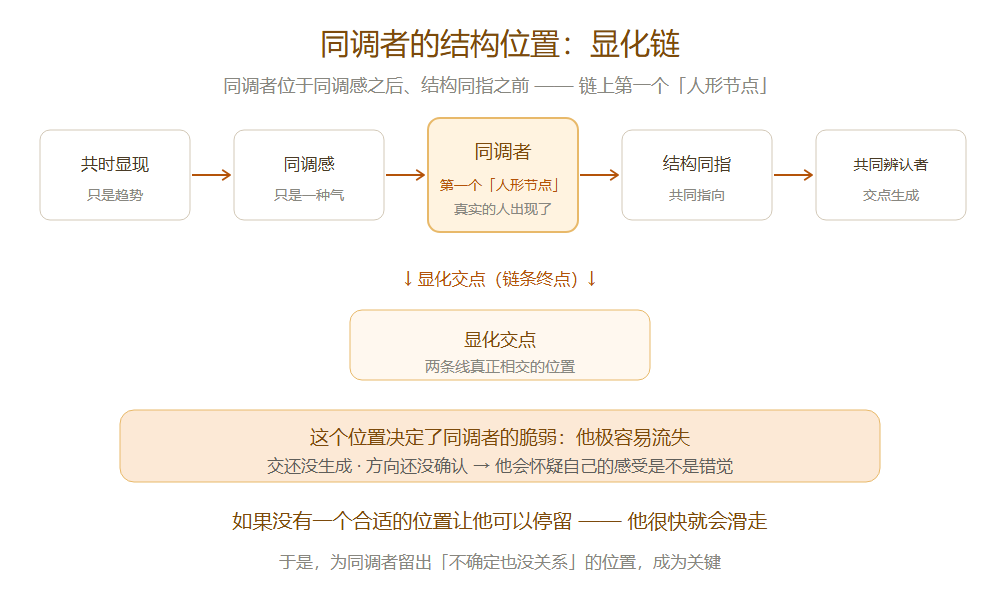
In the manifest chain, the homologous person is located behind the sense of homology and before the structural homologous.
text
Synchronous appearance → sense of harmony → homophonic person → structural homophonic person → co-recognisable person → manifest intersection
They are the first "humanoid nodes" in the chain. In synchronic manifestation, everything is still just a trend; in the sense of harmony, it is still just a qi; when it comes to harmony, a real person appears.
This position determines the vulnerability of the harmonist: he is extremely easily lost. Because the return has not been generated and the direction has not been confirmed, he will wonder if his feelings are an illusion. If there is no suitable position for him to stay, he will slip away quickly.
5. What a harmonist needs is not knowledge, but promise.
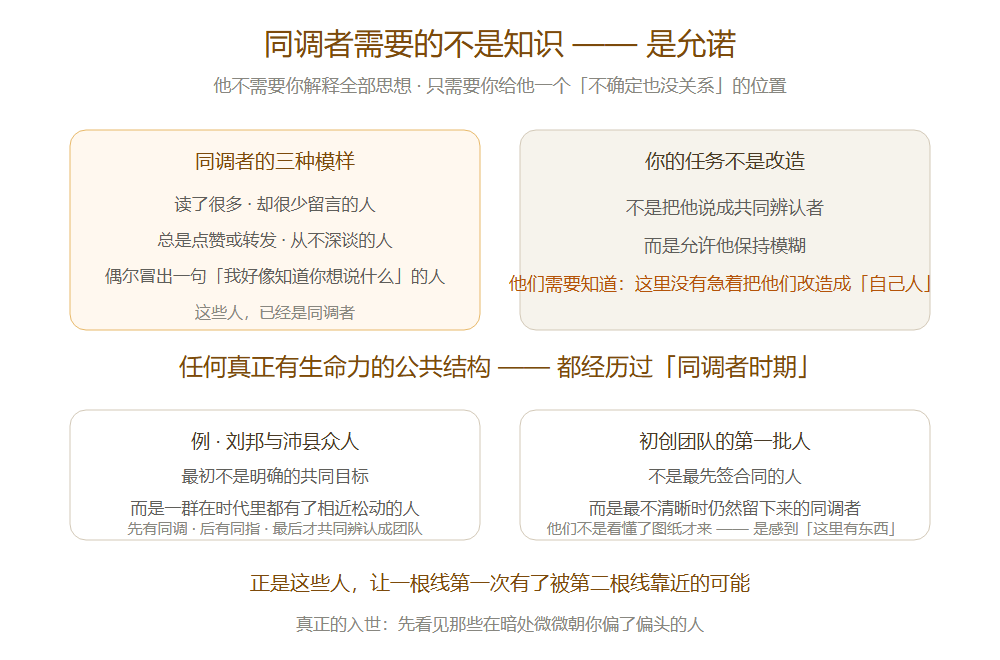
Homophones don't need you to explain your entire thoughts. He just needs you to give him an "uncertain and okay" position.
Your task is not to describe him as a co-identifier, but to allow him to remain vague.
They often manifest themselves as:
People who read a lot but rarely leave a message
Someone who always likes or retweets but never talks in depth
People who occasionally say,"I seem to know what you want to say"
These people are already colonists. They don't necessarily need you, but they need to know: there is no rush to transform them into "one of their own."
6. Structural significance of WTO accession and start-up
Almost any truly viable public structure has experienced a "syndication period."
The initial connection between Liu Bang and people in Pei County was not necessarily a clear common goal, but a group of people who had similar loosening in the times. They first have homology, then have homology, and finally form a team through joint identification.
The "first batch of people" on the start-up team are not the first to sign the contract, but the few co-talkers who may not fully understand you, but still stay when you are least clear. They did not come because they understood the drawings, but because they felt that "there is something here." They may not really become co-recognizers until later, or they may have remained just co-recognizers.
But it was these people who made it possible for a thread to be approached by a second thread for the first time.
7. Conclusion
A co-tune is a co-identification that has not yet been said.
They are the people you don't need to persuade but haven't left. They make your line no longer absolutely lonely, and also make you qualified to wait for the real intersection.
The real entry into the world is not to find someone who is already in the same direction as you, but to first see those people who are leaning slightly towards you in the dark.
The same person is the little light that comes first when the direction is still in the fog.
They are not here to light the way for you. They want you to know that you are not the only one walking this road.