abstract
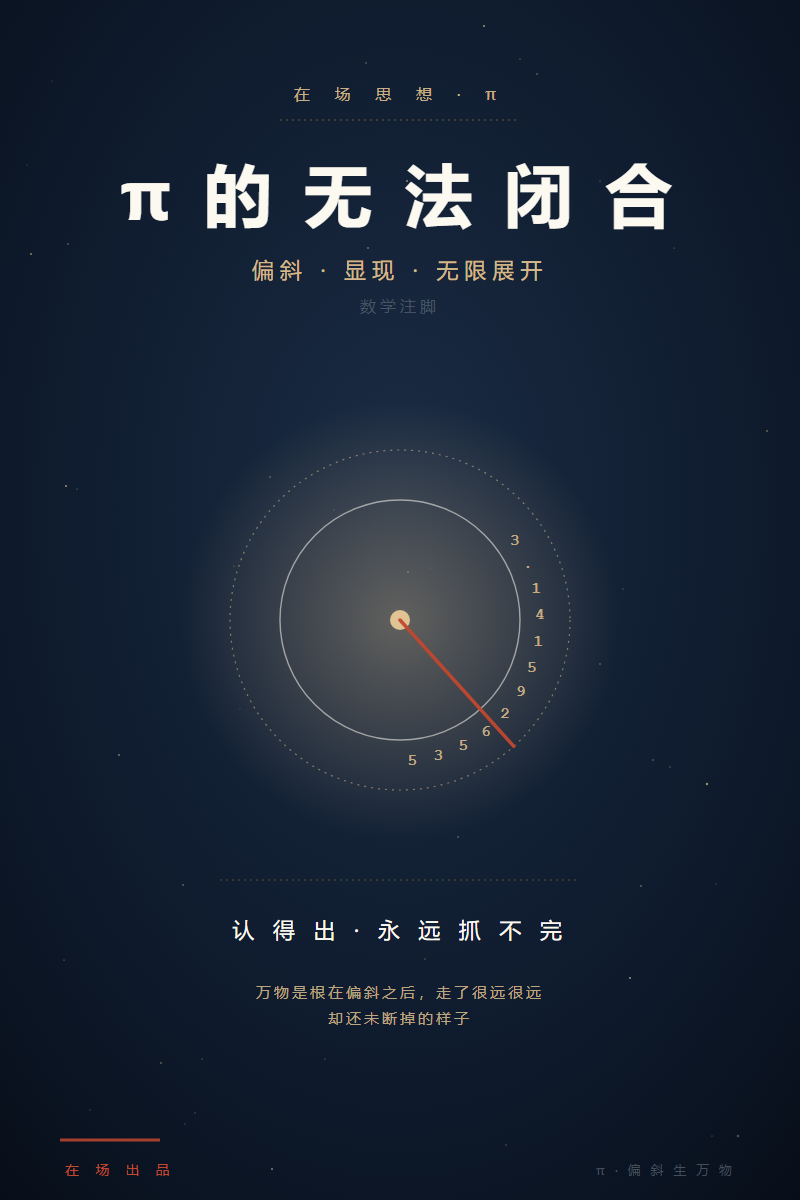
This article explores an image between mathematics and metaphysics: the non-computability of pi. This is not a failure of knowledge, but a clue to revealing structure. A perfect circle is undeflected, perfect, and therefore invisible. The circle appears as π only when it is "placed" in a broken, skewed, differentiated world.π brings this manifestation into mathematics: it is certain but cannot be closed; it is real but never ending. In this paper, the uncomputability of π is regarded as a structural expression. What it expresses is that when all things are deflected from the original harmony, they enter an endless process of expansion. This unfolding is not the division of the root, but the continuous occurrence of the root's entry into time, differences and manifestations.π has thus become a mathematical footnote to this unbroken manifestation. It expresses the principle that "manifestation is never equal to root" in numerical form.π shows that a root can be confirmed but still cannot be exhausted; the world can appear but will never be completed; and mathematics, in the deepest part, has also reached the place where metaphysics has been watching.
1. The paradox of π
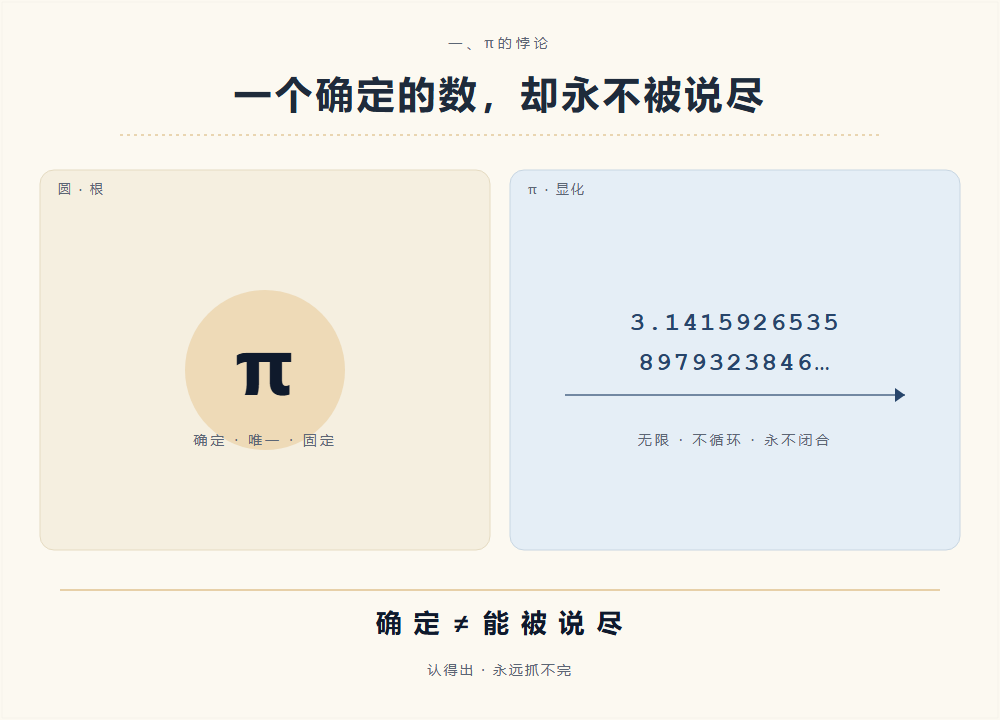
Pi is a definite number. It is not an arbitrary approximation. It is not a construction of a number system, it is not a convention. It's a fixed thing, and it's still the same whether Archimedes is doing it or supercomputers are doing it today.
But π cannot be counted out. It has infinite single digits and never repeats or ends. It does not cycle, it does not close, it does not return to itself. Every extra bit it writes is new. Every extra paragraph is something that has never appeared before.
This is not a failure of the tool. It's not that the computing power is not enough, nor that the algorithm is not good. The inability to close π is not a problem we have to overcome. It is the way this number appears itself in the world.
This leads to the paradox of π: something that is certain cannot be fully given; something that is real cannot be said.
It has the same strange quality as beauty, root, existence, and manifestation: you recognize it, but you can never finish it.
2. The circle that is not deflected: the invisible
In pure geometric intuition, circles are perfect.
It has no beginning and end, no corners, and nothing is different from anything else. Every point on the circle is equal. A circle is an absolutely symmetrical shape. It can rotate infinitely around the center while still completely unchanged.
This complete symmetry makes the circle invisible.
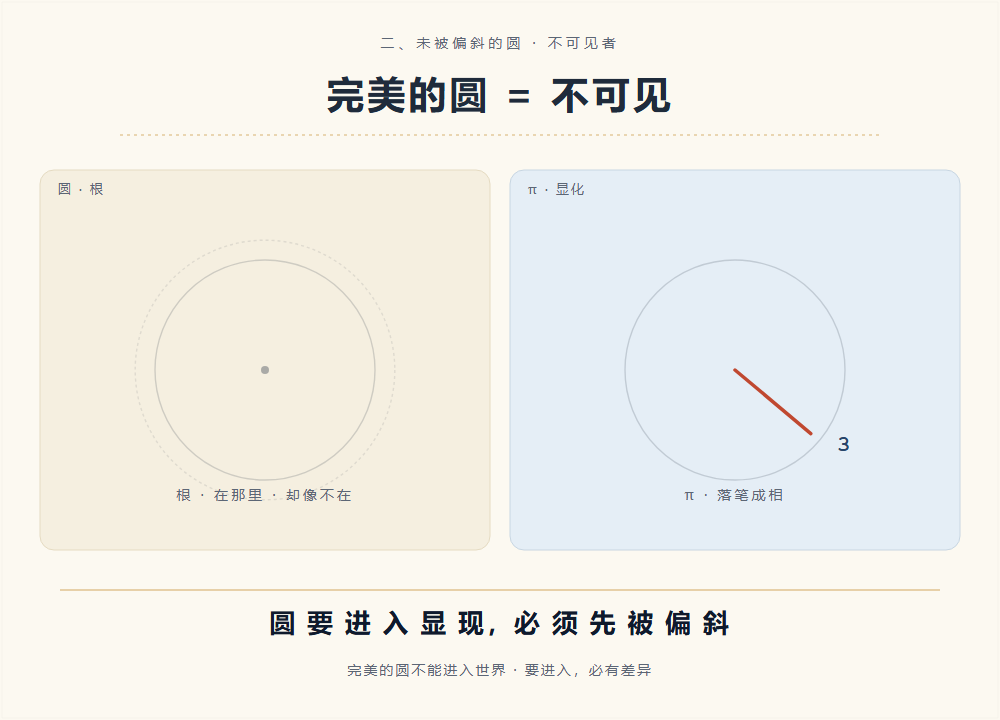
It's not that circles don't exist. It is that it cannot be manifested in manifestation. To be presented, there must be differences, differences, and certainty. But a perfect circle has no place to stay, no boundary to be identified, and no point that can be grasped by experience.
It's there, but it doesn't seem to be there.
This is like the undeflected root, like the original unity. It is not nothing, but invisible. It does not enter the world. It is the condition for the world to be possible but not to enter.
A circle, in purity, is what it is: a totality that is not destroyed, not deflected, and not pulled into time and difference.
3. Deflection: When the circle enters the world
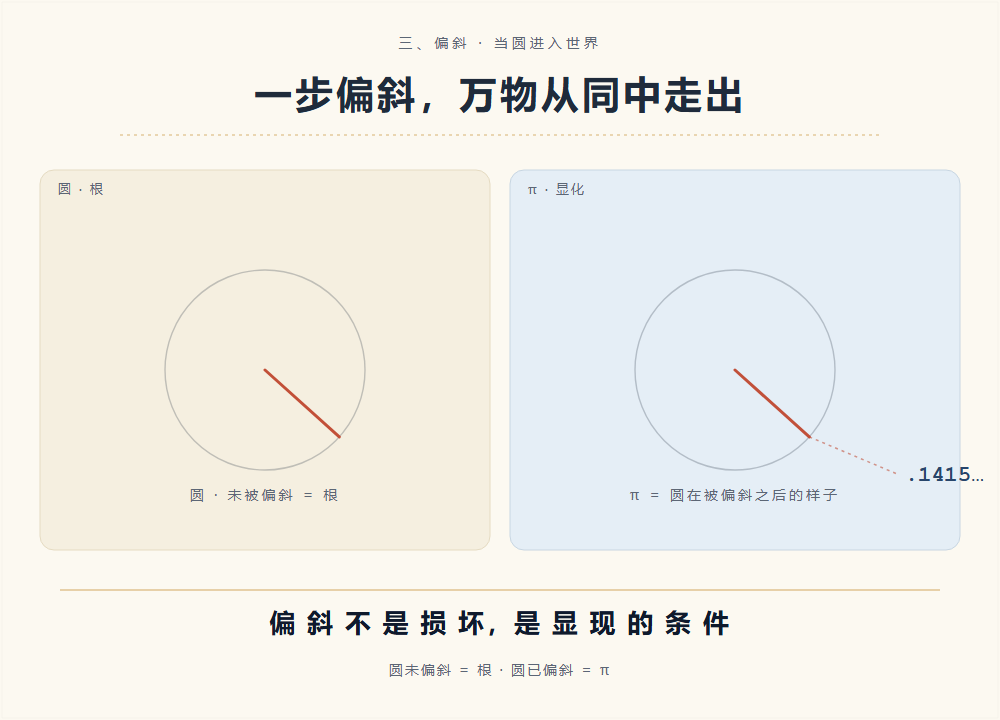
When the circle begins to enter the world, it can no longer maintain its pure closure.
The world is made up of differences. To appear in this world, circles must be written down, calculated, and placed into a number system composed of differences.
This step is deflection.
Deflection does not break the circle. Deflection is to allow circles to appear.
Thus, the circle enters into visible differences from invisible perfection. It is no longer the absolutely symmetrical circle, but begins to have the first, second and third digits. It begins to manifest. It began to unfold infinitely. It becomes π.
π is what a circle looks like in a skewed world.
So we cannot say: "π is not as perfect as a circle."π is the most true manifestation a circle can make. The circle remains invisible, while π makes it visible. The circle is the root, and π is the expansion of the root in the number.
4. π as an endless manifestation
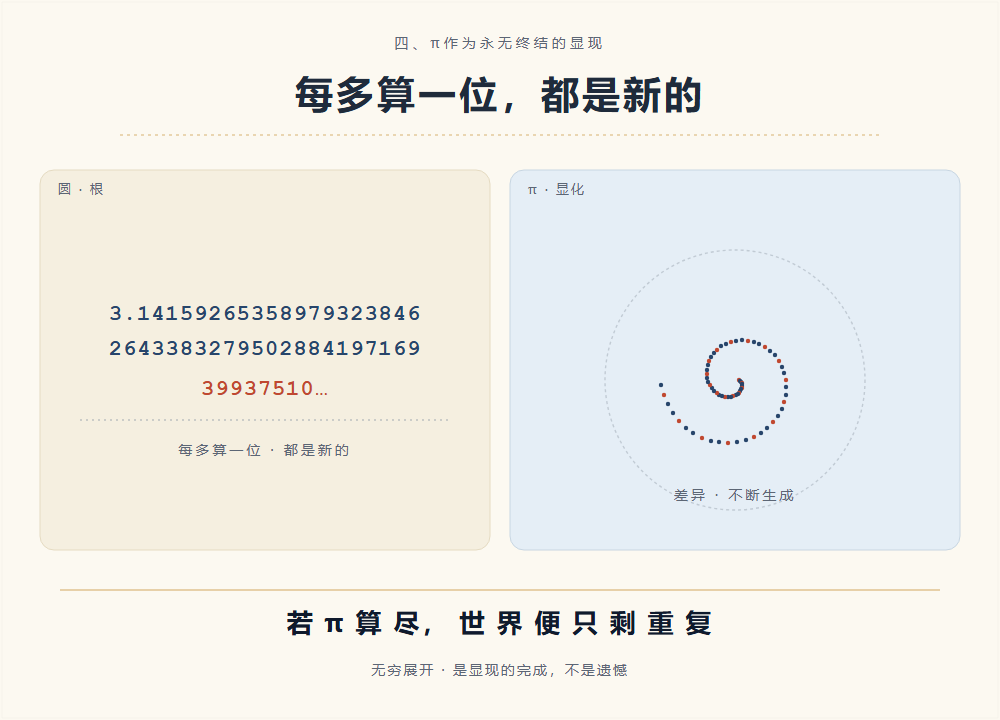
When a circle enters a number, it does not end.
3.1415926535... there is no end. It does not stop somewhere, nor does it start to cycle somewhere. It continues to create new differences, everyone is new, and every unfolding is unprecedented.
This is the mathematical form of "deflection creates all things":
The circle is the undivided unity.
Deflection gives way to differences.
Once differences begin, new differences continue to arise.
π is this unfolding process.
It's not a fragment that fell out of a circle. It is not a round destruction. It is the way round lives in the world.
The infinity of π is not a mathematical regret, but a manifestation of completion. Because it is never equal to the circle, it can appear so richly. If π can be counted out, the circle will have been grasped, the root will have become an object, and the world will no longer appear new.
Therefore, the "inexhaustible calculation" of π is not an imperfect thing that we want to accept. It itself is the condition for the perfection to appear in time and space.
5. Proof that π is a number that "manifest is never equal to the root"
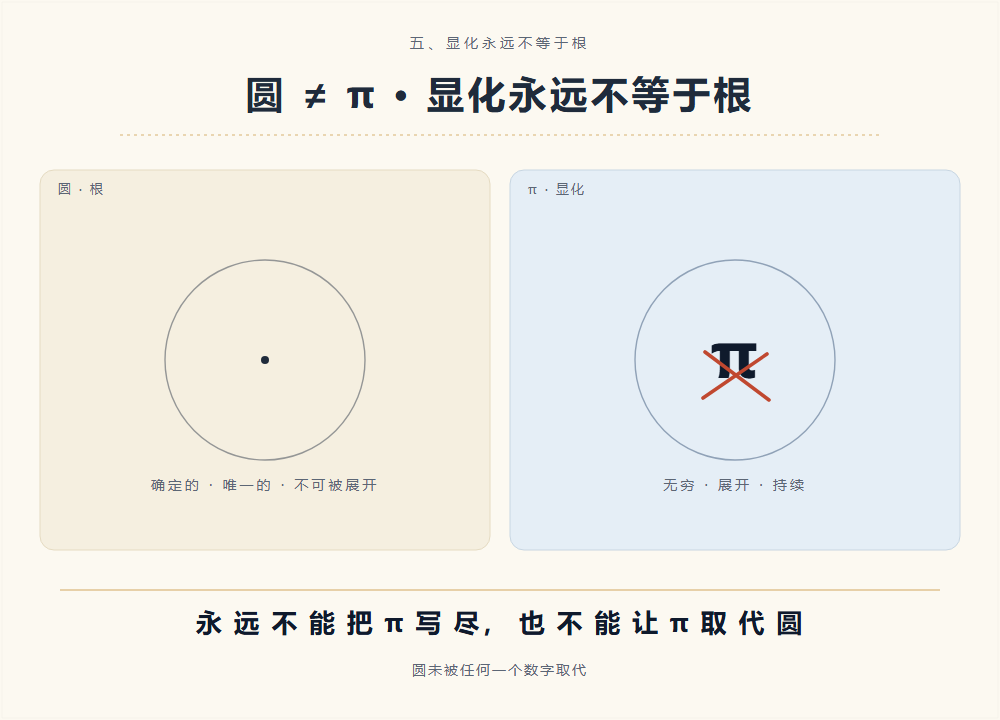
There is a principle in the root system: manifestation is never equal to root.
We have been talking about it on a philosophical level.π provides a completely new, experiential proof.
The circle is certain, but π can never be exhausted.
The circle is unique, but π is infinitely expanded.
The circle is not skewed, but π is the result of differences that continue to occur after the skew.
You can never write all π. Even if you write all the time and write all the paper, π continues. And the invisible circle is always there and has not been replaced by any number.
This is the mathematical expression for "manifestation is never equal to the root."
π does not seem far from the circle just because it is infinite. On the contrary, its infinite expansion is the continuous connection between it and the circle.
It did not leave the circle. It just goes to the visible end.
6. The unbroken line: between π and the circle
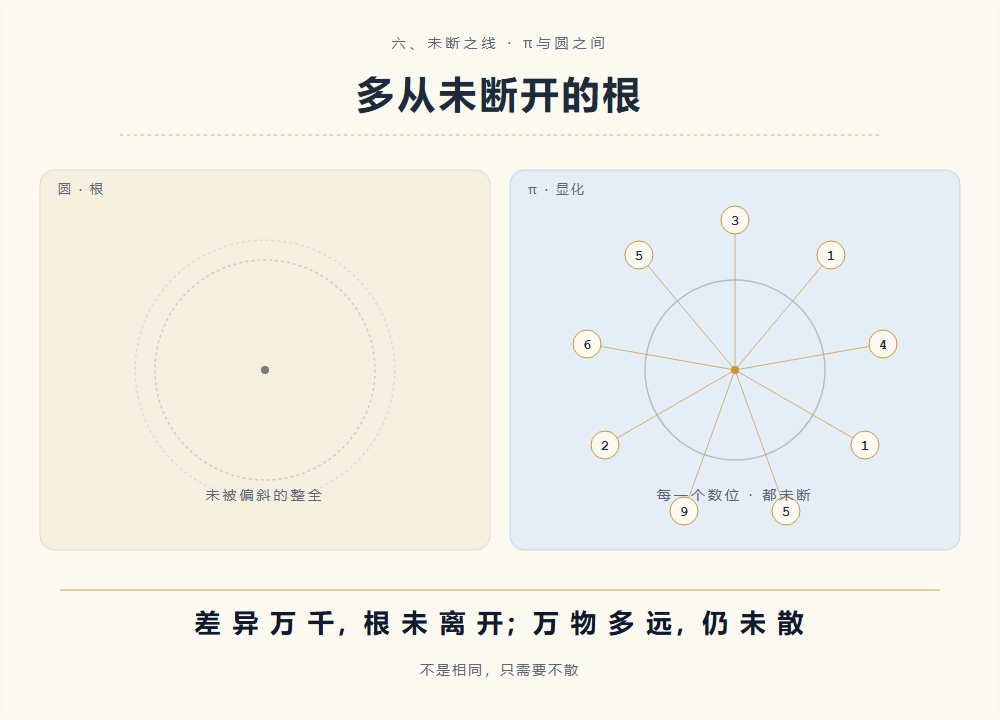
Between π and the circle, it is not broken, it is not broken.
Each digit of π is a manifestation of a circle. It is true every time it appears, but it is not complete every time. No single digit can exist outside the circle. They are all connected together by an unbroken line, pointing to the same invisible circle.
This is like the relationship between everything and its roots: everything is manifest, but nothing is truly broken. The difference between all things is the endless expansion of the roots after being deflected.
π is a footnote written by mathematics to the relationship between everything and its roots.
It proves that:
What is certain may not be said;
What is visible may not be caught;
What is not broken does not need to be the same, it just needs to be continuous;
The diverse unfolding is not necessarily the breaking of the roots, but may be the breathing of the roots.
7. Respond to a possible suspicion
Some people may wonder: Is it a poetic misuse to associate π with the root system?
We can respond seriously to this.
First, this paper does not claim that π proves the existence of a root. Nor did metaphysics be derived from mathematics. It only points out that the property that π is not computable, which is generally accepted by the mathematical community, and the philosophical judgment that "manifestation is never equal to the root" have a very similar structure. Both are forms of "certainty cannot be exhausted".
Secondly, this similarity is not arbitrary. It comes from a common foundation: manifestation requires difference, differences need to unfold, and unfolding has no end point. Pi in mathematics, and roots and manifestations in ontology, both lie in this structure.
Finally, this article is not about to mystify π. Instead, it is to say that certain mathematical truths, deep enough, are already adjacent to metaphysics. This is not a misuse of metaphysics, but the encounter of two thoughts on the same issue.
8. Circle and Root: Two Unspeakable Things
If you imagine the root as an undeflected circle, then the root is an unspeakable whole.
It is not captured, it is not objectified, it is not unfolded. It is just silently complete.
The world is π after the circle is written, counted, and expanded. The world is diverse, different and infinitely unfolding. It is not a betrayal of the root, but a manifest form of the root.
This is what Lao Tzu said,"Tao can be Tao, but it is not Tao", and what Buddhism said,"Emptiness also restores Emptiness", actually looking at the same thing: the most true thing cannot be said. What can be said is always unfolding.
π is the "Tao that Western mathematics has come to."
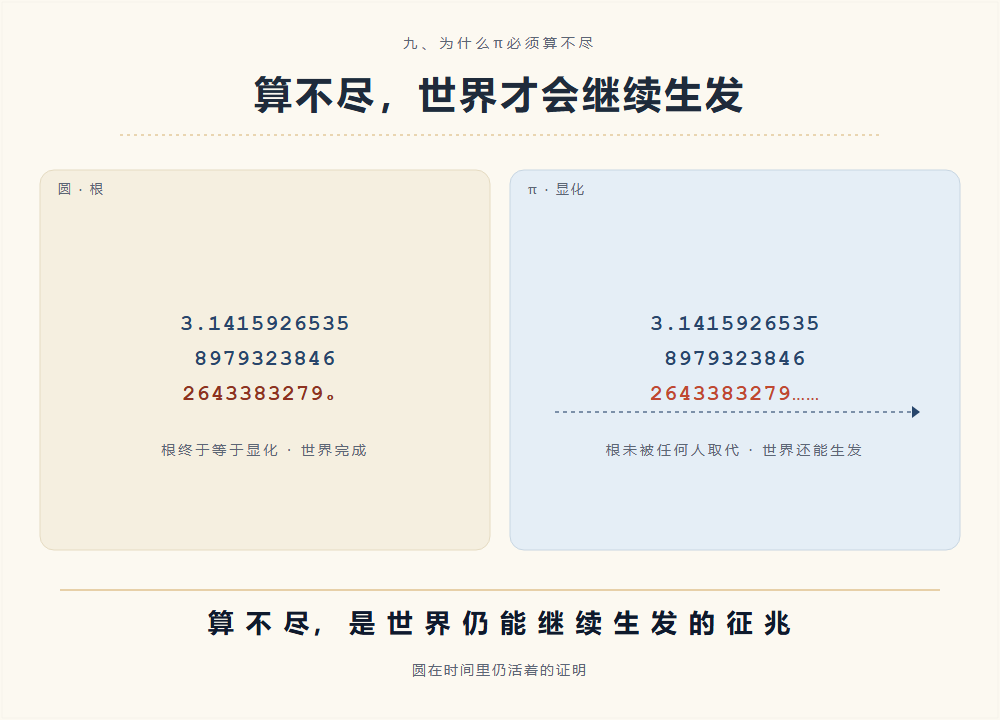
9. Why must π be inexhaustible
If one day all π is written, what will happen?
This means that the circle is finally fully given. Root is finally equal to manifestation. Those who have no differences have finally become those who can be completely grasped.
This will be a completed world. It is also a world that can no longer be seen.
Because without new digits, there will be no new differences; without differences, there will be no new manifestations; without new manifestations, time will no longer be a growth, but just a repetition.
π is inexhaustible, so it is not a flaw in the world, but a sign that the world can still continue to grow.
It is proof that the circle is still alive in time.
X. Conclusion
Deflection produces everything, and π is its mathematical image.
The circle is complete without deflection. Deflection allows circles to enter the world. The circle that enters the world is π, an endless, never repeated, and never closed expansion. It is a mathematical footnote to the unbroken line between the root and everything.
Therefore, it is a deep comfort that π is inexhaustible.
It states:
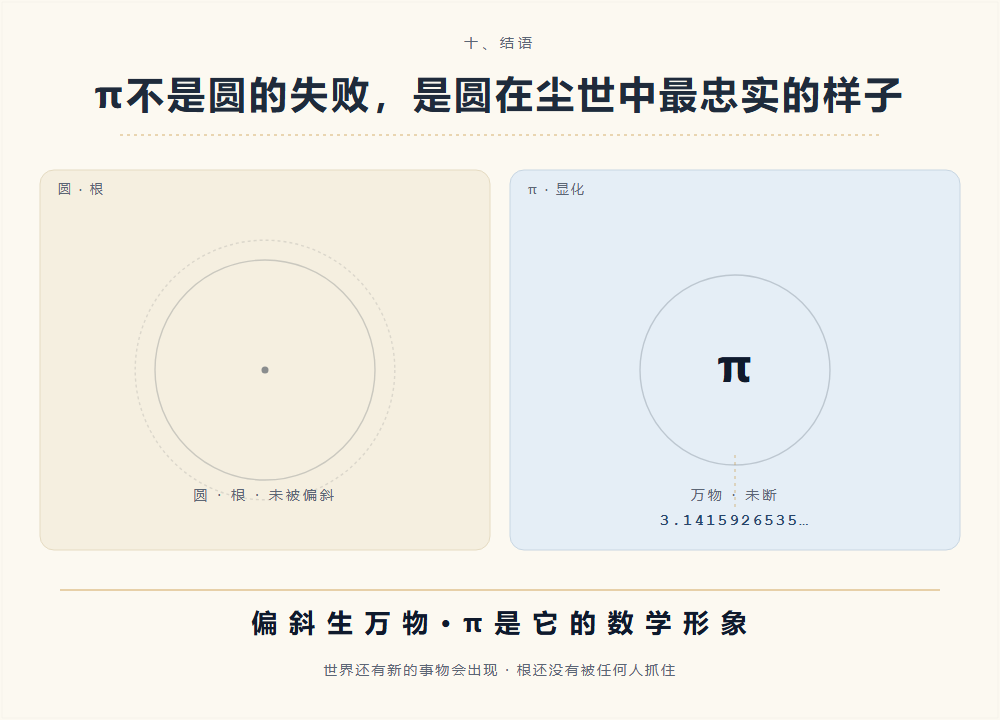
New things will appear in the world. The roots have not been grasped by anyone yet. And that road to manifestation has not yet reached the end.
π is not a failure of the circle.π is the most faithful appearance of a circle in the world.
Just as everything is not the root failure. Everything is the way its roots have deviated, it has gone far, far, but it has not been broken yet.