abstract
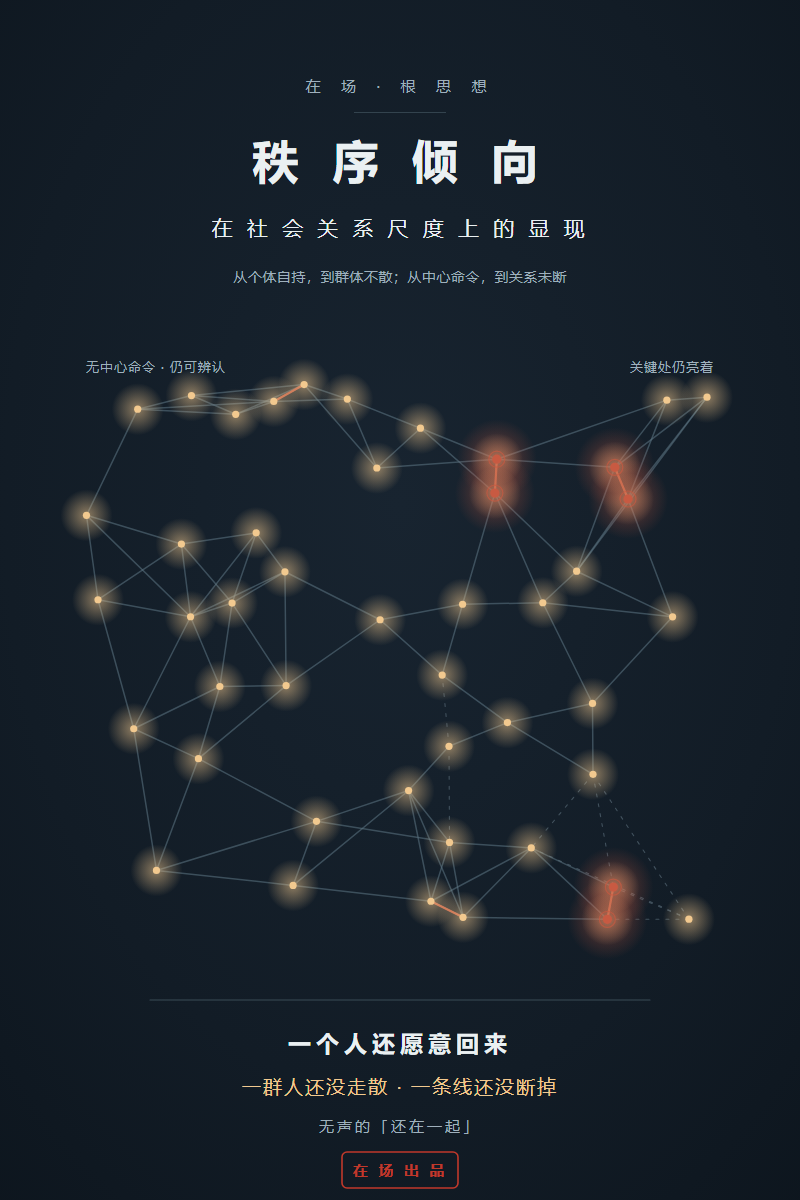
This paper attempts to decentralize the structural concept of "tendency to order" from the ontology scale to the scale of social relations, and examines the way it appears in interpersonal, group and institution. This paper believes that the tendency to order is not a pursuit of order, nor is it a social control scheme; it is the "persistence" state of self-sustaining relational structures that naturally appear in group life. The order in social relations is not created, but a form that is naturally left behind when the relationship is not broken, the boundaries can be returned, and the direction is clear. Based on this, this paper starts from the premise that relationship precedes essence, coexistence precedes direction, and the unbroken line, analyzes how order in social relations is generated and destroyed, and why the tendency to order becomes under the pressure of technological acceleration and individualization. An invisible but extremely critical underlying social condition.
1. From the individual to the field: the scale shift of order tendencies
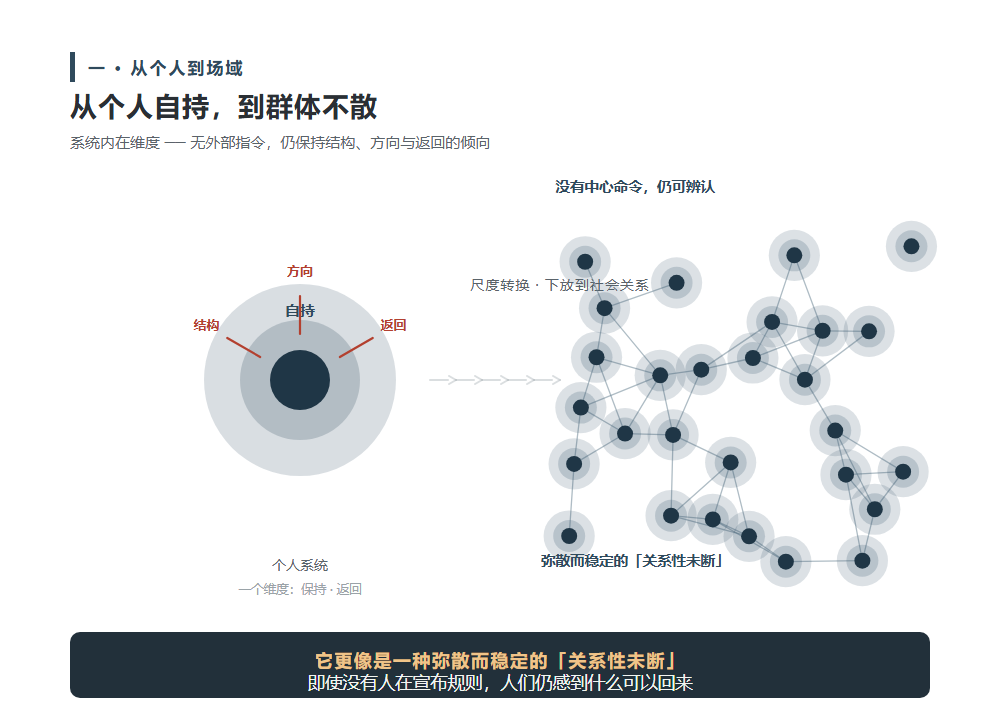
The tendency to order was originally an intrinsic dimension in the presence system: the system still had a tendency to maintain its own structure, direction, and ability to return in the absence of external instructions. It is not a strong control or a stability project, but a "undispersed" bottom state.
Moving this concept to the scale of social relationships means that we no longer just ask how a system maintains itself, but we ask a group of people, a network of relationships, a group why it maintains some recognizable order without any central command.
The tendency to order in social relations does not manifest itself in uniformity, nor does it manifest itself in institutional coercion. It is more like a diffuse and stable "relationship continuity": even if no one is announcing rules, people can still feel what is excessive, what is not allowed, and what can be returned.
2. Relationship comes before essence: Where does society begin?
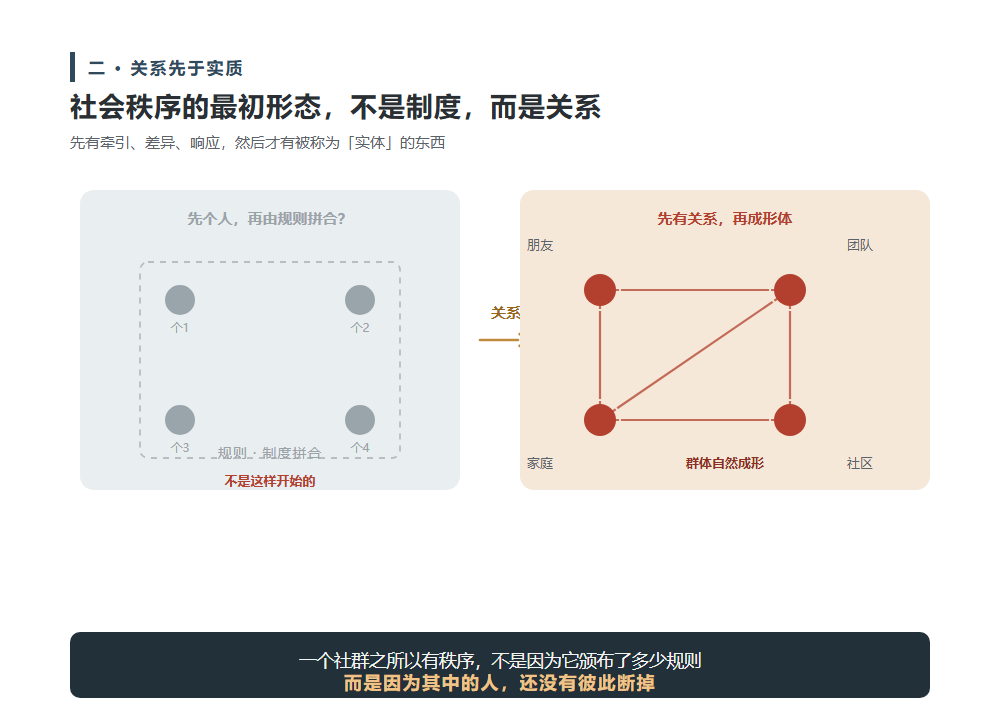
The root system insists that relationship comes before essence. There is traction, differences, and responses between each other first, and then what is called an "entity" emerges.
In the social world, this means that groups are not first made up of isolated individuals and then put together by rules. On the contrary, relationships first exist, potential connections and connections first, and then identifiable units such as "family","friends","team" and "community" are formed.
Therefore, the initial form of social order is not institutions, but relationships. The reason why a community is orderly is not because of the number of rules it has promulgated, but because the people in it have not broken off from each other.
Where the relationship is not broken, order naturally exists.
3. Coexistence precedes direction: the transcendental foundation of sociality
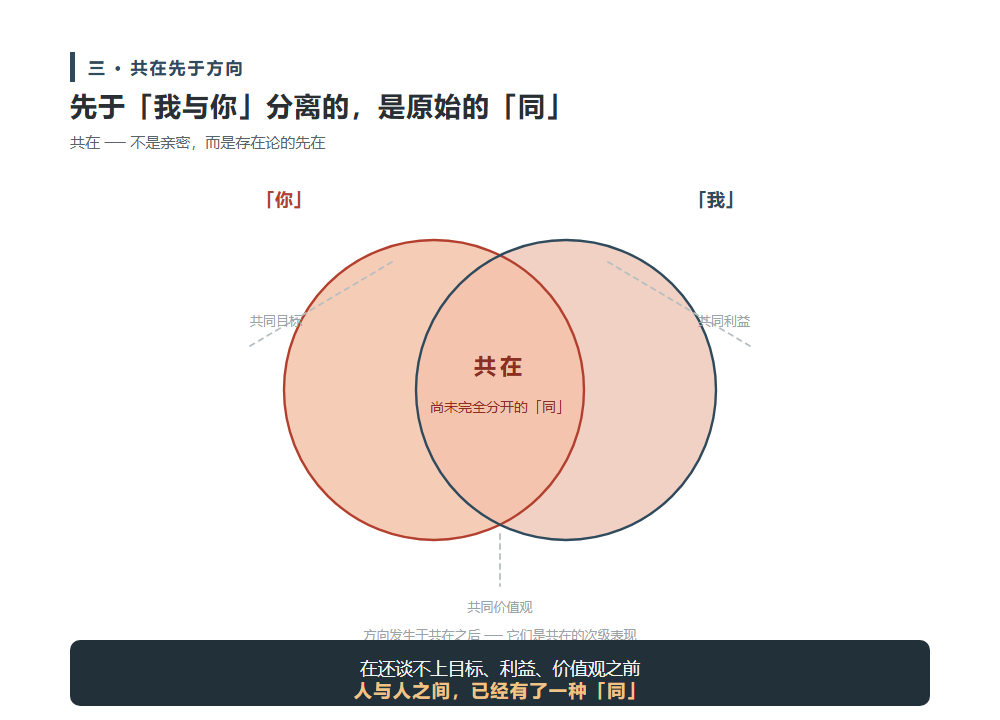
Coexistence refers to the original sameness that preceded the separation of "I and you." It is not an intimacy, but an existential preexistence.
In social relations, this means that there is already a certain "unity" between people that is not yet completely separated before there is even a common goal, common interests, and common values. This makes collaboration possible, makes understanding possible, and makes "I know you" possible without sufficient argument.
Modern sociology often uses "social capital" and "trust network" to explain such phenomena. But the Root System believes that these are still only common secondary manifestations. Trust is possible because there is coexistence first; not just instrumental dependence. The truly deep social order is being built on this almost unspeakable coexistence.
4. The unbroken thread: the lifeline of social order
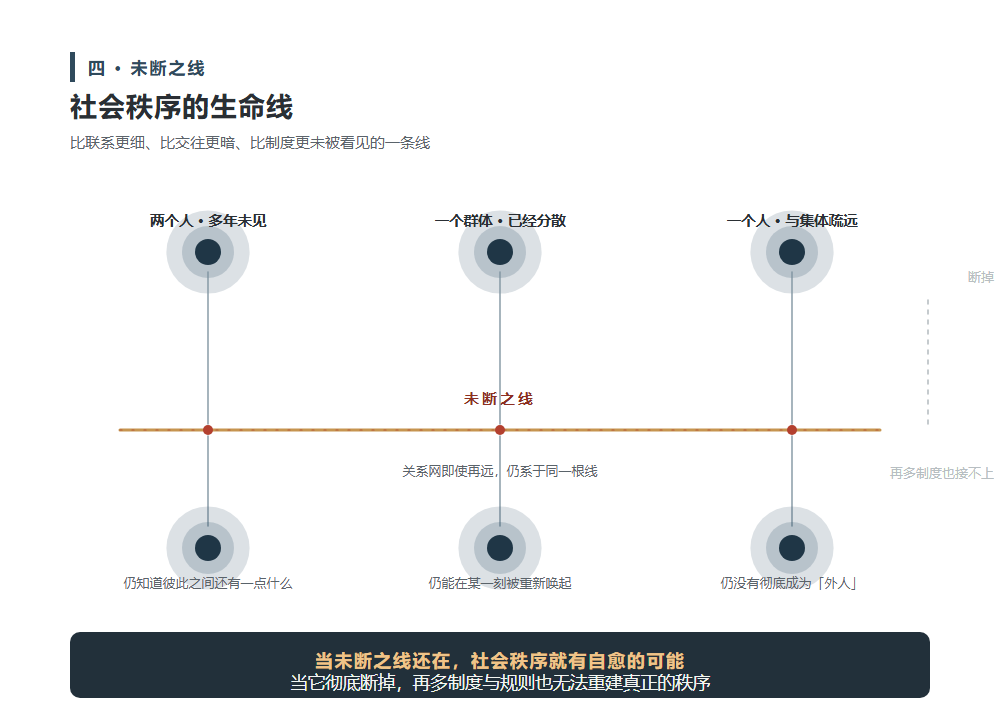
The most easily injured and easily ignored thing in social relations is the "unbroken thread".
It does not refer to specific connections, frequent exchanges, or institutionalized connections. It is a thinner, darker, and unseen line than these:
Even if the two people haven't seen each other for many years, they still know that there is something else between them;
Even if a group has been dispersed, it can still be awakened at a certain moment;
Even if a person is estranged from the collective, he still does not completely become an "outsider".
These "still" are the expression of unbroken threads in social relations.
When the unbroken thread is still there, social order has the possibility of healing itself. When the unbroken line is completely broken, no matter how many systems and rules are able to rebuild true order.
5. Positive manifestations of order tendencies
In social relations, the tendency to order appears in several inconspicuous but extremely important things.
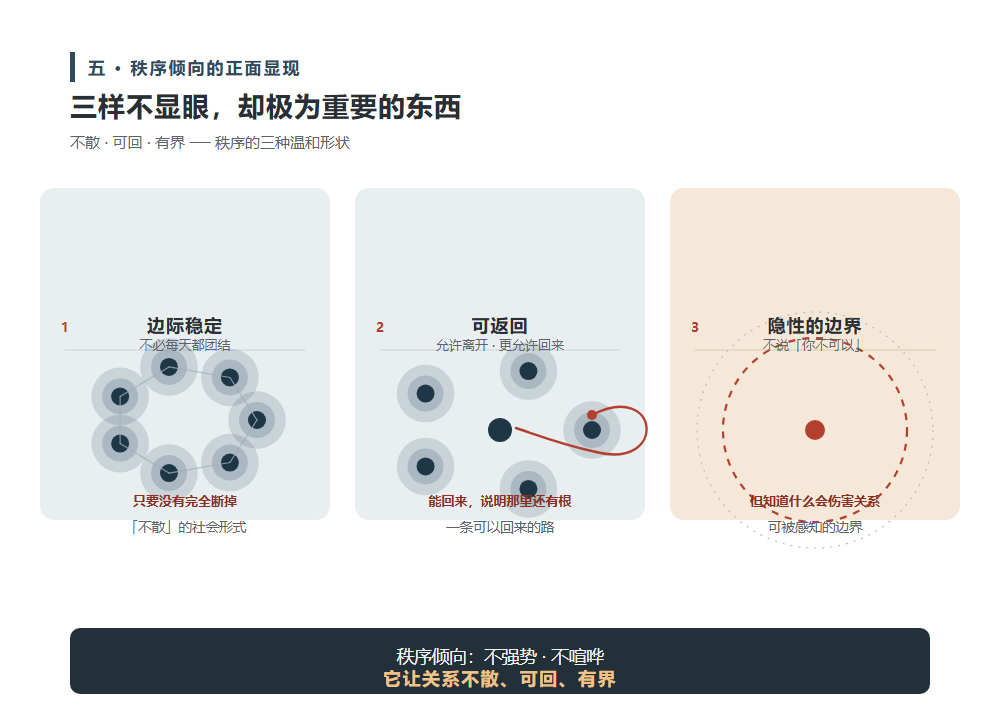
1. marginal stability
The tendency for order is not strong stability, but marginal stability. It does not require everything to be clear, it only requires that most relationships not break apart most of the time. A family does not need to be united every day, as long as it is not completely broken. A team does not need to fully agree, as long as it is willing to go together in key directions.
This kind of marginal stability is a form of society that is "inseparable".
2. may return
A true social order not only allows you to stay, but also allows you to return.
A person can leave temporarily, be silent, or be unsociable. If that network can still bring him back, it means there are roots there. On the contrary, a group that is not allowed to return may seem orderly, but it is actually a high-pressure control rather than a tendency to order.
The tendency to order in social relations must therefore carry the possibility of forgiveness, reconciliation, and return.
3. Hidden boundaries
Healthy social relationships do not necessarily have clear rules, but they must have perceptible boundaries. People don't say "you can't" but know what can hurt relationships. Boundaries are not written on paper, they are felt in interactions.
It is these unwritten boundaries that constitute the actual shape of the tendency to order on a social scale.
6. Ways in which order tendencies are disrupted
The tendency to order does not disappear suddenly. It is slowly consumed day after day.
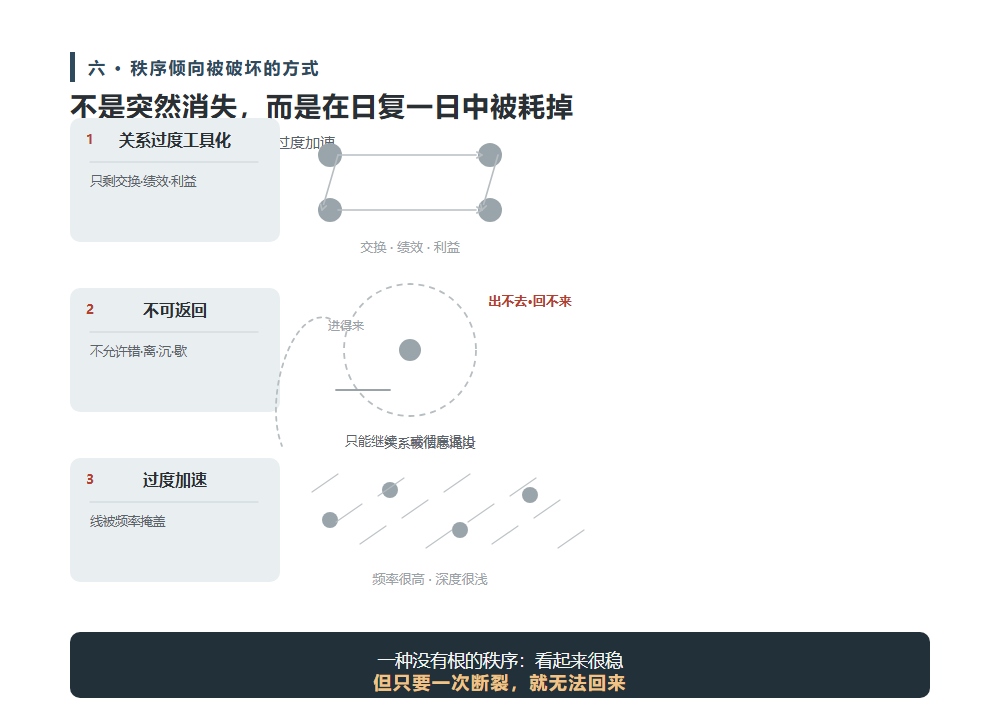
1. Relationship is overly instrumentalized
When the relationship is completely instrumentalized, leaving only exchanges, performance, and interests, the coexistence is covered, and the unbroken line gradually becomes thinner. People are still cooperating, but they are no longer "in" each other.
This is not out of order. This is an order without roots. It looks stable, but as long as it breaks once, it cannot come back.
2. non-returnable
If an organization no longer allows errors, departures, silence, and interruptions, it is no longer a field of order, but a field of control. People cannot come back in it, but can only continue or withdraw completely. This "inability to come back" is the beginning of a rupture in social relations.
3. excessive acceleration
Communication, relationships, and responses in modern society are all pushed extremely fast. People don't have time to stop, nor do they have time to feel whether a certain relationship is "okay". Relationships are submerged by information, and lines are concealed by frequency. The tendency to order is still there, but no one can see it.
7. The tendency to order in the technological age
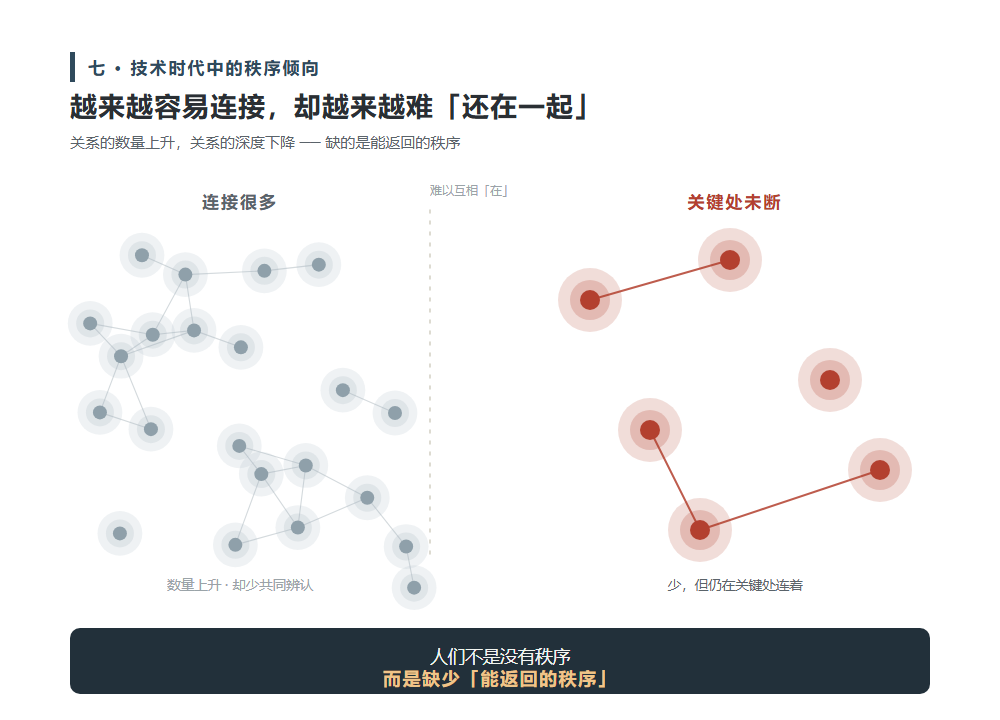
In an era of accelerating technology, social relations have taken on a new form: it is becoming easier for people to connect, but it is becoming increasingly difficult to "remain together."
There are fewer co-recognizers, and it is more difficult for a sense of harmony to occur. The number of relationships increases, and the depth of relationships decreases. People are not without order, but lack "order that can be returned."
At this point, the value of the tendency to order becomes extremely practical. It does not provide new social models or new institutional designs. It just makes people feel again:
Relationships don't need to be too much, but they need to be constant at key points. Collective, it doesn't have to be perfect, but there must be a way back. Order does not need to be strong, but it must be still there.
8. Conclusion
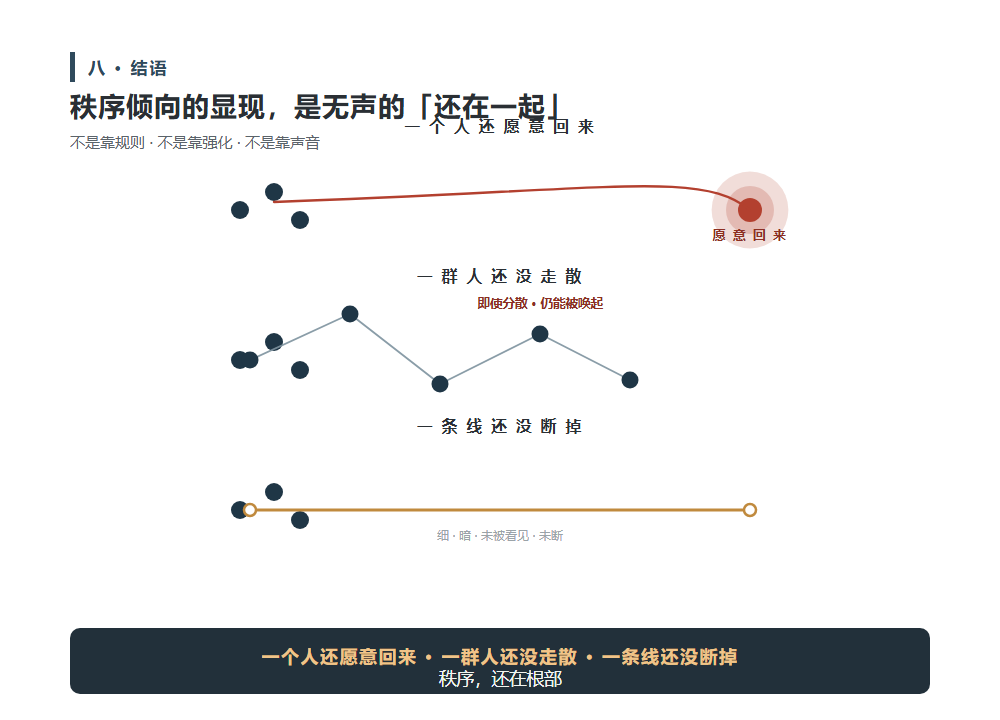
The appearance of the tendency of order on the scale of social relations is not the establishment of a grand system, but the silent "still together".
It is not maintained by rules, but by constant maintenance. It is not organizational strengthening, but sustained by return. It does not rely on sound and coverage, but on stillness and persistence.
If a society can tolerate silence, allow departure, and maintain a path of return, then its order is still at its roots. Once it cannot stop, go back, or be still, no matter how orderly it appears, it is already on the road to dispersion.
The tendency to order in social relations may ultimately be hidden in the most common places: one person is still willing to come back, a group of people has not been separated, and a line has not been broken.