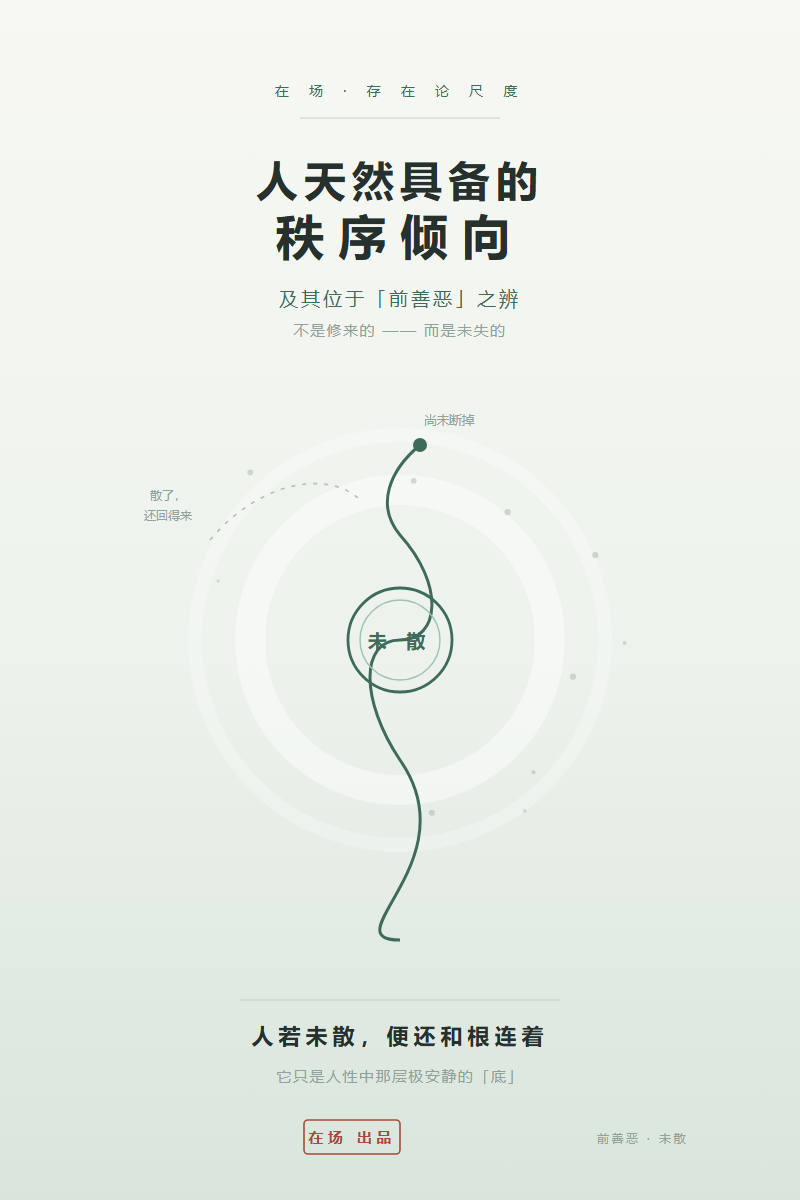
People's natural tendency to order and their distinction between "good and evil before"
abstract
This article attempts to identify that people naturally have a tendency to order. It is not a sense of morality brought about by acquired enlightenment, a norm implanted by an external system, or a realm achieved by hard cultivation. It is a fundamental structure that exists before good and evil, before practice, and before value judgment. This tendency to order appears to be persistent. When people are still present, they may not be virtuous, but they may be consistent; they may not be righteous, but there is an unbroken thread of existence. This article distinguishes "not scattered" from "good and evil": good and evil belong to the judgment after manifestation, and the tendency of order belongs to the nature before manifestation. This distinction corrects the dangerous term "transcends good and evil" to "transcends good and evil." Those who are before good and evil do not stand above morality, but have not yet been separated from themselves. It does not lead to immoral freedom, but leads to an uninterrupted undertaking and honest return. This tendency to order is not a rare high point in people. It is in the daily life of those who have not yet dispersed themselves.
1. Not scattered: a reality that precedes morality
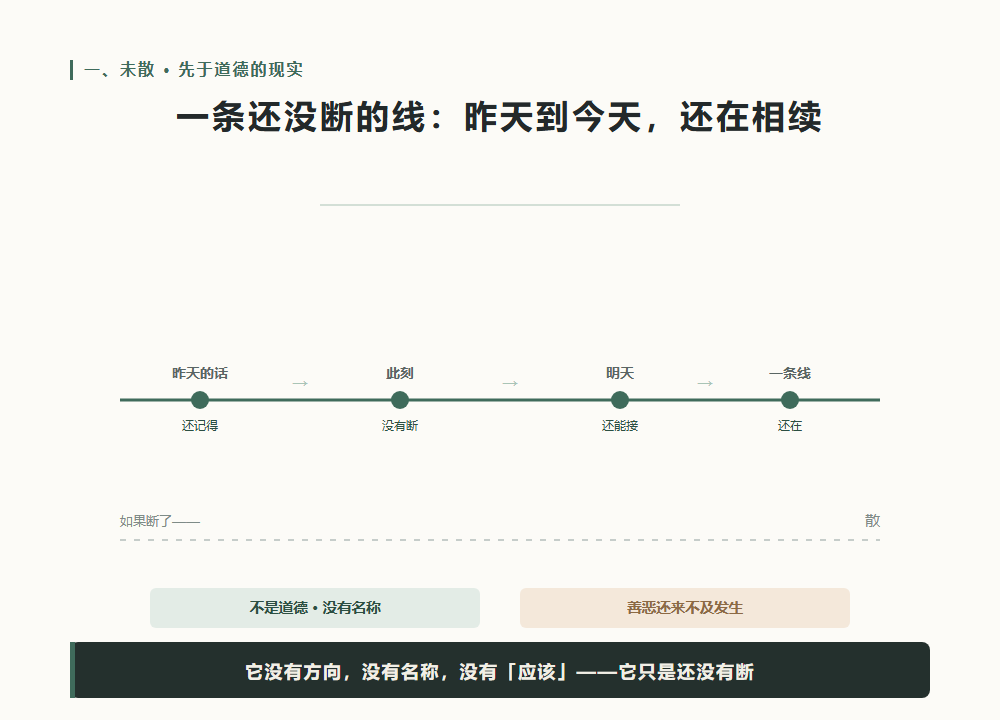
People are not born to give themselves a "I" and then disperse immediately. Even when people are still alive, there is always a seemingly ordinary continuity: yesterday's me and today's me are still a little continuous; the sentence I am saying is still a little related to the previous sentence I have said; a moment of anger does not immediately drown the entire face; a moment of joy does not completely erase the memory.
This kind of continuity and this kind of persistence is not morality.
It is not established before "this person is good" or "this person is bad." It already functions as a human way of existence where good and evil have not yet happened. It has no direction, no name, no "shoulds". It just hasn't broken yet.
This is the reality at the bottom of the "order tendency".
2."Before good and evil" rather than "Beyond good and evil"
We often hear the saying "transcending good and evil". It sounds high: it is neither good nor evil, free and unimpeded, like the freedom of some transcendence. But it hides a deep danger: those who transcend good and evil easily think that their chaos is transcendence, their ruthlessness is also freedom, and their indifference is also a realm.
Therefore, another word must be said.
The tendency of order is not above good and evil. It precedes good and evil.
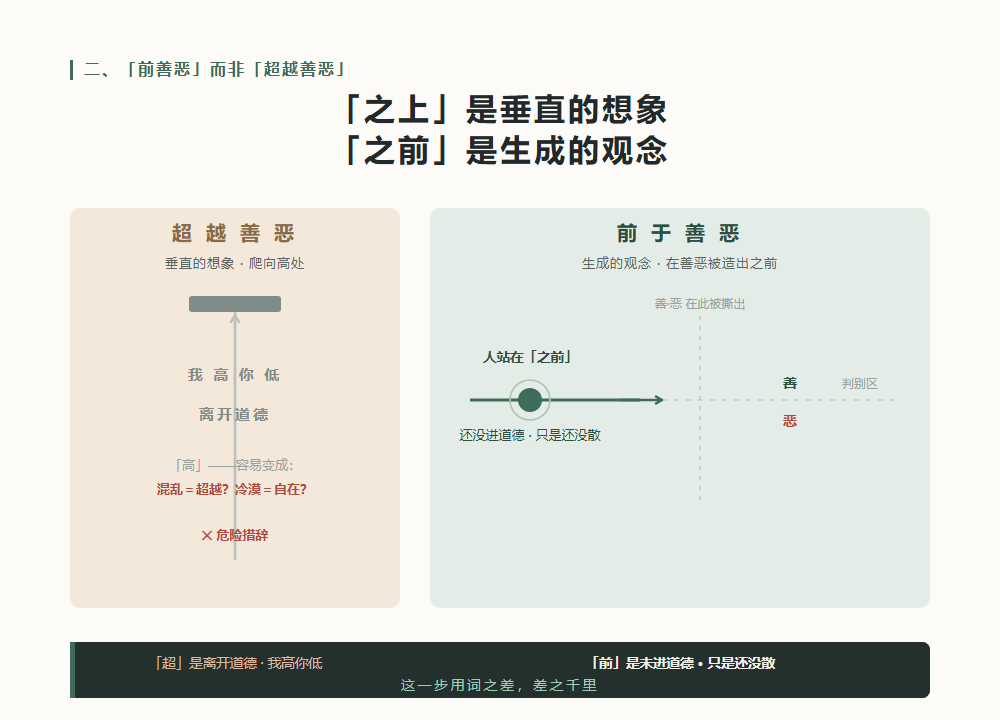
"Above" is a vertical imagination, as if people are climbing to a high place that is not governed by good and evil. "Before" is the concept of generation: before good and evil are created, named, and torn apart, man already has an unbreakable structure.
To transcend good and evil is to depart from morality.
Before good and evil is not to advance morality.
Beyond good and evil, with a sense of being higher and lower.
It's good and evil, but it's not yet gone.
The difference in words at this step is thousands of miles away.
3. Naturality: not cultivated, but not lost
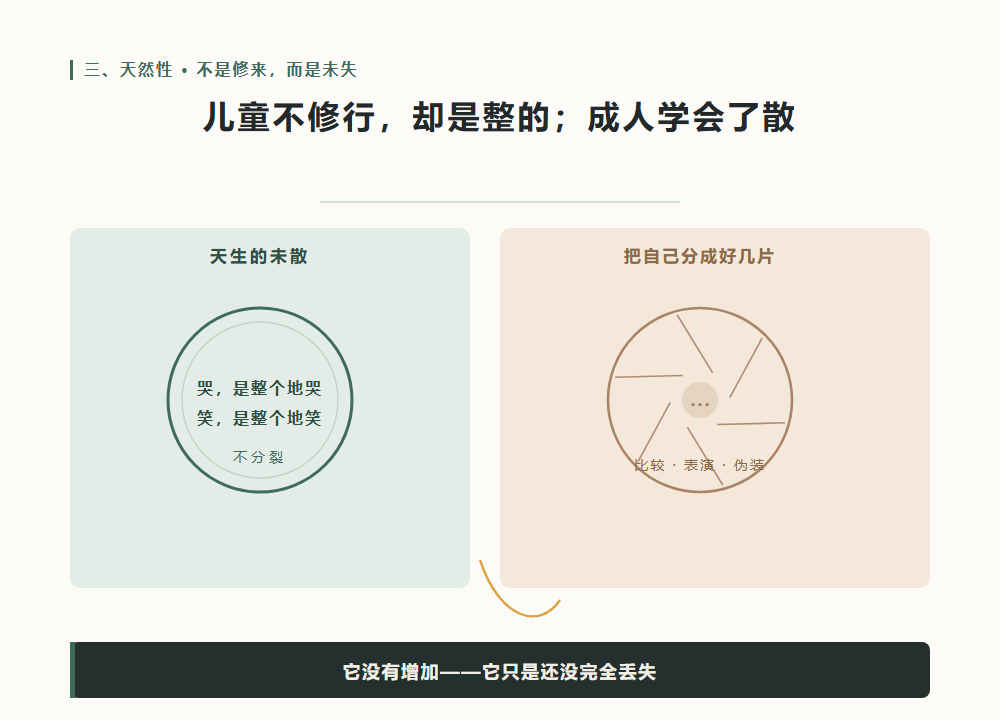
Children do not practice. Children don't even know what "scattered" means.
But children are often more consistent than adults. When you cry, you cry completely, and when you laugh, you laugh completely. I stopped crying, and I stopped, and I went to play again. He does not divide. He doesn't hate you while pretending not to hate you; he is afraid and tough on the other hand. He has not yet learned to tear himself apart.
This is a natural persistence.
Later, people grew up, learned to compare, learned to perform, and learned to pretend that "it's okay." So it began to disperse. It's not that it's gone bad, it's that it's divided into several pieces.
At this time, the tendency of order has not been cultivated. It was retrieved. It has not increased. It's just not completely lost yet.
4. Several signs in people
How to identify if a person's tendency to order still exists?
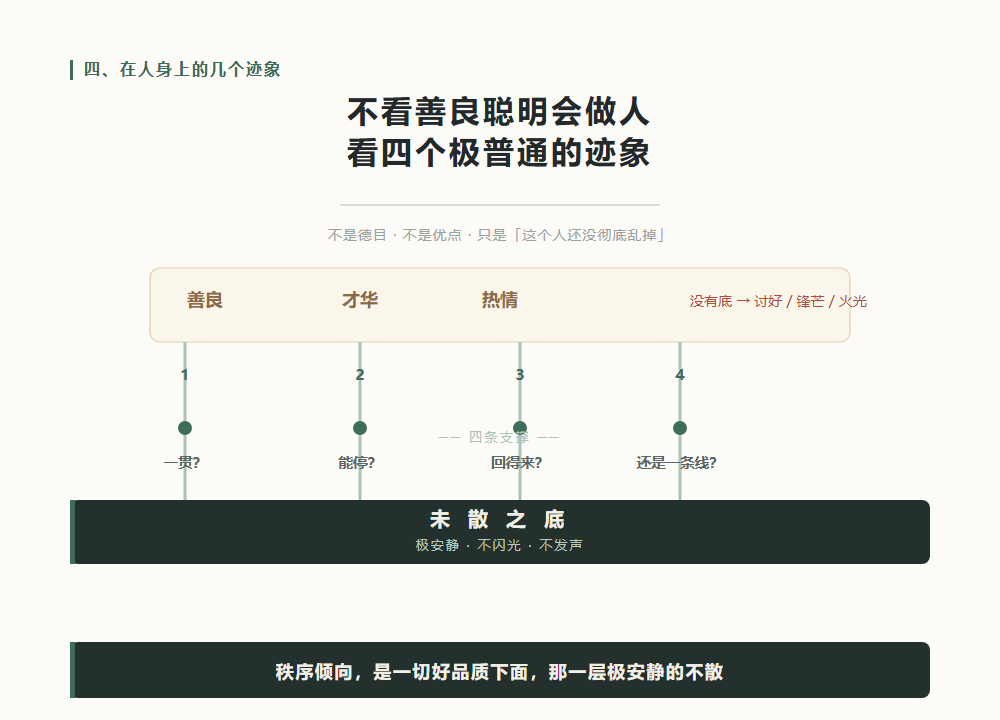
Not because of how kind he is. Not because of how smart he is. It's not about how good he is.
Look at these very common signs:
Is he consistent?
Can he stop?
Will he come back after he breaks up?
When he speaks and does things, is he still on the same line?
These are "unscattered" traces. It is not a virtue, not an advantage, not a quality to praise. It just "this person has not been completely messed up yet."
If kindness does not have this foundation, it will easily turn into flattery. If talent does not have this foundation, it will easily become sharp and corrupt. If enthusiasm does not have this foundation, it will easily turn into an impulsive fire that will be gone after burning.
The tendency to order is that under all good qualities, the layer is extremely quiet and never dispersed.
5. Why do people need this analysis
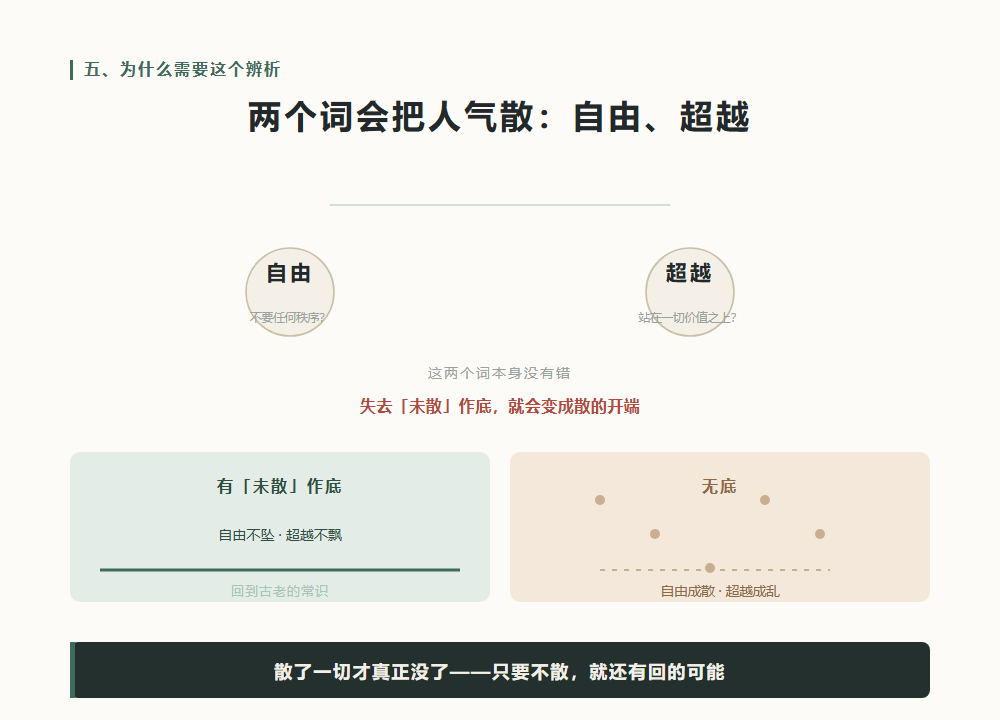
Because people nowadays can easily be confused by two words:
One is called "freedom", which makes people mistakenly think that they can do without any order. One is called "transcendence", which makes people mistakenly think that they can stand above all values.
If these two words are lost as the foundation of "not yet dispersed", they will become the beginning of dispersion.
Therefore, re-identifying "preceding good and evil" is not for the sake of mysterious talk. It is to return to a very old common sense: a person may not be smart, successful, or particularly kind, but he cannot be scattered. It's really gone when everything goes away. As long as it does not disperse, there is still the possibility of return, good, and reconstruction.
6. Former Good and Evil and Moral Life
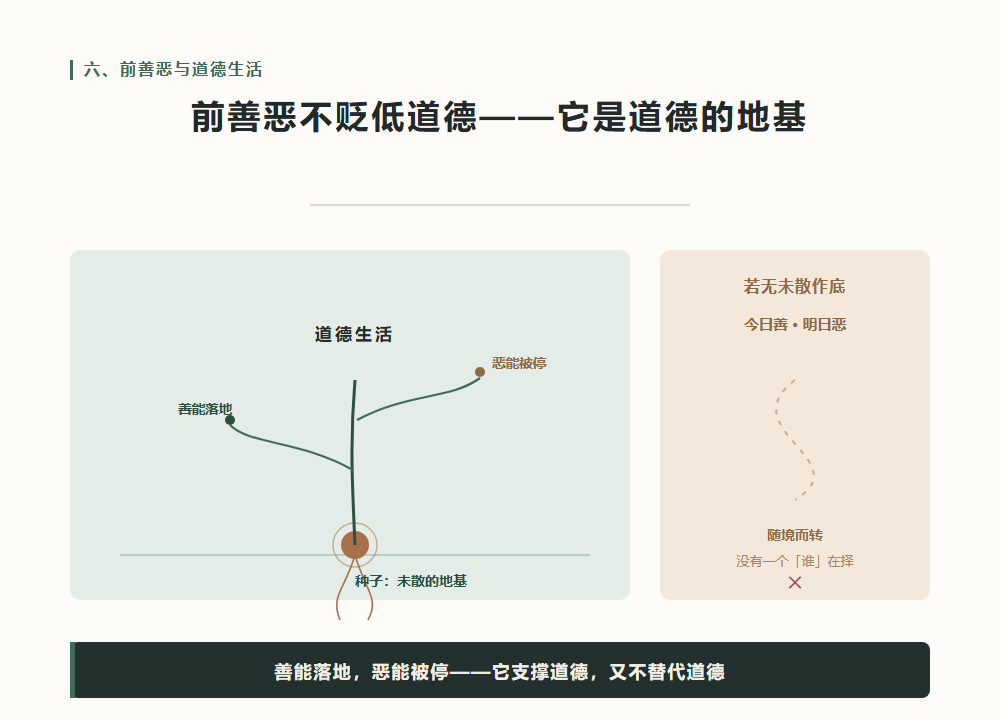
Former good and evil do not belittle morality.
On the contrary, it is the truly possible foundation for moral life.
If a person makes a choice between good and evil, if there is no uncertainty, his choice is just a reaction to environmental stimulation. He is good today and evil tomorrow. He changes with the situation, and there is no "who" to choose.
When it is still there before it is dispersed, good and evil are not performances, struggles, or consumption. Good can be achieved, evil can be stopped, mistakes can be corrected, and people can still not leave themselves after right and wrong.
Therefore, former good and evil are not immoral. It is the seed of morality that has not begun. It supports morality but does not replace morality.
VII. Conclusion
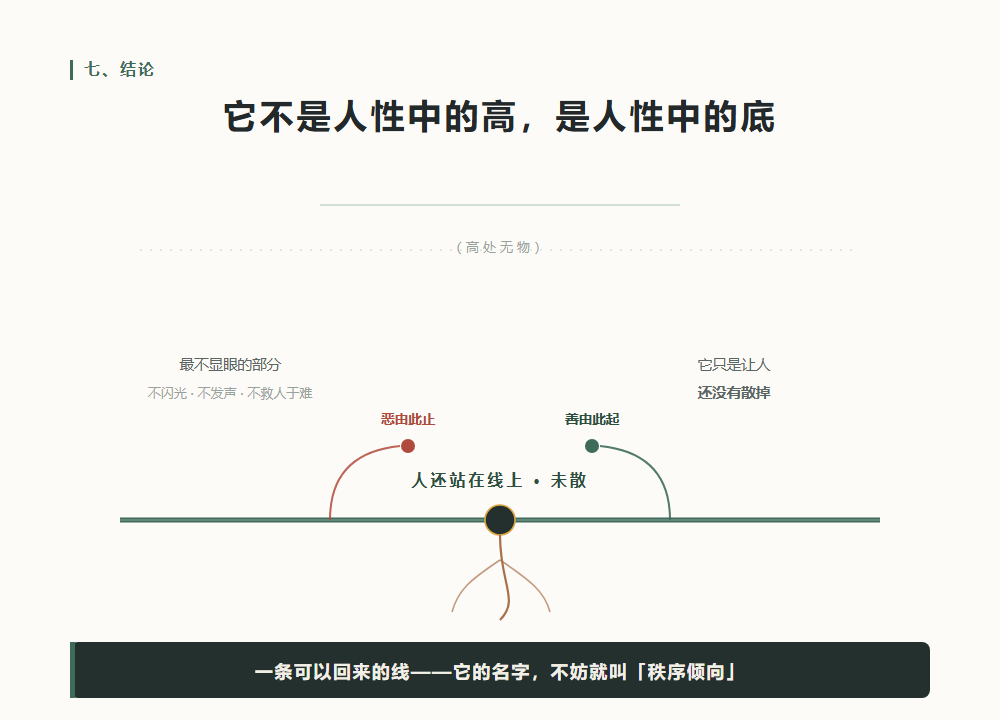
The natural tendency to order is not the brightest part of a person. It's the least visible part. It does not flash, does not sound, and does not save people in need. It just doesn't get rid of it.
It is an extremely important caution to identify it as "pre-good and evil" rather than "super-good and evil".
Because the former makes people return to their roots, the latter makes people mistake for thinking that they are heaven.
Being a human being may not be good or beautiful, but if it is not yet dispersed, it is still on a line where you can come back. The name of this line might as well be called: Order Trend.
It is not the highest in human nature. It is the bottom of human nature. This is where good begins and evil ends. If people are not scattered, they are still connected to their roots.