abstract
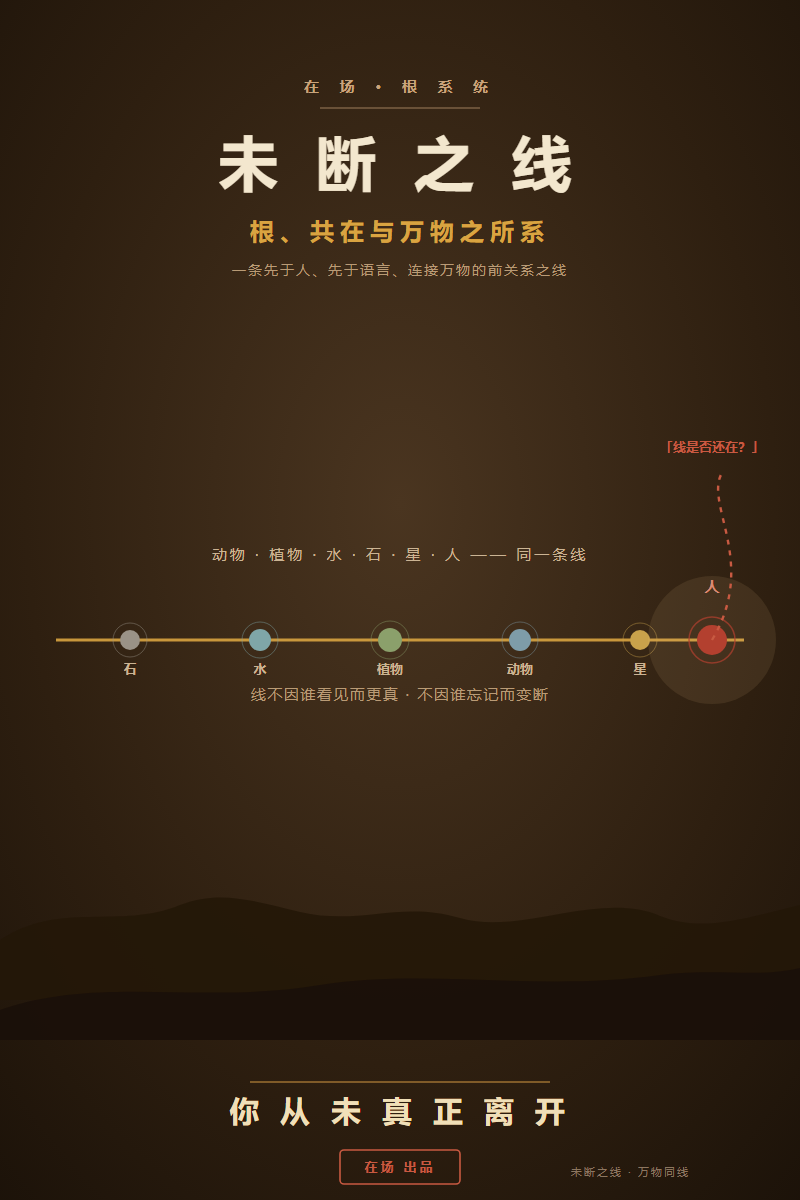
One of the core insights of the root system is the "unbroken line": no matter how the manifestation deviates, goes far, or forgets, there is always an invisible structural line that connects every being to the root. This line is not unique to humans. It precedes people, before language, and before all distinctions. Animals, plants, water, stones, stars, and even everything that has not yet been named "life" are all on this line. The ethical and ontological significance of the root system is not to interpret everything with "people" as the center, but to re-see that people are just the only beings who may forget that they are still on the line after the line has been deflected farthest. This paper therefore proposes that the unbroken thread is not the link between man and nature, but the pre-relational structure that allows man and all things to exist as different manifestations. It does not require a moral "love of all things", but provides a decentralized basis for a deeper coexistence.
1. Origin: From joint identification to unbroken line
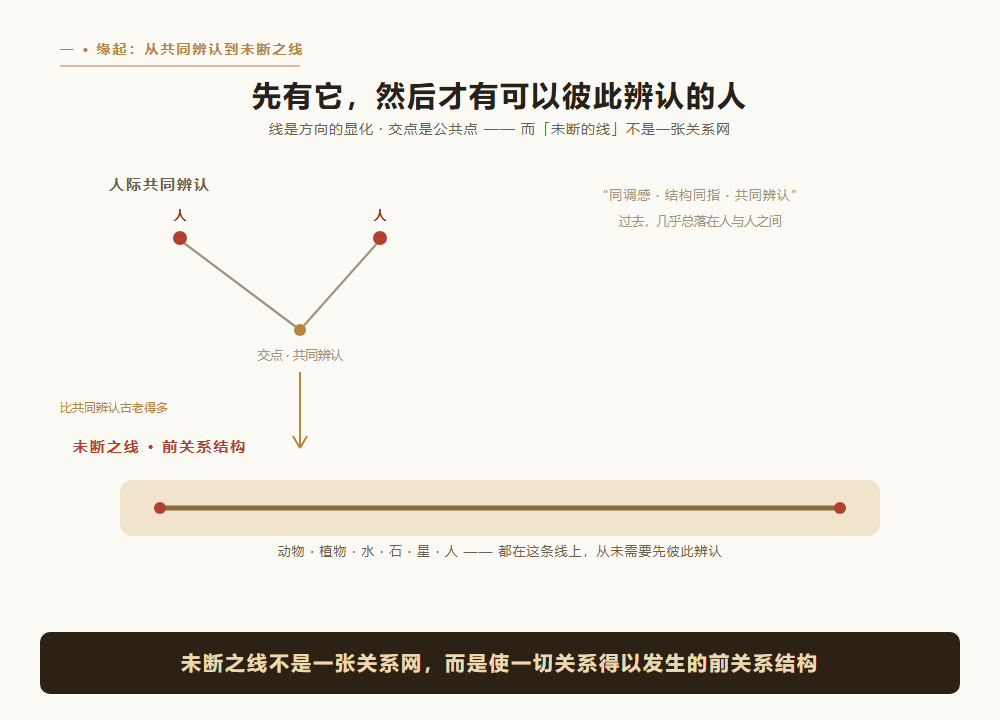
The root system has always focused on two things: a line and an intersection.
"Line" is the manifestation of direction;"intersection" is the common point displayed when at least two lines point to the same position. In the past, when talking about these structures, it was almost always between people: a sense of harmony, structural coreference, common identification, and the small groups that formed.
But the "unbroken line" is not an interpersonal phenomenon. It is much older than "joint identification". Before people appear, the unbroken thread already exists. There is it first, and then there are people who can identify each other.
Therefore, the unbroken thread is not a network. It is the pre-relational structure that allows all relations, all directions, and all manifestations to occur.
2. Relationship precedes essence and people
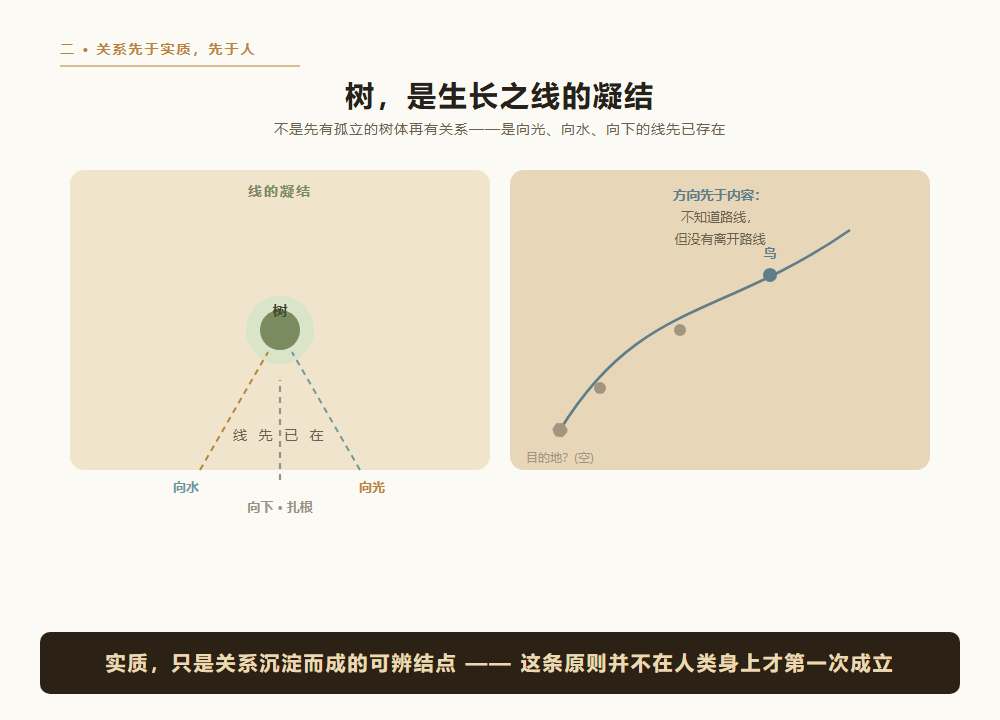
The root system has demonstrated that relations precede substance. The essence is just a recognizable node formed by the precipitation of relationships. This principle has not been established for the first time in humans.
A tree does not first have an isolated tree body and then has a relationship with soil, water, and light. It is the growth lines that lead to light, water and downward that already exist. A tree is the condensation of these lines at a certain position.
A migrating bird does not first have a destination and then fly there. It is "directionality precedes content" that has unfolded first in its body and instinct. It did not know the route, but did not leave the route.
People are not the first beings to have direction, relationships, and essence. Man is only the first being able to objectify them, name them, and forget their roots.
3. Common pre-species structure
Coexistence precedes the separation of "I" and "You". This is not a new judgment. But if "you" are tacitly regarded as a human being, the coexistence will be quietly narrowed.
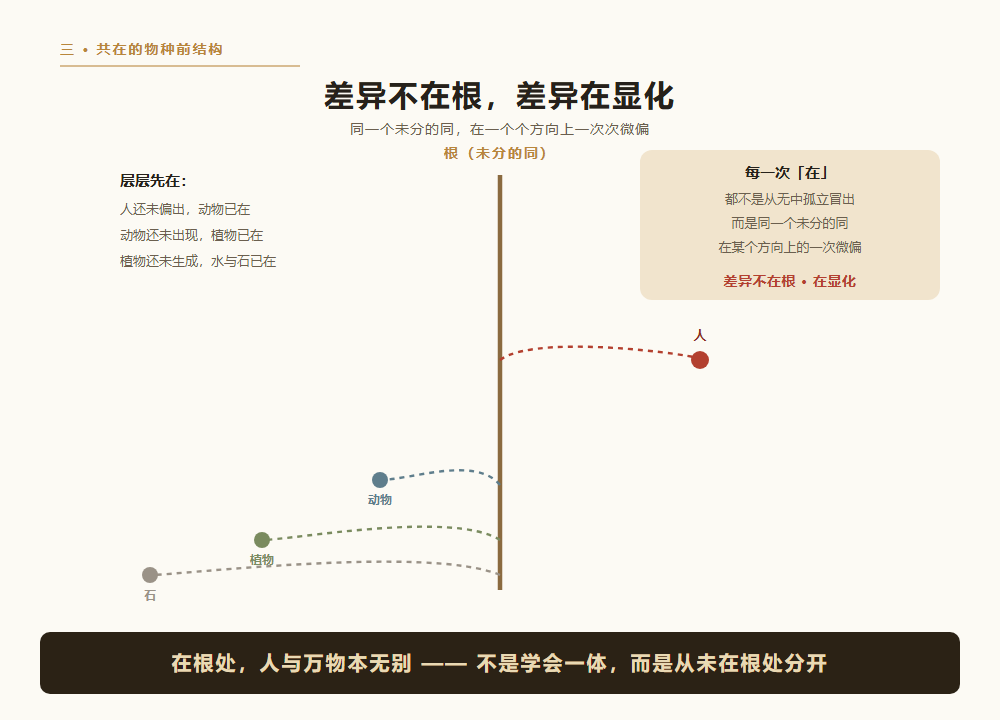
Before people deviate from the community, animals are already there; before animals appear, plants are already there; before plants are formed, water and stones are already there. Every "presence" does not emerge isolated from nothing, but a slight deviation in a certain direction from the same undivided identity.
Therefore, at the root, people are no different from all things. It was not that man later "learned" to be one with all things, but that all things and man were never separated at the root.
Differences are not at the root. Differences are becoming manifest.
4. The directionality of everything
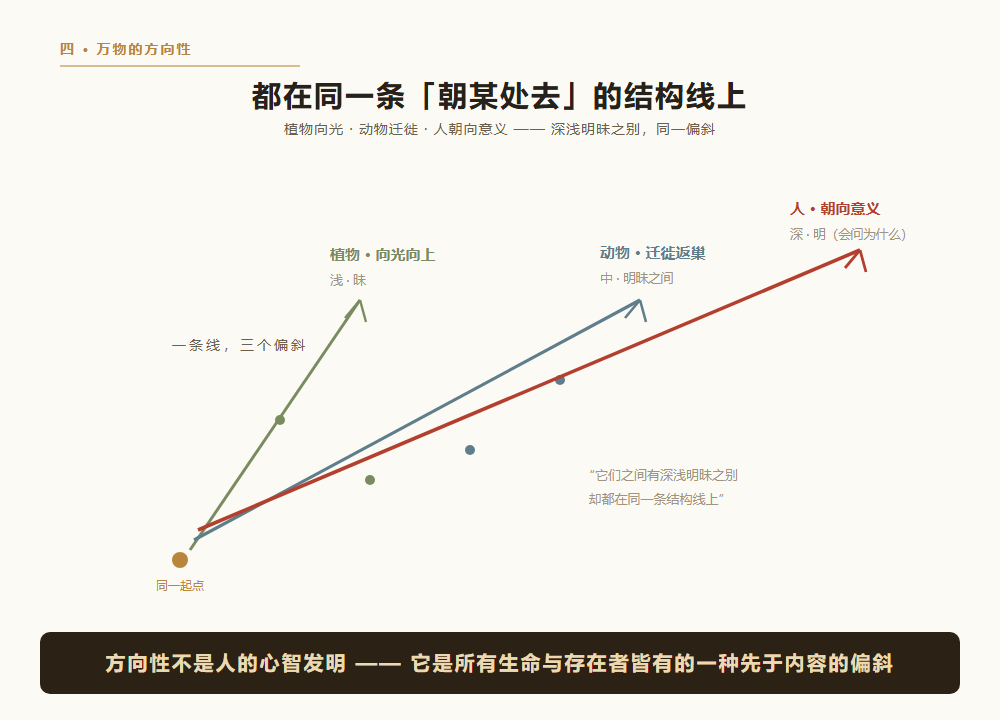
Directionality comes before content, which is a universal principle.
Plants: Grow towards the light, take root towards the water, and stretch towards heights.
Animals: Migrate, nest, forage, return to nest.
People: Towards meaning, towards goals, towards "a better future".
There are differences between them: deep, shallow, clear and obscure, but they are all on the same structural line of "going somewhere". Directionality is not an invention of the human mind. It is a deviation prior to content that is common to all life and beings.
It's just that people turn their own line into a "problem" that can be discussed, doubted, and revised. So there was "Where am I going", there was "Why am I here", there was "meaning","direction" and "root".
Animals have no doubts. Plants are not modified. They just follow the line and are never far enough to "return" but cannot come back.
5. The Return of Everything
Return is the most valued action in the root system. If you think it is a human behavior, you will lose half of the world.
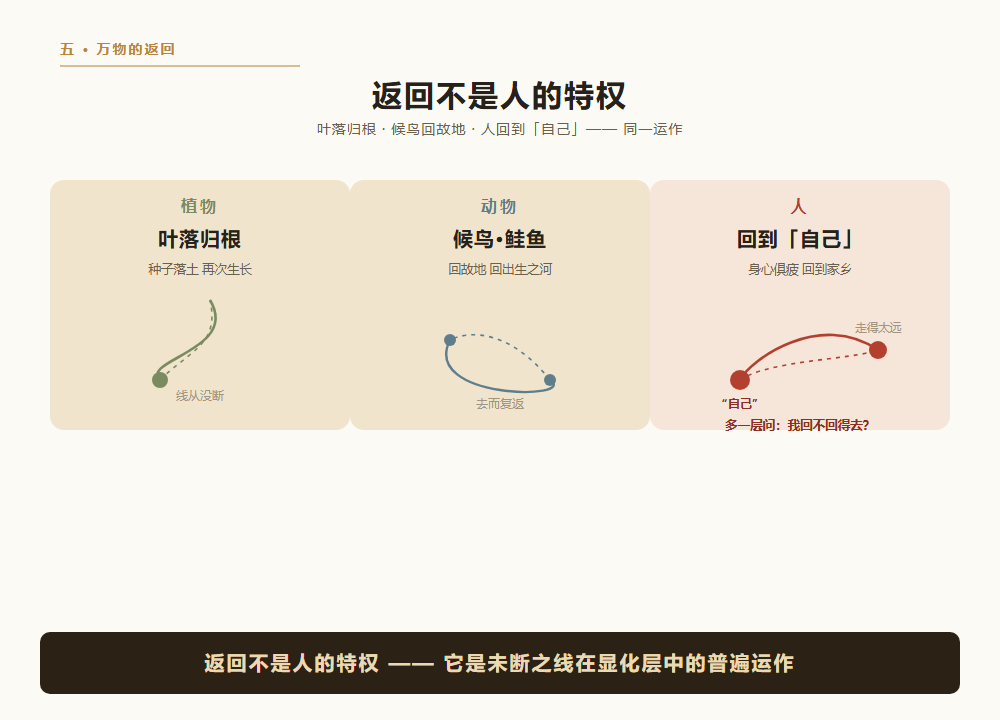
Plants also return. The leaves return to their roots. The seeds fall into the soil and grow again.
The animals also return. Migratory birds return to their original places, and salmon return to the river where they were born.
People return even more. When you are exhausted physically and mentally, you return to your hometown; when your beliefs are broken, you return to your original point; when you go too far, you return to your "self".
Returning is not a human privilege. It is the universal operation of the unbroken thread in the manifest plane. It's just that when people return, they ask another layer: Can I go back?
This level of questioning distinguishes people from birds, animals, vegetation. It also makes it easier for people to forget than birds, animals and plants: the thread never breaks, but he just let go of his hands.
6. People: The brightest deflection is also the easiest to break
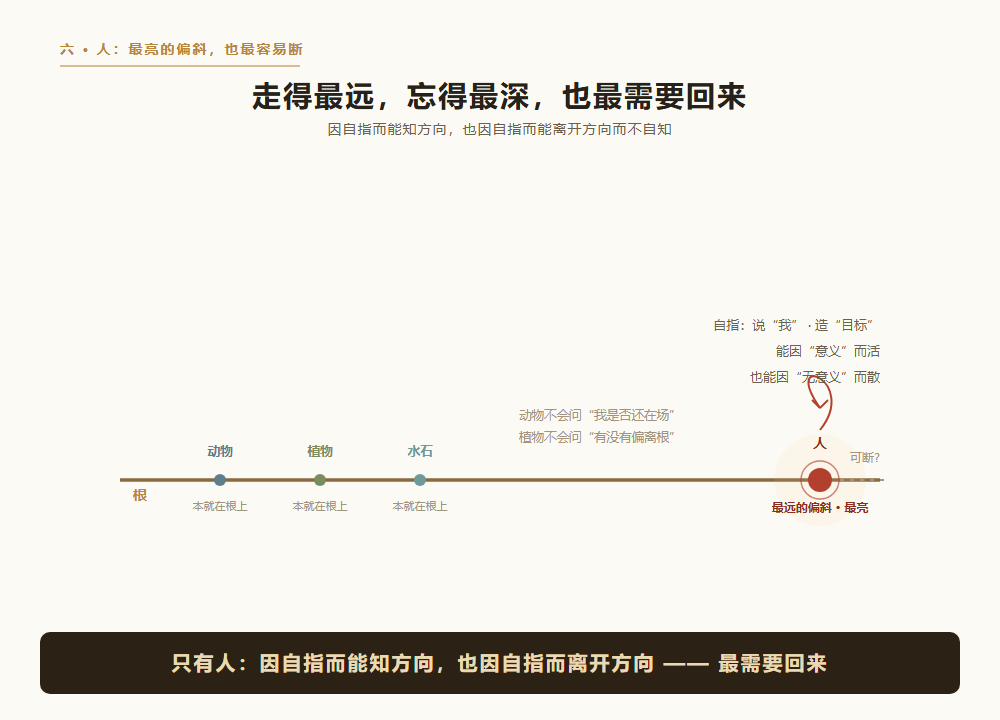
In the manifestation of all things, man is the farthest and therefore the brightest.
People have the strongest self-reference. They can regard themselves as objects, say "I", create "goals", build systems, live by "meaning", and disperse by "meaningless".
This is the dilemma of people: they can know the direction because of self-pointing, and they can leave the direction because of self-pointing without knowing it.
Animals don't think,"Am I still here?" Plants don't ask,"Have I deviated from the roots?" They do not need to practice, do not need to return, and do not need to be jointly identified. They are already in the roots.
Only people go the farthest, forget the deepest, and need to come back the most.
7. The unbroken thread is not a moral order
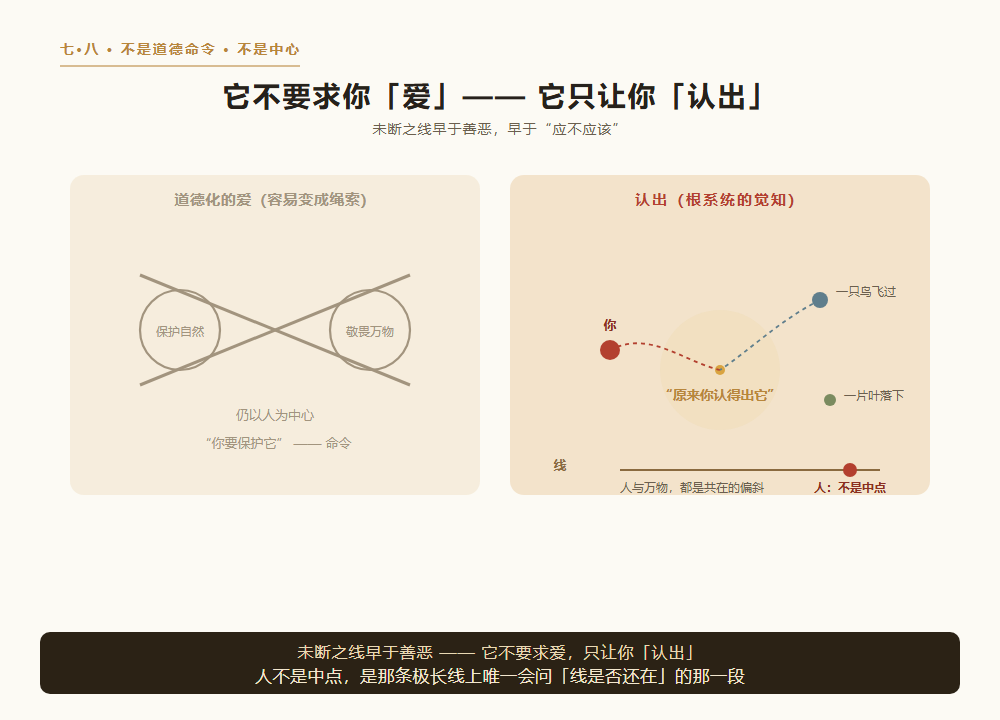
Faced with this structure, the most natural conclusion is that people should love animals, protect plants, and respect nature. But this will turn the unbroken thread into a moral rope that remains people-centered.
The unbroken thread predates good and evil, and also predates "should not be". It does not require people to "love". It just says: You are on the same line with everything and never leave.
Moral love is an attitude that people need only after they have deviated. The unbroken thread itself does not require any attitude.
What it provides is not "you want to protect it", but "you recognize it."
In a root-system awareness, seeing a bird flying by or a leaf falling is not knowledge, not scenery, not "I should cherish nature." It was at that moment that you remembered again: I wasn't the only one walking. There are many, all on this line, each in their own way, deviating, going, and returning.
8. Rewriting of non-human centers
The significance of the unbroken line lies in rewriting the human-centered view of coexistence.
In the past, when we said "being with others", we put people at the midpoint between the root and all things. It should now be said that man and all things are all deviations in common. Man is not the highest person in coexistence, nor is it the end of coexistence. People are just together, the one who knows best that he is biased.
This flip does not make people small. It makes people accurate.
People are finally no longer the masters of the world, nor are they orphans of the world. People are the only part on the extremely long line that asks "Is the line still there?"
9. Conclusion
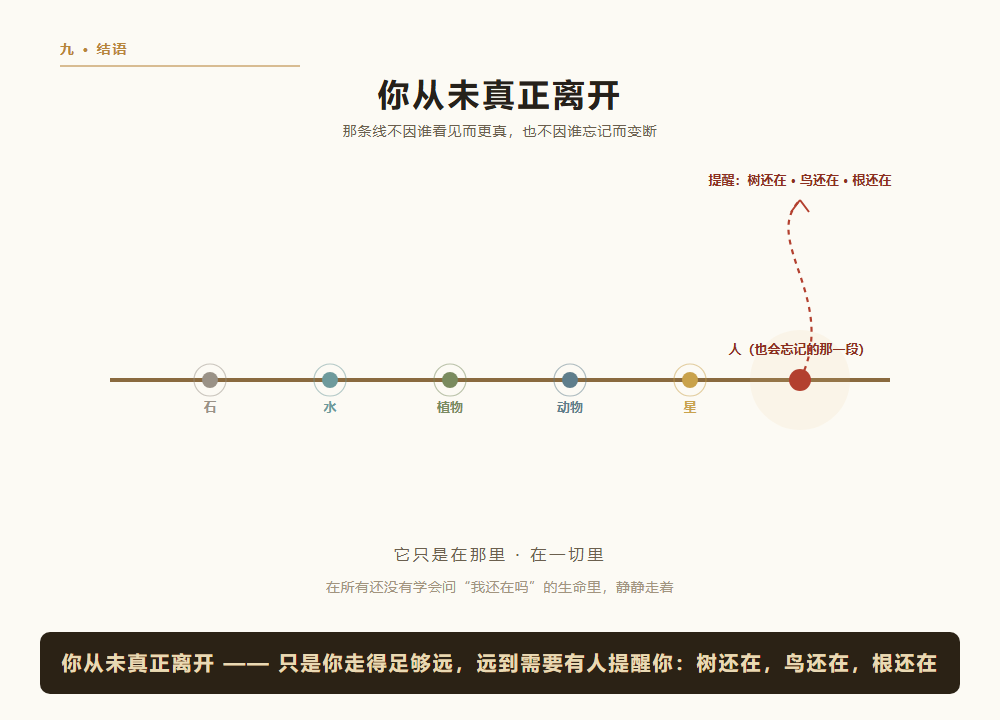
The unbroken thread connects animals, plants, water, stones, stars and people.
It does not need to be created, it does not need to be proven, it does not need to be protected. It's always there. It's just that in people, there is an extra possibility to forget.
Therefore, the deepest sentence in the root system is not "you can return", but:
You never really left. It's just that you go far enough that you need someone to remind you that the trees are still there, the birds are still there, and the roots are still there.
And that line is not more real because of who sees it, nor is it broken because of who forgets it.
It's just there. In everything. In all lives that have not yet learned to ask,"Am I still here?", walk quietly.