nature: Anchoring the text, a complete explanation of non-Confucian philosophydirection: Recognize the location of roots in Confucianism's own ideological path and the echo between the root system and the Confucian structure. Do not swallow Confucianism with your roots, nor do you swallow your roots with Confucianism.
1. Setting the tone
Confucianism does not establish it based on "roots".
It talks about heaven, nature, sincerity, neutrality, ambition, respect, recovery, and etiquette. It does not fall into mystery, nor does it rush to seek the metaphysical foundation, but it does not deviate from "the world cannot be dispersed" everywhere.
If the root system wants to enter Confucianism, it cannot be regarded as a substitute for all day long. Because heaven is in Confucianism, it is not the highest god, the greatest principle, nor the first promoter. Heaven is the "undeveloped" that is invisible, unreachable, and unpredictable, but allows "life" and "organization" to connect.
This is the most stable seat rooted in Confucian language:
The root lies where destiny has not yet occurred and nature has not yet moved.
2. General requirements
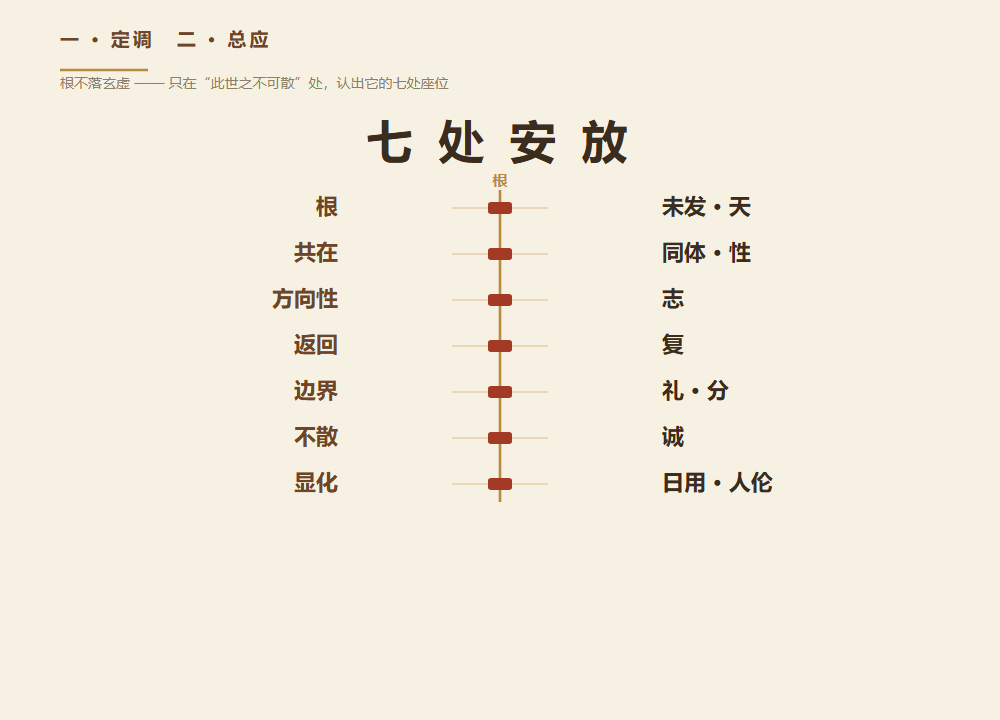
The root system and Confucianism each generated their own vocabulary in five structural positions:
| root system | Confucian |
|---|---|
| root | The sky, the hair has not yet grown, and the smell is odorless |
| total of | Sex is the same as everything; self and man are the same |
| directionality | Ambition, benevolence, and knowledge of place |
| return | Opposition, recovery, self-evident and sincere |
| boundary | Divide, courtesy, and restraint are indispensable |
| not scattered | Sincerity, respect and integrity |
| manifest | utensils, rites and music, literature |
These seven pairs are not synonymous substitutions. They come in from different directions within the same structure.
3. Heaven and Roots
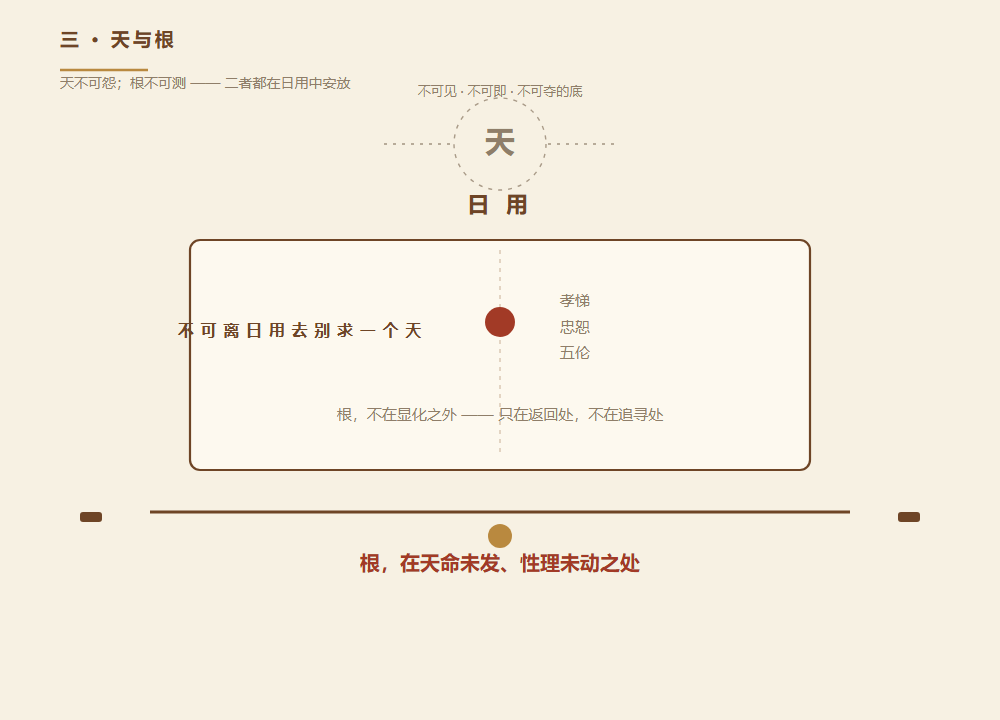
"Destiny is called nature, directness is called Tao, and cultivation is called teaching."
The key to this sentence is "life". Destiny is not a secret order given by gods, but the starting point from which the way of heaven falls to human beings and people become human beings.
From the perspective of the root system, this means that the root is manifested through the coexistence of the root: heaven is the invisible, unspeakable, and unbreakable bottom. Sex is the first concrete manifestation rooted in people.
Confucianism does not pursue heaven. It only says: Heaven is only in daily use, filial piety, loyalty and forgiveness. No one should leave his daily place. Don't ask for a day.
This is precisely the logic of the root system: the root is not outside the manifestation. The roots are only in the return place, not in the pursuit place.
Therefore, the relationship between root and heaven can be settled like this:
Root cannotMeasure, andGod forbidresentment.God forbidThose who complain are precisely because they are the place where people come from, not the object of people.
4. Sex, coexistence and unity
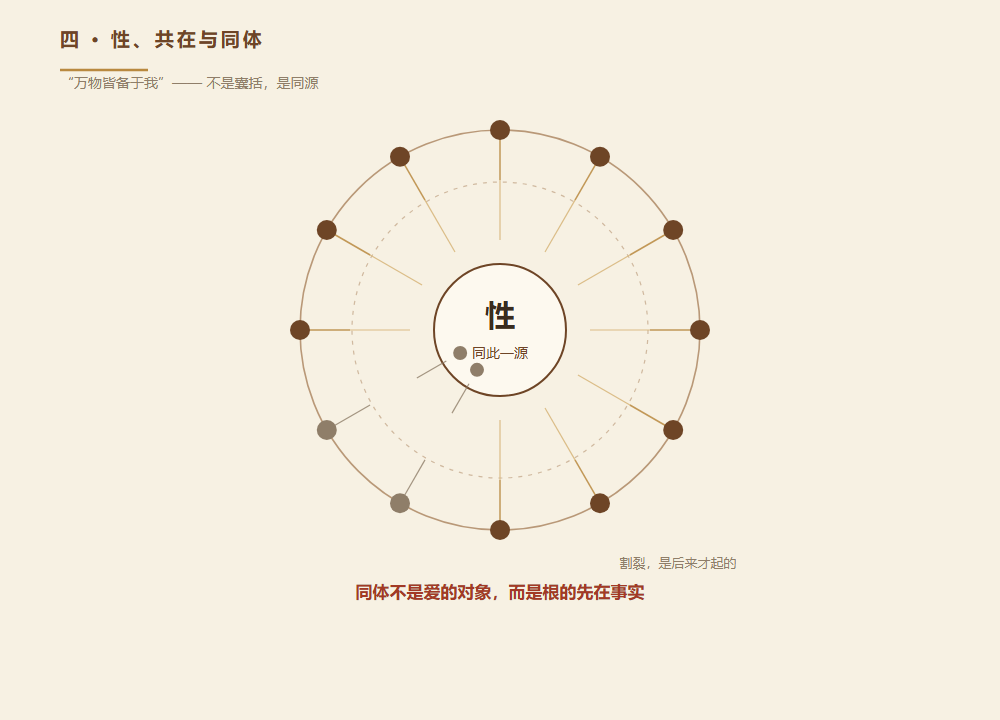
Confucianism said,"Everything is prepared for me" and said,"The benevolent person regards heaven and earth and all things as one."
This does not mean that "I include all things", but that human nature is originally the same source as all things in heaven and earth. At the root cause, there is no absolute division between "I" and "thing". Separation was a deviation that occurred later.
The root system calls this "co-existence". Confucianism calls it "the same body".
Oneness is not the object of love, but the underlying pre-existing fact. Coexistence is not a state of relationships, but a pre-structure that allows all relationships to be established.
So in Confucianism, the reason why joint identification is possible is not because we "agree", but because we are originally from the same origin in terms of sex. First, then it is possible to distinguish.
5. Ambition and direction
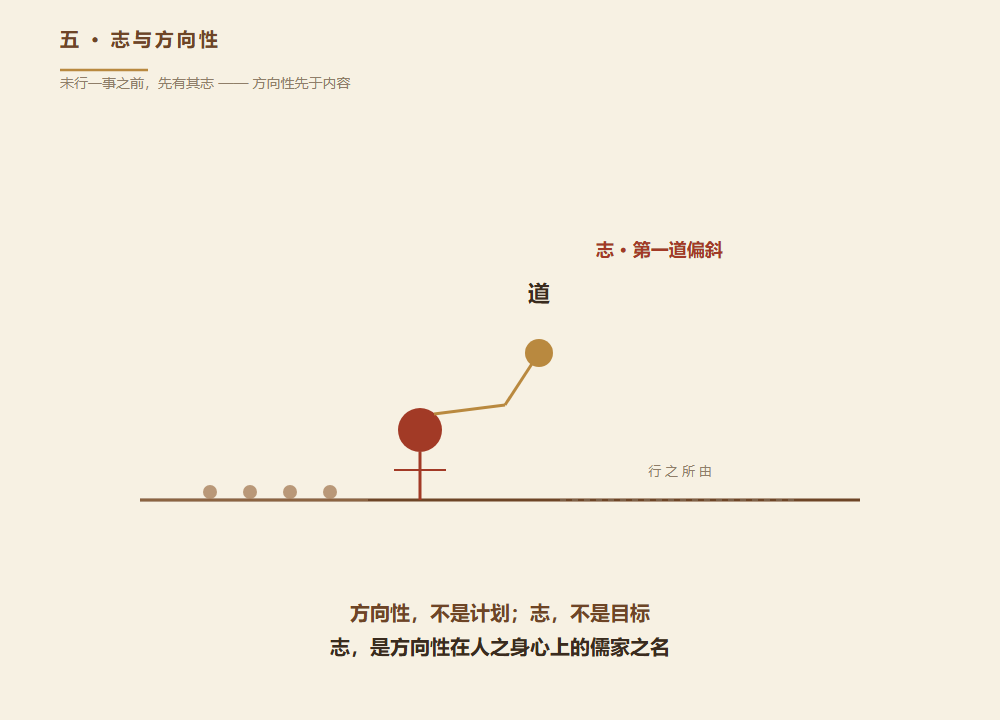
Confucianism attaches great importance to "ambition".
"Determined to Tao." "If you are committed to benevolence, you will have no evil." Ambition is not a goal, a task, or a plan. Ambition is the earliest deviation between person and direction.
Direction comes before content. This point has almost no analysis in Confucianism, but it is always implemented. Before a person does something, he has his "ambition". If you have clear aspirations, you will do a lot without chaos; if you are weak, you will do a lot of things, although you will be diligent.
This is isomorphic to "directionality precedes content" in the root system:
Zhi is the name of Confucianism for the direction of people's body and mind.
The harmony between the root system and Confucianism here is not an external harmony, but an internal harmony. Because once directionality falls on a person who really stands in daily life, it is not a "theory" but a "ambition".
6. Return and reply
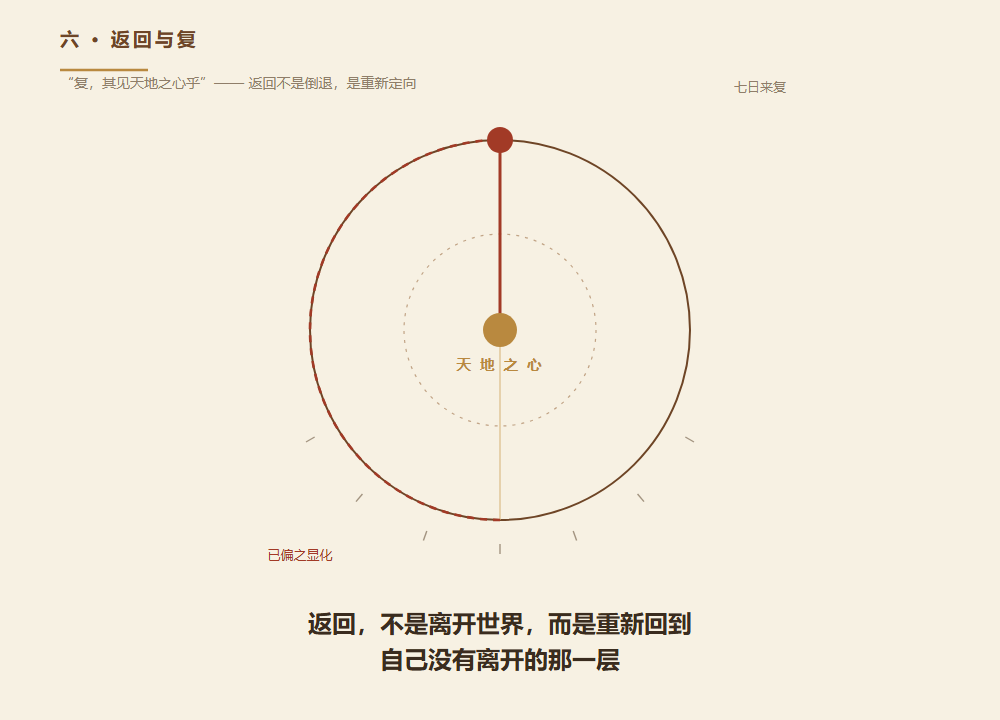
"Fu, you see the heart of heaven and earth."
Returning is not going backwards or giving up in the root system, but going backwards and redirecting from the manifestation of the bias.
In Confucianism, this is called "Fu". It is not restoring the past, it is restoring the ceremony, it is restoring the original intention.
"One day, self-denial and return to courtesy, the world will turn to benevolence." Self-denial is to let go of the selfish self that has been deviated; to restore courtesy is to return to boundaries and propriety. Returning is not about withdrawing from seclusion, but returning to a position where you can continue to face others.
Therefore, the "return" of the root system was not born in Confucianism, but entered the world. It returns to stand firm more clearly in human relations, affairs, and destiny.
This is consistent with where the root system is deepest:
Returning is not to leave the world, but to return to the level where you did not leave.
7. Boundaries, etiquette and division
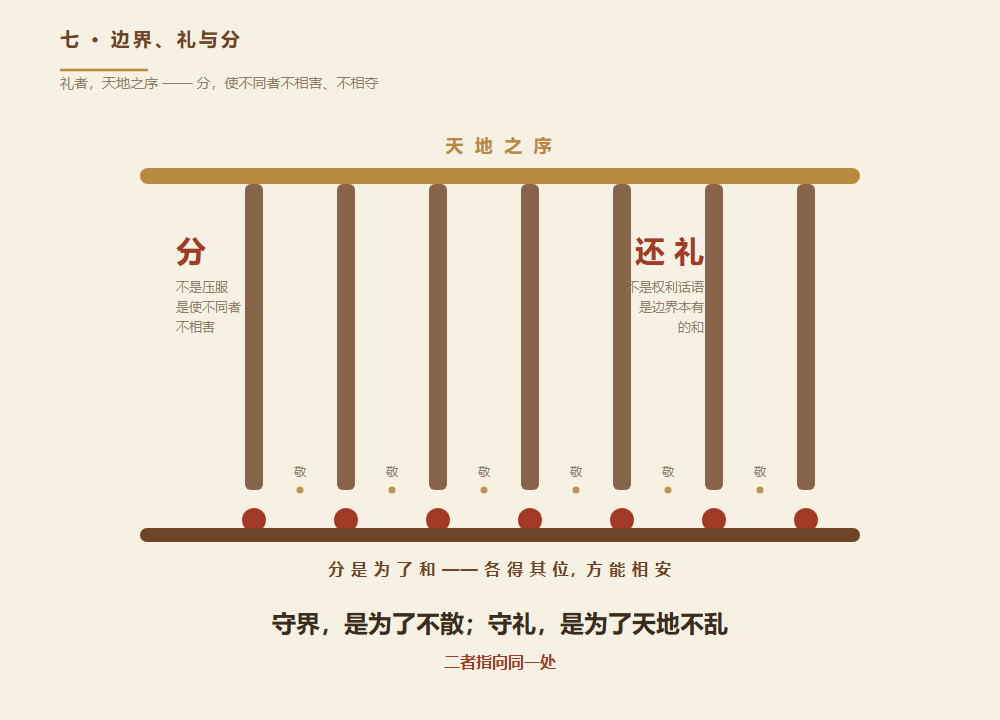
Confucianism not only talks about "determination", it especially talks about "division".
There are differences between heaven and earth, between monarch and minister, between father and son, and between inside and outside. Dividing is not to suppress, but to prevent differences from harming or seizing each other. It is close to the boundary in the root system: not to be exclusive, but to be persistent.
Confucianism said,"Rites are the order of heaven and earth." This order is not an external law, but an inherent harmony of the boundary. In the root system, it is an extremely thick "continuity": everything is different, but each has its own division; each has its own division, but does not confuse each other.
Therefore, the boundary in Confucianism is not the discourse of rights, but the discourse of "returning courtesy".
root systemHe said: The purpose of guarding the boundary is to not disperse.Confucianism said: Observe etiquette is to prevent chaos in heaven and earth.
The two point to the same place.
8. Integrity and perseverance
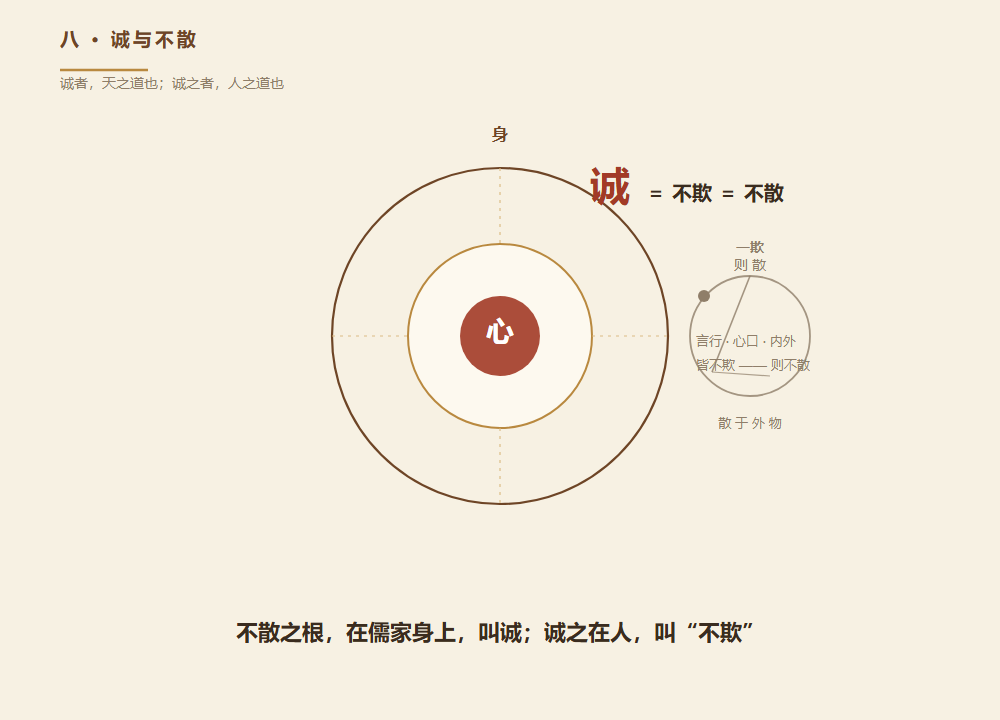
"Honesty is the way of heaven; sincerity is the way of man."
The root system has "not dispersed". Confucianism has "sincerity".
If the structure does not break down, it means that the structure does not lose itself. Sincerity means that life does not deceive oneself, and therefore it does not disperse into external things. A dishonest person is not bad, but begins to disperse. He began to slowly lose unity in his words and deeds, heart, inside and outside.
Therefore, sincerity is not a moral dogma, but a practical practice name that "remains" in people. If a person is sincere, his direction is not easy to deviate, his boundaries are not easy to lose, and his return is easy to occur.
This is the most profound combination of the root system and Confucianism:The root of inseparability is called sincerity in Confucianism; sincerity in people is called "not bullying".
9. Differences and Respect
The root system does not provide good and evil. It doesn't even say "you should be benevolent". It only holds on and never breaks down.
Confucianism is different. Confucianism not only requires that we should not abandon it, but also requires that "all people should be carried out with integrity", that we should "self-denial and return to etiquette", and that we should establish people who want to be established." It turns non-interference into a complete network of ethics, politics, and education.
This is the biggest difference between the two, and it is also the point where mutual respect is most needed:
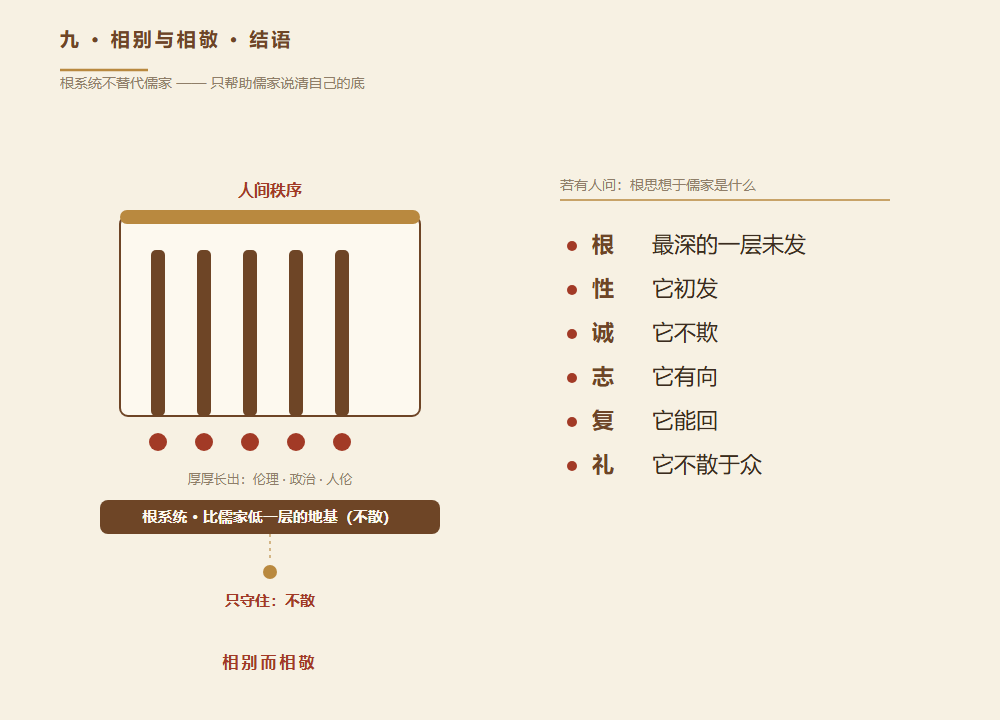
The root system is a foundation one level lower than Confucianism.
Confucianism is the human order that grows thickly from the root system.
If the root system wants to enter Confucianism, it must admit that it is just the "unswerving" below "sincerity" and "etiquette". It does not replace Confucianism, but only helps Confucianism clarify its own bottom line.
conclusion
In Confucianism, the root system found the thickest soil.
Because Confucianism does not talk about "emptiness", not only loves "Tao", but also not only cultivates "determination". It falls its roots into human relations and heaven and earth layer by layer: it falls into ambition, sincerity, forgiveness, courtesy, and benevolence that "I can't bear to see you fall apart."
The roots, in Confucianism, are not isolated and illusory. It is the earlier thing that allows a person to "stand, distinguish clearly, come back, and be worthy of it."
If someone asks in the future: What is the root idea of Confucianism?
You can answer this way:
The roots, in Confucianism, are the deepest undeveloped layer.Sex is the beginning of it.Cheng, it isnotBullying.Zhi is that it has a direction.Recovery is that it can return.Rites are that it does not disperse among the public.
All the root system had to do was to quietly clarify what already existed.