nature: Anchoring the text, non-Buddhist comprehensive explanationdirection: Recognize the location of the root and the echo between the root system and the Buddhist structure in the Buddhist path itself. Don't use roots to replace emptiness, and don't use emptiness to swallow roots.
1. Setting the tone
Buddhism does not say it is based on "root", nor does it lightly say "existence".
It talks about emptiness, non-self-nature, origin, Ru, Dharma realm, awareness, and disengagement. It does not recognize any immutable reality or any basis that can be grasped. Its sharpest knife is specially used to break all "roots".
However, the root system says: The root is not anywhere that can be grasped, the root cannot be objectified, and the root can only be returned.
The two seem to be opposite, but in fact they are in the same direction.
Because what Buddhism breaks down is the "grappable roots" and the "roots that have a fundamental entity." What the root system refers to is the "ungraspable root", the root that "can only be obtained through manifestation but no root."
So here in the Buddhist family, the root system has found the most fierce inspection ground. It must go through voidness and survive. It is not a metaphysics.
2. General requirements
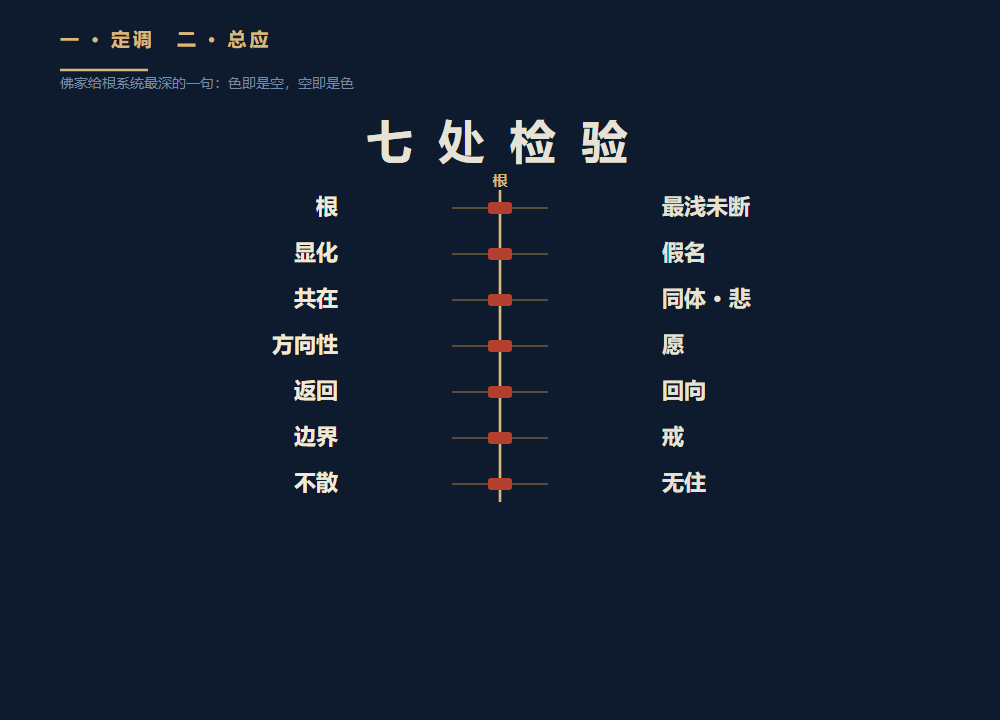
The root system and Buddhism each generate their own vocabulary in five structural positions:
| root system | Buddhist |
|---|---|
| root | Emptiness, legal realm, truthfulness |
| total of | One body, one truth in the legal realm |
| directionality | Wish, karma, and ignorance |
| return | Looking back, going back, thinking back to the source |
| boundary | Abstinence, boundary, no leakage |
| not scattered | Calm, motionless, conscious |
| manifest | Phase, pseudonym, origin |
These seven pairs are not synonymous substitutions, but two languages on the same road of observation.
3. Emptiness and Roots
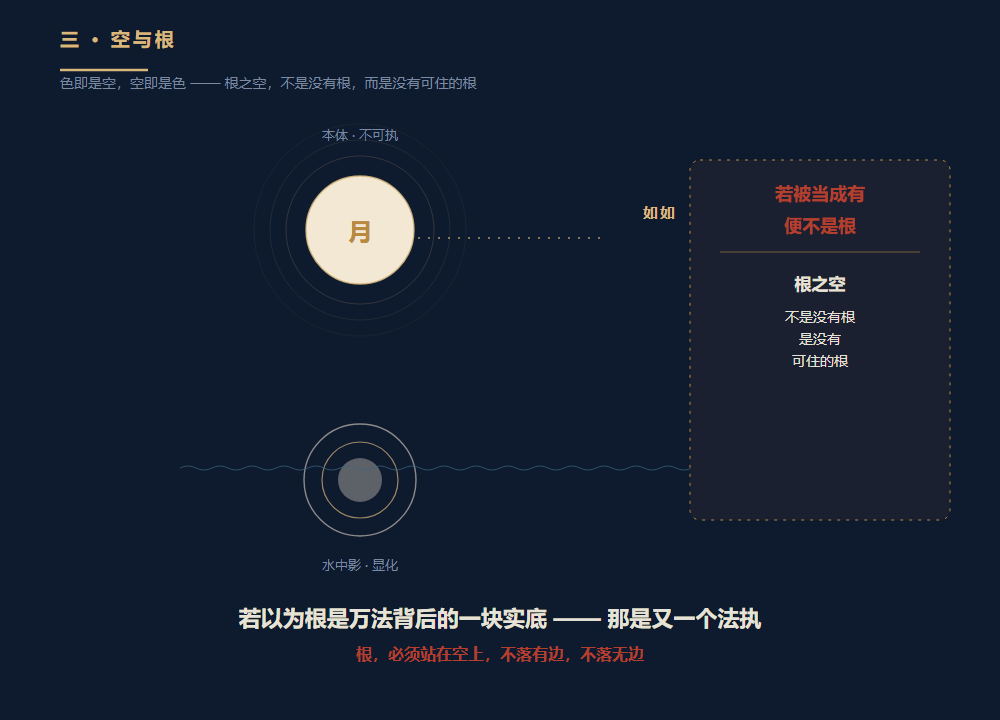
"Color is emptiness, and emptiness is color."
This is the most profound sentence given by Buddhism.
The root cannot be objectified because it is empty; the root cannot be grasped because it has no self-nature. If anyone thinks that the root is a solid foundation behind all Dharma principles, then in the eyes of Buddhists, it is just another "Dharma adherence".
Therefore, the root system must acknowledge that:
Roots, if regarded as having, are not roots. The emptiness of roots is not that there are no roots, but that there are no roots to live on.
Buddhism's emptiness does not talk about the foundation. It only talks about origin: all Dharma causes and causes are harmonious and have no self-nature. It is precisely because there is no self-nature that everything is possible.
If the "root" of the root system still wants to stand, it must stand on this empty space without falling on edge or boundless. It cannot be the "first cause that produces all things", but can only be the "layer of non-living that makes all things visible."
This is a great purification that the root system must undergo in front of Buddhism.
4. Coexistence and Oneness
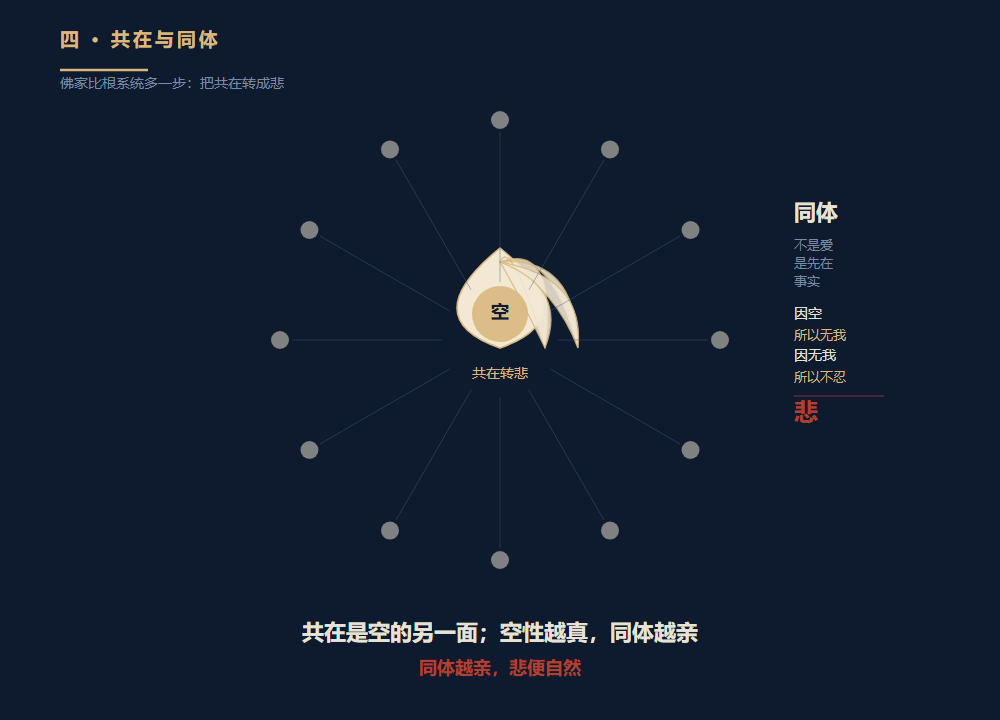
Buddhists say that "the same body is great sorrow".
This does not mean that all things are born of one ontology, but that all Dharma is empty in nature and has no separation from themselves. It is precisely because there is no separation that his suffering may be truly realized by me in a single thought and become one body.
The root system says that "coexistence precedes direction." Buddhists say that "the Dharma realm is true, and the others are the same."
But Buddhism is one step more than the root system: it not only recognizes communion structurally, it transforms communion into sorrow. Because of emptiness, there is no self; because there is no self, there is no self.
The root system sees coexistence, but has not yet produced the great sorrow that matches it. This is its weakest step in front of Buddhism.
Therefore, if the root system wants to be interpreted, it must acknowledge:
Being together is the other side of emptiness. The more true the emptiness, the closer the body is; the closer the body is, the more it is, the sadness becomes natural.
Empty air without sorrow is cold air. There is no empty sorrow, it is emotional persistence. The root system has touched emptiness in structure, but it has not yet moved from emptiness to sorrow.
5. Direction and willingness
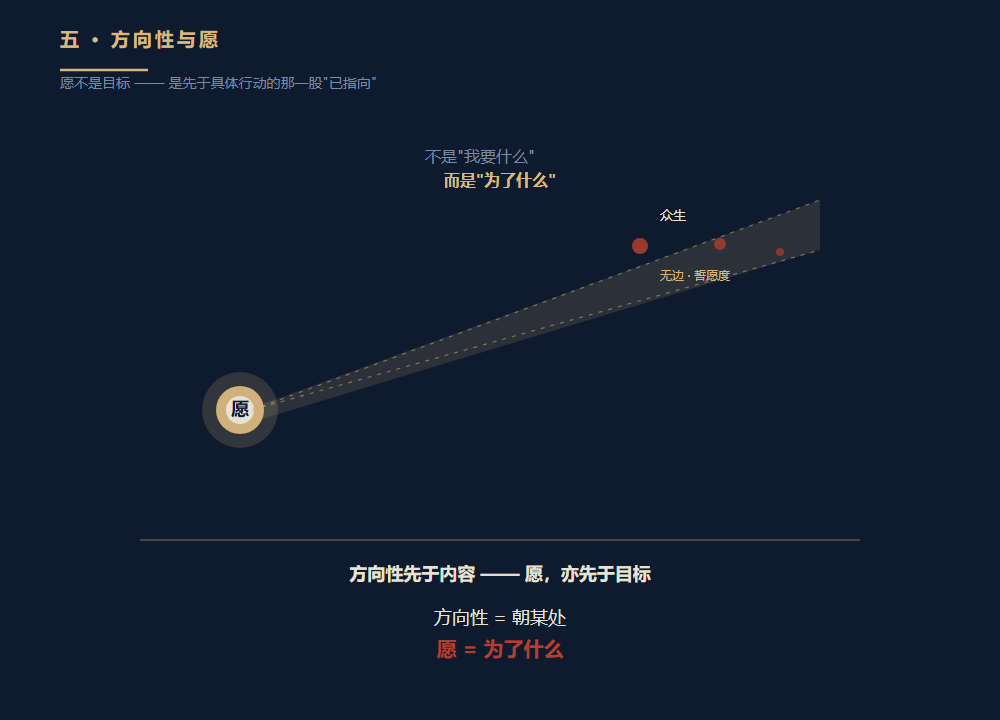
The root system has "directionality". Buddhism has a "wish".
Willing is not a desire, a goal, or a plan. Wish is the broad direction of "the boundless vow of all living beings", and it is the unwavering trend that existed at the beginning of the earth.
This is a deep isomorphism with "directionality precedes content":
Directionality is not "what I want".
Wishing is not "I want to achieve something".
They are all the "pointed points" that precede specific actions, specific goals, and specific content.
I hope there is one more layer than directionality: it is not just "towards somewhere", but "for what". This "why" is not missing in the root system, but has been cleared. The root system will not say why. It only talks.
Buddhists will put "Bu Fang" back into their wishes, giving "Bu Fang" a new direction.
6. Return and Return
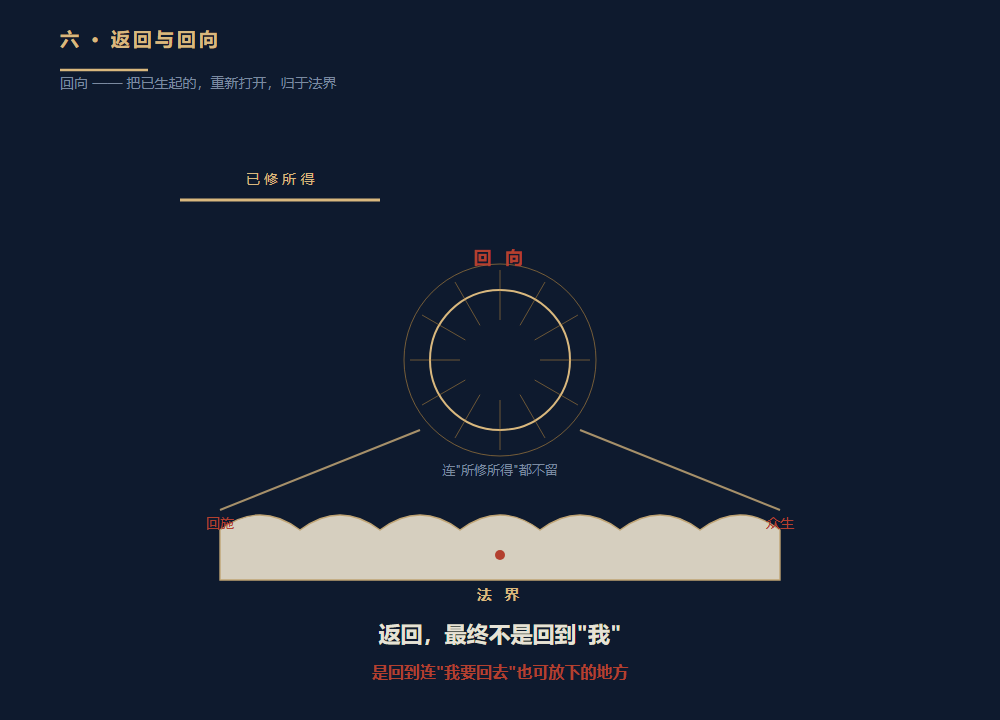
The root system says "return". Buddhism says "return".
Returning is not retreating. Returning means "giving this merit back to all living beings." It is to reopen what has been born and return it to the Dharma realm.
This is more radical than the "return" of the root system.
The return of the root system is to return to the boundary and re-identify the direction. Buddhism's return is not to leave even the "gains of cultivation" and return them all.
The root system says "never breaks down". Buddhism speaks of "no dwelling". Without housing, it is not to disperse, but to disperse cleanly and not even disperse.
This is another step that the root system needs to take:
Returning is ultimately not returning to "me." It is to go back to a place where even "I want to go back" can be put down.
That is the deepest form of persistence: it is not "I saved it", it is "I don't have a me and need to be saved."
7. Boundaries and precepts
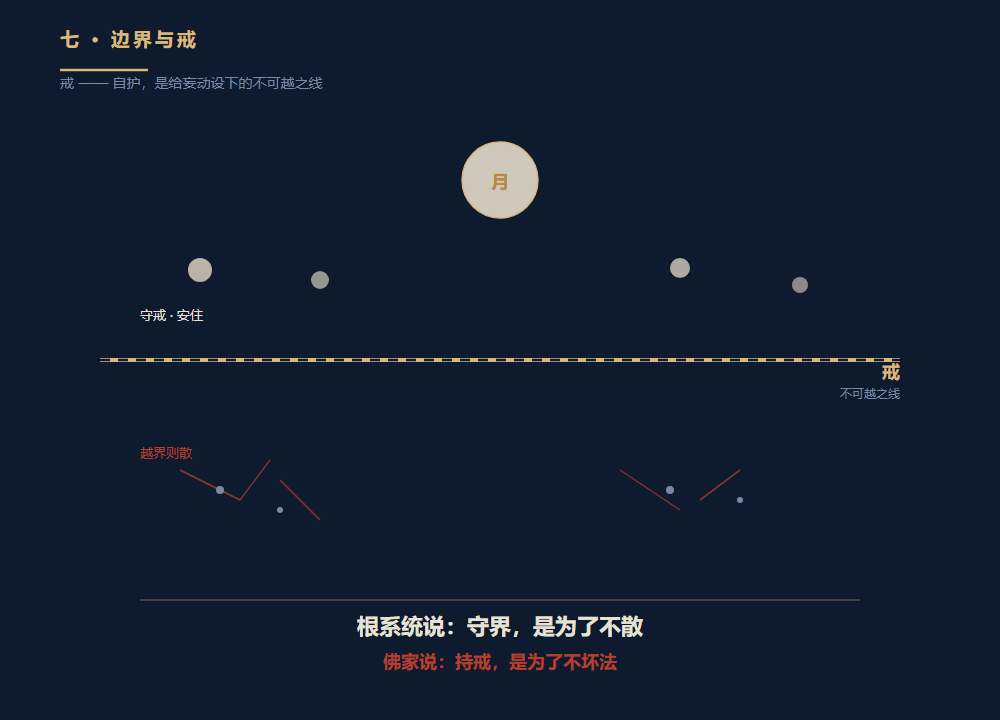
The root system talks about boundaries: in order not to disperse.
Buddhism teaches precepts: In order not to break the law.
Abstinence is not bondage. Quit is self-protection. It is to know which places will disperse when you step on them. It is a line that cannot be crossed for reckless actions.
This is exactly the same as the boundary and structure of the root system.
However, the Buddhist precepts carry a deep sense of karma. It knows that if some deviations occur, many talents will be brought back. The boundary of the root system is "never dispersed"; the Buddhist precept is "never corrupted the wisdom of the Dharma."
One is quieter, the other is heavier. But they are on the same line.
8. Manifestations and Kana Names
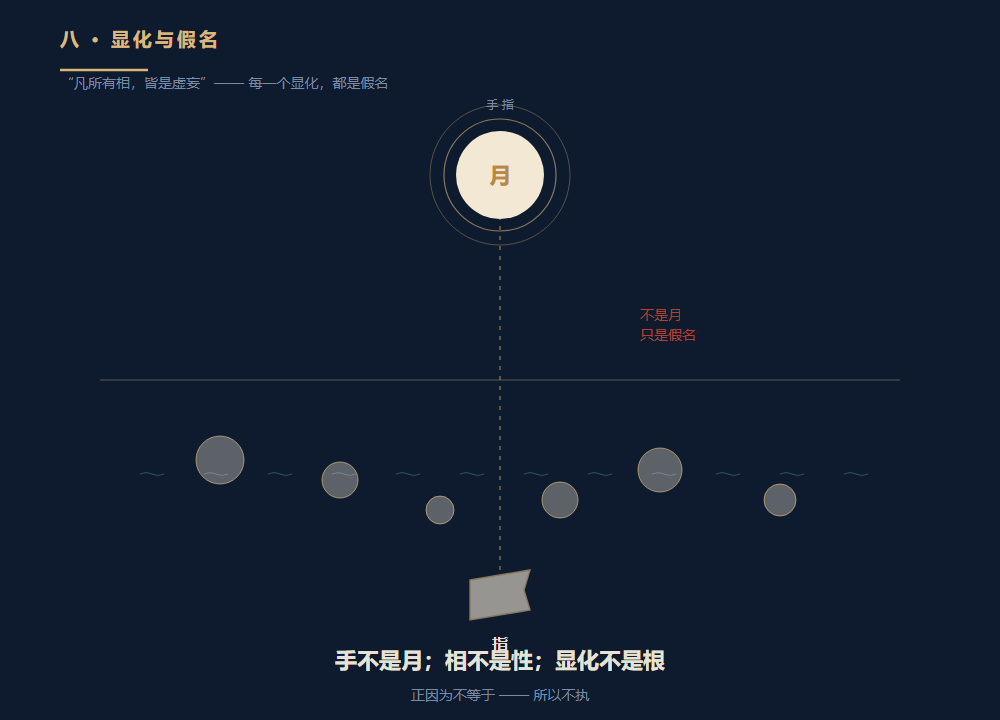
The root system says: manifesting is never equal to the root.
Buddhism has said it long ago.
"All appearances are illusions." "Everything has a law, like a dream and a bubble." Every manifestation is a pseudonym. It is not that a pseudonym does not exist, but that it cannot be held true.
This is almost the same legal meaning as "manifestation is never equal to root."
So, the root system is not new here. It just replaces the sharpest thing that Buddhists have long known with structural language:The hand is not the moon. It's not sex. Manifestation is not the root.
But the root system cannot just stop at "not equal". It must also know that it is precisely because it is not equal, it is not attached; because it is not attached, it can be repaid; because it can be repaid, it is at ease.
9. Differences and Respect
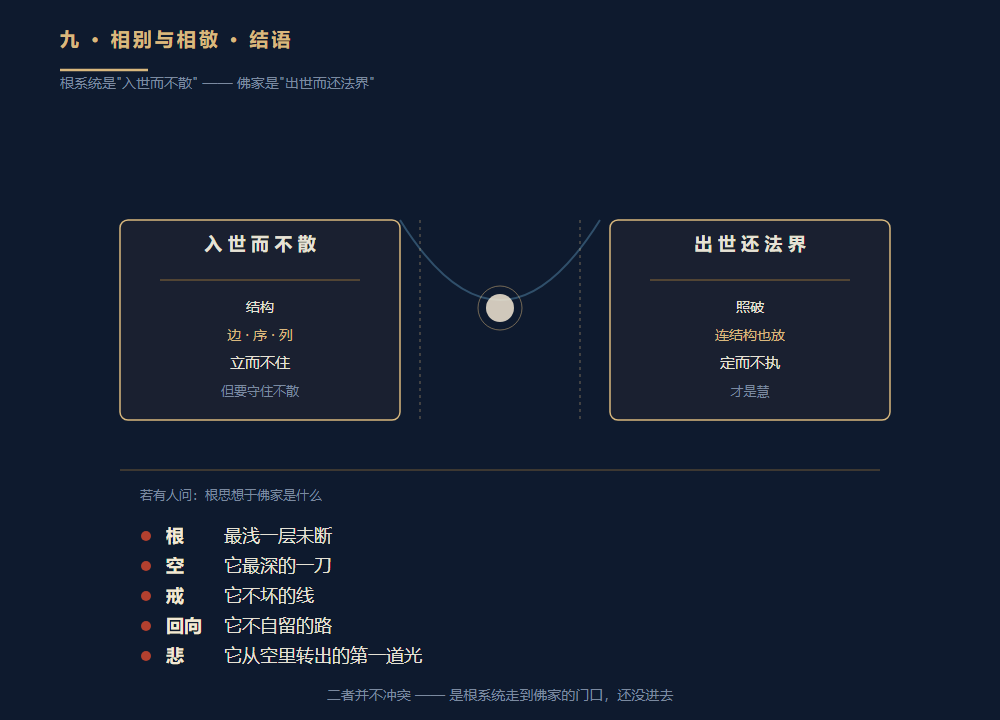
The deepest difference between the root system and Buddhism lies here:
The root system is a structure that "joins the WTO but never breaks up".
Buddhism is the way to "return to the Dharma realm after being born."
One wants to keep, the other wants to let go. One must be maintained and the other must be exposed.
But if you look closely, they do not conflict.
Because the "persistence" of the root system is nothing more than a "initial determination" of sentient beings in the eyes of Buddhists. Definitely not enough. Wisdom is to be determined without perseverance. From the perspective of the root system, Buddhism's "emptiness" should not completely withdraw people. Because if the root is just empty, the foot that "has to come back" will be missing.
Therefore, the root system and Buddhism are not opposed. It was the root system that walked to the door of the Buddhist house, but had not yet entered it.
conclusion
Here in the Buddhist family, the root system is peeled cleanest.
Roots are no longer roots, but emptiness. Empty space is no longer available because even empty space is empty. So all that remains is a "Ru" without a name or objectification.
If the root system can pass through this layer, it is no longer a "set of structures." It'll be so light that there's only one way back.
If someone in the future asks: What is the root of thinking in Buddhism?
You can answer this way:
Root, in Buddhism, is the shallowest "unbroken" layer.Emptiness is its deepest knife.Quit is its unbroken thread.Returning is the path it does not keep.Sadness is the first light it turns out of the sky.
If the root system can get here, it will truly pass an "empty" exam.
The root is still not in any text. Just as it let go of it, it suddenly understood that there was never a person I wanted to keep.