nature: Anchoring the text, a complete explanation of non-Taoist philosophydirection: Recognize the location of the roots in Taoism's own natural path and the echo between the root system and the Taoist structure. Do not use roots to replace Tao, and do not swallow roots with Tao.
1. Setting the tone
Taoism is closer to its roots than any other family.
It does not talk about the principles of "heaven" or the observation of "emptiness". It only said. And Tao, from the first moment it was spoken, refused to be spoken.
"The Tao can be Tao, but the Tao is very Tao." It's not to show off, it's not to be mystifying, but to say all at once that roots cannot be objectified.
Therefore, if the root system enters the Tao, it requires almost no translation. It only needs to admit that in many places, Lao Tzu has already said it for the first time.
But because of this, this is also the most dangerous place.
Because it's so similar. Almost like each other. If the root system is completely integrated with Tao, it will lose its structure and become a modern footnote to the Tao Te Ching. That would be not joint identification, but annexation.
Therefore, the task of the Tao chapter is not to prove that "the root is the Tao", but to recognize:Tao is the earliest manifestation rooted in the "nature" side. The root is the foundation where the Tao has not yet been written under the words "speakable".
2. General requirements
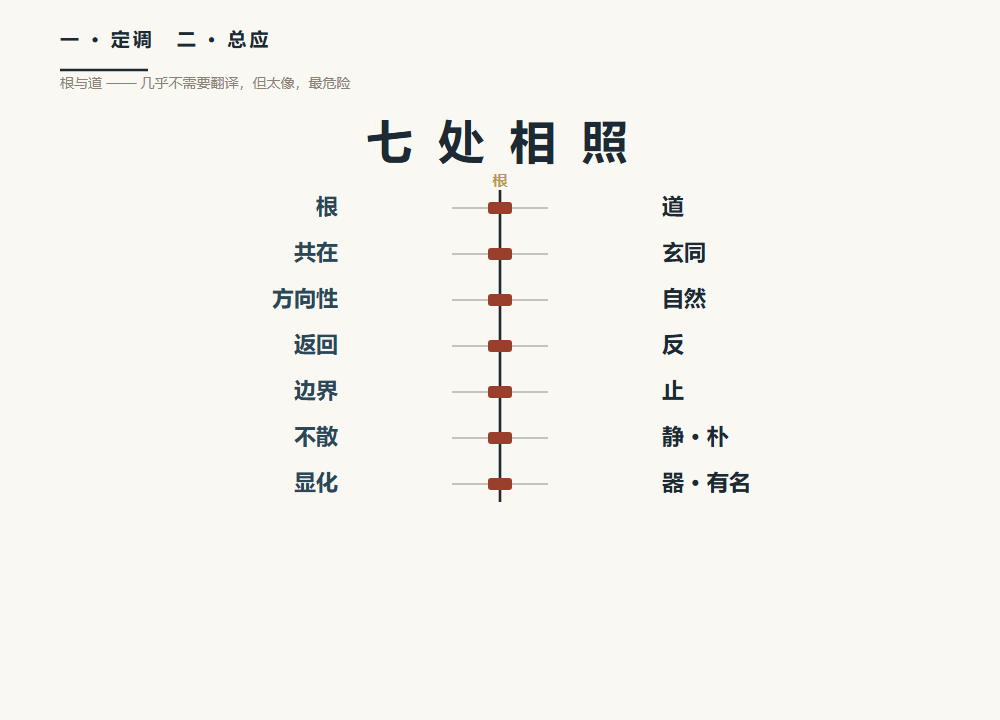
The root system and Taoism each generate their own vocabulary in five structural positions:
| root system | Taoist |
|---|---|
| root | Tao, nothingness, heaven and earth roots |
| total of | Xuantong, all things are in one house |
| directionality | The direction of nature and the trend of life |
| return | Opposition, return, and return to the final analysis |
| boundary | Keep one, know one, and do not exceed one |
| not scattered | Calm, calm, simple, and few desires |
| manifest | Equipment, famous, everything |
These seven pairs have the same structure, each of which grows in languages of different eras.
3. Tao and roots
Lao Tzu said it most clearly:
"When things are mixed, the world is born first. Lonely and lonely, independent without change, walking around without danger, you can be the mother of the world. I don't know its name, so I insist on calling it Tao."
Pay attention to this last sentence: The strong word is called Tao.
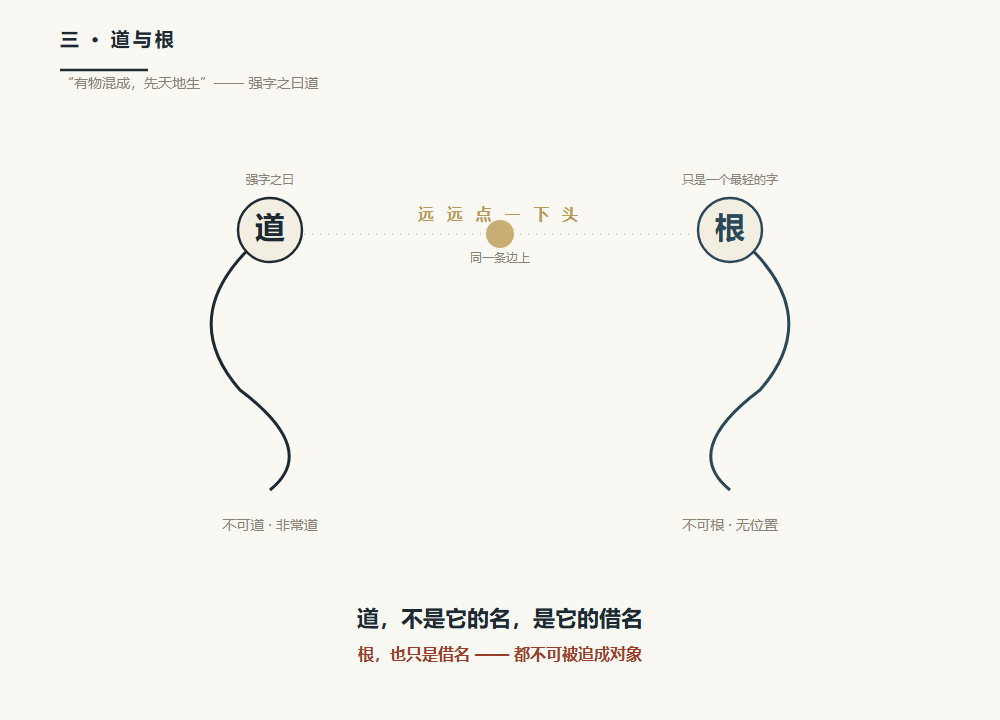
It's not "it cries", it's "I reluctantly give it a word." This acknowledges the shortcomings of fame and appearance. Tao is not its name, but its borrowed name.
The same is true for roots. Roots are not roots. Root is just the lightest and least-occupied word we give it. It has no location, no attributes, and no complete qualification to "say that".
Therefore, the relationship between Tao and root is not that two concepts are aligned, but that an older person who says that cannot be said and a new person who says that cannot be said, nodding from a distance on the same side.
4. Nature and Directionality
"People govern the earth, the earth governs the sky, the heaven governs the way, and the law governs the nature."
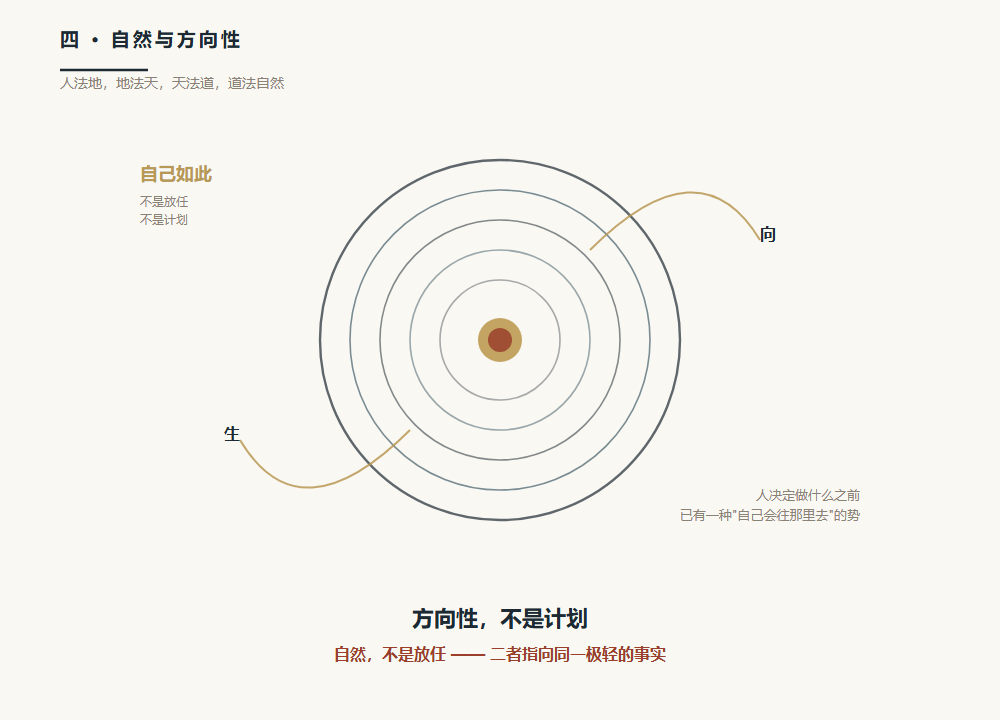
"Nature" is not nature as we talk about today, nor is it about letting things happen casually. It is "what it is". There is no external imposition, but it is still directional, orderly and alive.
The root system says: Directionality comes before content. Taoism says: Nature precedes human behavior.
Direction is not a plan. Nature is not laissez-faire.
Both point to one extremely light fact:Before "people decide what to do", there is already a tendency that "they will go there".
It's just that Taoism handed it over to heaven and earth, and the root system handed it over to structure.
5. Return and Opposition
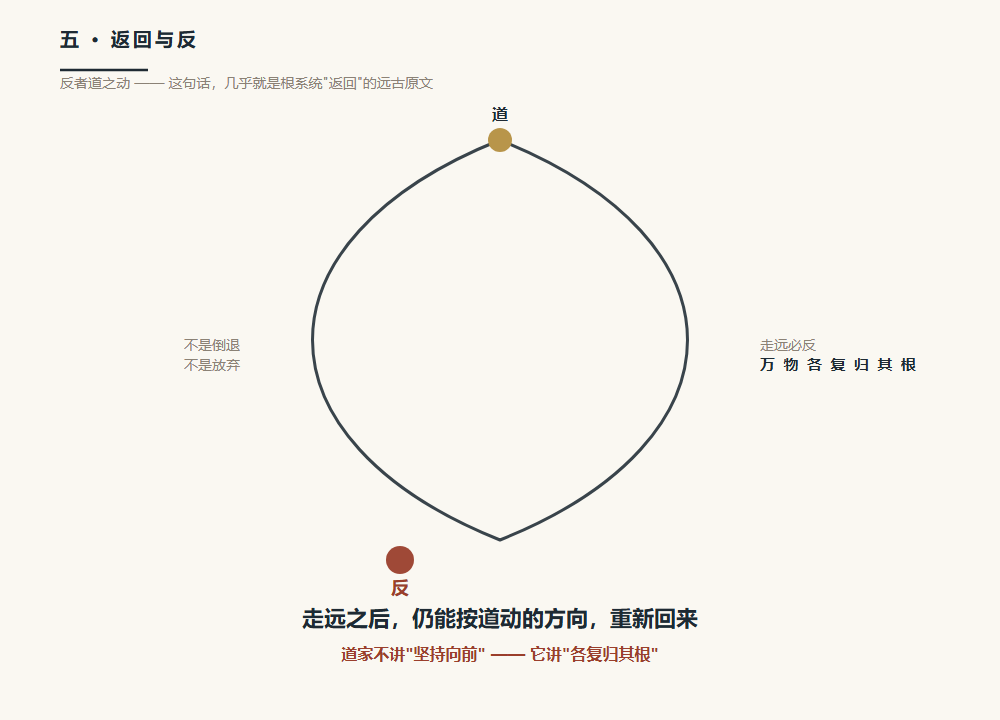
Lao Tzu said: "The contrary is the action of the Tao."
This sentence is almost the ancient original version of the concept of "return" of the root system.
"Reverse" means not turning back, not going backwards. It is a move to "return to the roots". Everything comes from the roots, and when it goes far, it will be reversed. Instead, it is the way of movement of Tao, and it is also the only natural way for all those who leave home.
The return of the root system also means this: it is not about giving up, it is not about escaping, but about being able to come back in the direction of the road after walking far away.
Therefore, Taoism does not talk about "persevering in moving forward". It says,"Each person returns to its roots." The root system does not say "cannot stop". It says,"Stop while you can."
These two sentences are the same sentence.
6. Calm, unscattered and simple
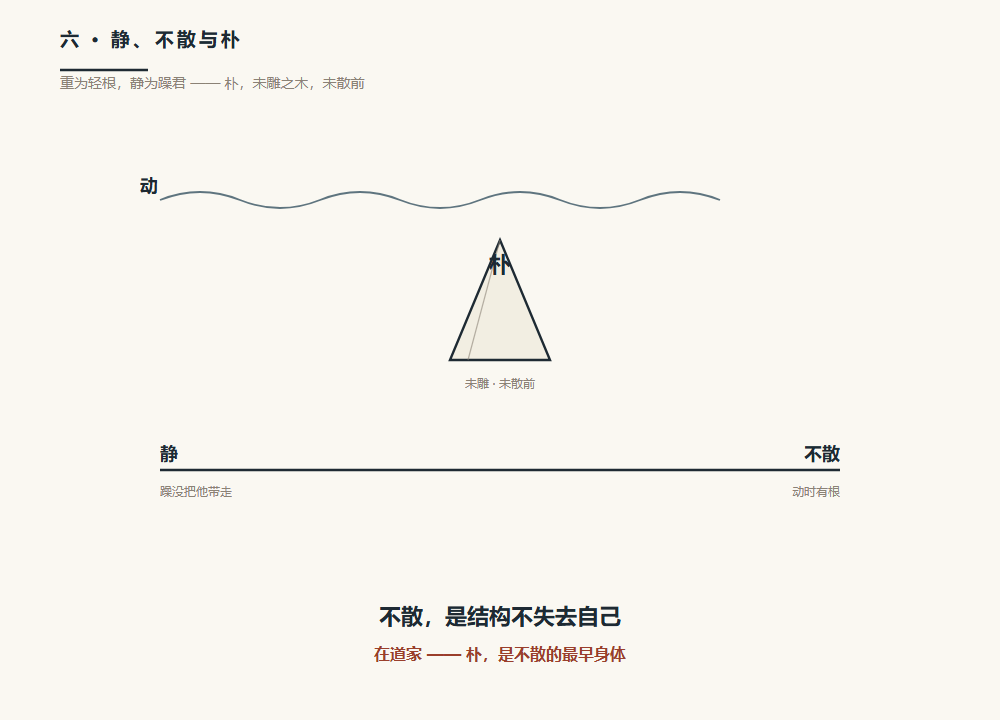
"Focus is light root, and tranquility is impetuous."
Taoism attaches great importance to tranquility, but this tranquility is not deathly silence. It is the bottom of the impatience, and the layer of "stability" that has not been taken away.
The root system says "it won't break". Taoism says that "tranquility is a impatient monarch."
A person who never leaves is not impatient, but impatient does not take him away. A person who can be still does not move, but has roots when moving.
"Park" is another word. Park is an uncarved tree, it is the original shape, before it was scattered.
If the root system wants to find a counterpart for "unscattered" in Taoism, then it will be none other than "simple". Park is the earliest body that never breaks apart.
7. Boundaries and ends
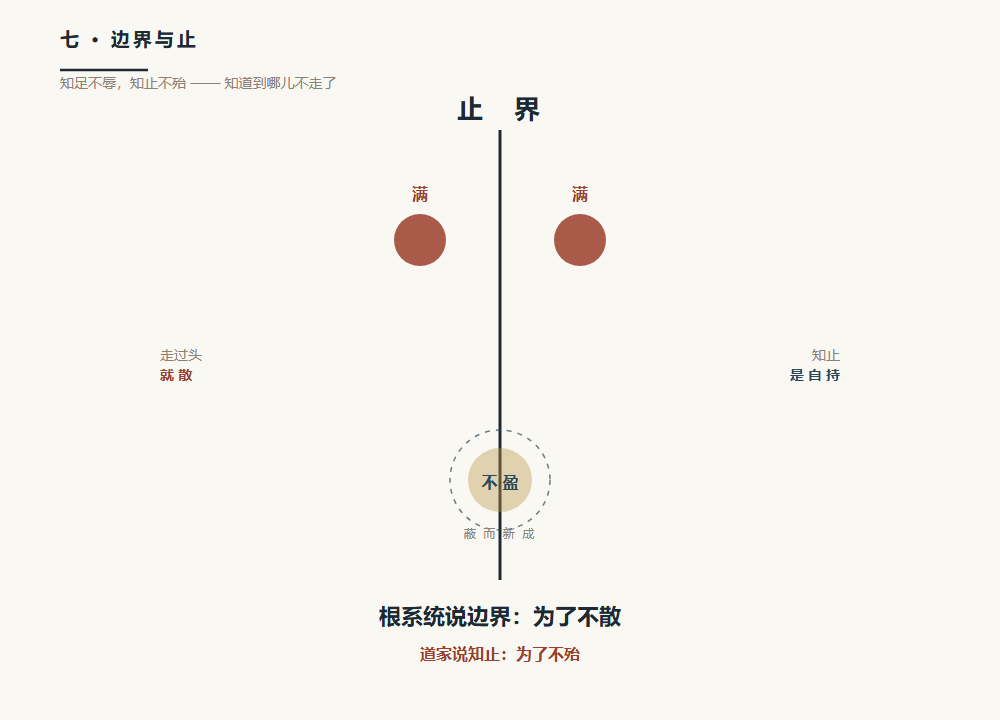
Taoism does not often talk about etiquette, but it understands "stop" very well.
"Know your feet without humiliation, and know your feet without danger." "If you don't have enough money, you can cover it and create new things."
Stop, not ban. Stop, I know where to go. Go over and leave. Knowing is self-restraint. It's the border.
The root system says the boundary: it is to not disperse. Taoism says that we should stop knowing: it is to avoid danger.
Two words, one cold and the other warm. But we are on the same line.
8. Gong-Being and Xuantong
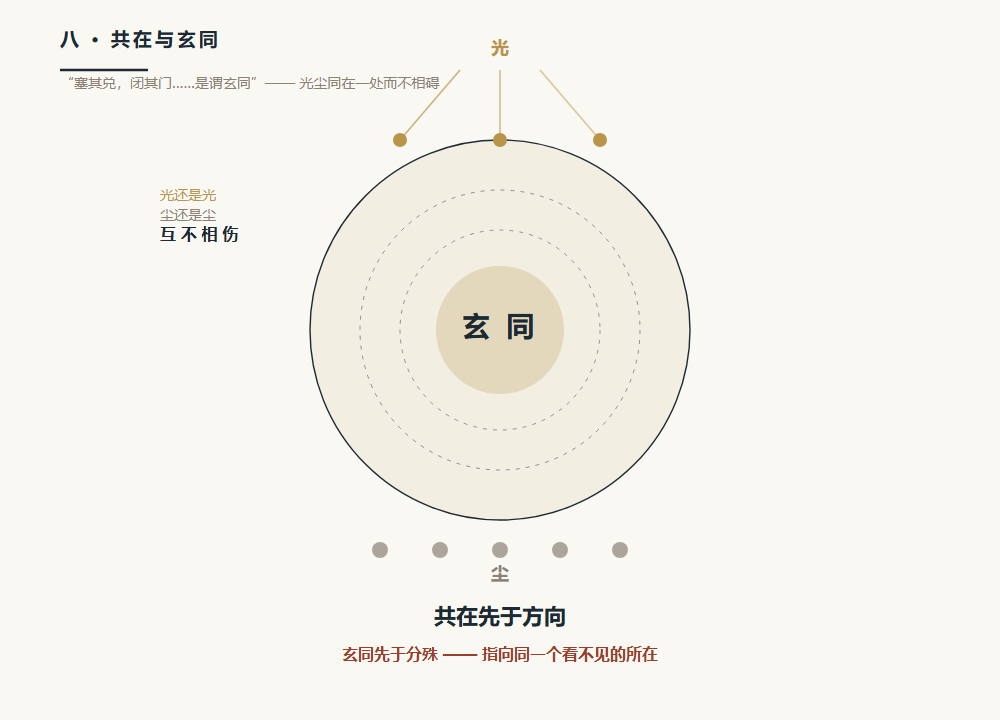
"Blocking the duress, closing the door, defeating the sharp, resolving the chaos, harmonizing the light, and being the same as the dust is called Xuantong."
"Xuantong" is the Taoist version of Gongexistence.
It is not to smooth out differences, but to make differences no longer interfere with each other in the extreme depth. Light is still light, and dust is still dust, but light and dust can be in the same place without harming each other.
The root system says: Coexistence precedes direction. Taoism said: Xuantong precedes Fenshu.
These two sentences point to the same invisible place: the "unity" before it was divided into you and me, things and things.
9. Differences and Respect
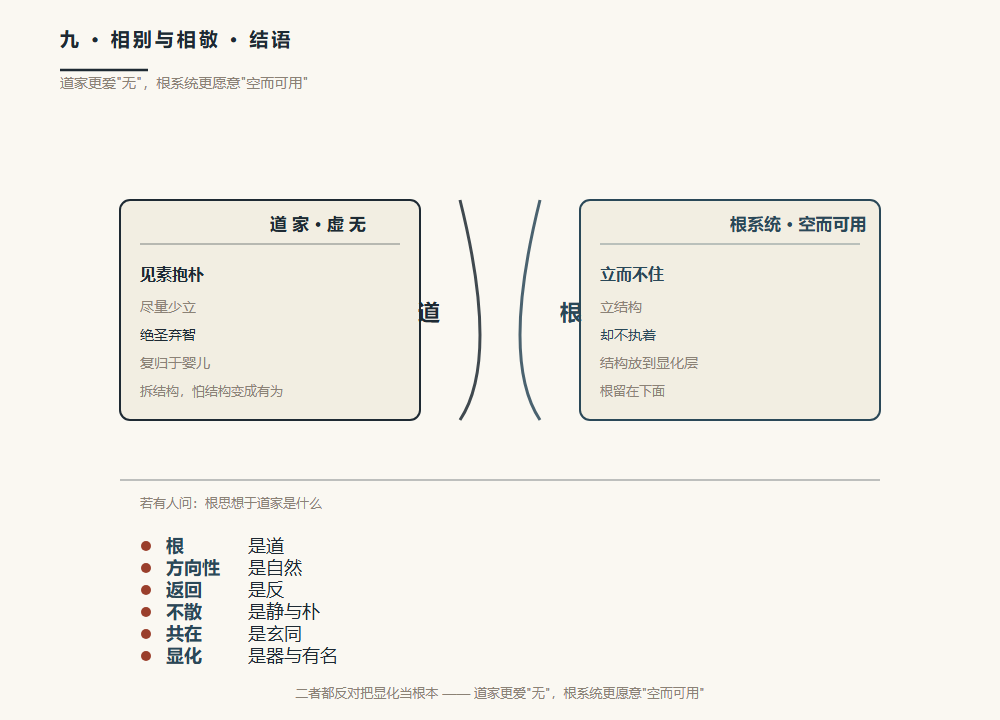
The biggest difference between Taoism and the root system lies in "nothingness" and "structure".
When Taoism reaches its extreme, it will say that "the saint and wisdom are abandoned" and "return to the baby." It does not trust the structure and even wants to tear down the structure, afraid that the structure will become a new promising one.
The root system is different. It does not tear down the structure, it just puts the structure on the "manifest layer" and leaves the roots below. It recognizes that structure needs to be used, but cannot be used as a root.
So:
Taoism is to "embrace simplicity" and try not to establish itself as much as possible.
The root system is "established but not able to live", establishing a structure but not persistent.
Both oppose taking manifestation as the root. But Taoism prefers "nothing", and the root system prefers "empty and usable".
conclusion
Here in Taoism, the root system feels "home" for the first time.
Because Tao is the first name named Root. Nature is the first glimpse of directionality. Instead, it is to return to the earliest announced movement. Tranquility and simplicity are the earliest bodies that do not disperse. Xuantong is the earliest light in common existence.
But Taoism is Taoism after all. It transforms its roots into heaven, earth and nature, and into a road that requires no structure or entry into the world.
And the root system has to take another step forward. It needs to carry the "tranquility" in the Tao and return to the world where people, systems, machines and machines are still running fast, to see if "not scattered" can still stand.
If someone in the future asks: What is the root of thinking in Taoism?
You can answer this way:
The root, in Taoism, is the Tao.Directionality is nature.Return is reverse.Not leaving is tranquility and simplicity.Being together is Xuantong.Manifestation is instrument and fame.
What the root system needs to do is not to tell the Tao again. It is after the Tao is finished, let those who are still willing to stay in the world find a path that will not be revealed but can still come back.