abstract
The fundamental feature of the manifestation of the phenomenal world is not "existence" itself, but that "existence must enter manifestation in an asymmetric way." The breaking of parity in basic interactions is not only a physical fact, but also the basic operation of ontological structures: if the source wants to appear, it must break its own perfect symmetry through the occurrence of direction, differences, opposites, and content. Based on this insight, this paper attempts to re-understand the relationship between manifestation, presence and origin. The core judgment is that the parity breaking of a phenomenon is not an existing defect, but a condition for the possibility of appearance; perfect symmetry cannot be seen, experienced, and become a phenomenon. Therefore, we cannot return to an "unbroken" source, and we do not need to. Living soberly in the process of breaking defects, and at the same time no longer mistaking breaking defects for everything, is the structural meaning of "seeing nature".
1. Breaking defects as a condition for appearance
If the source is perfectly symmetrical, it cannot be perceived.
Because the premise of perception is difference. Without left and right, without convergence and dispersion, without direction and boundary, there is no "object" to be experienced. All experience and all phenomena occur in an already asymmetrical field.
Therefore, the first nature of a phenomenon is not "existence" but "bias". Only when there is bias can it appear.
The non-conservation of parity in physics is exactly what this truth shows at the elementary particle level: in the deepest interactions, left and right are not equivalent. Nature breaks its mirror symmetry in the smallest position.
This is not an accidental flaw. This is an inevitable structure:If the world were still perfectly symmetrical, no structure would occur, and no observers would appear to ask,"Why is it asymmetrical?"
2. Where does the breach occur
Breaking does not happen "after the phenomenon", as if there is a perfect ontology first and then it is broken.
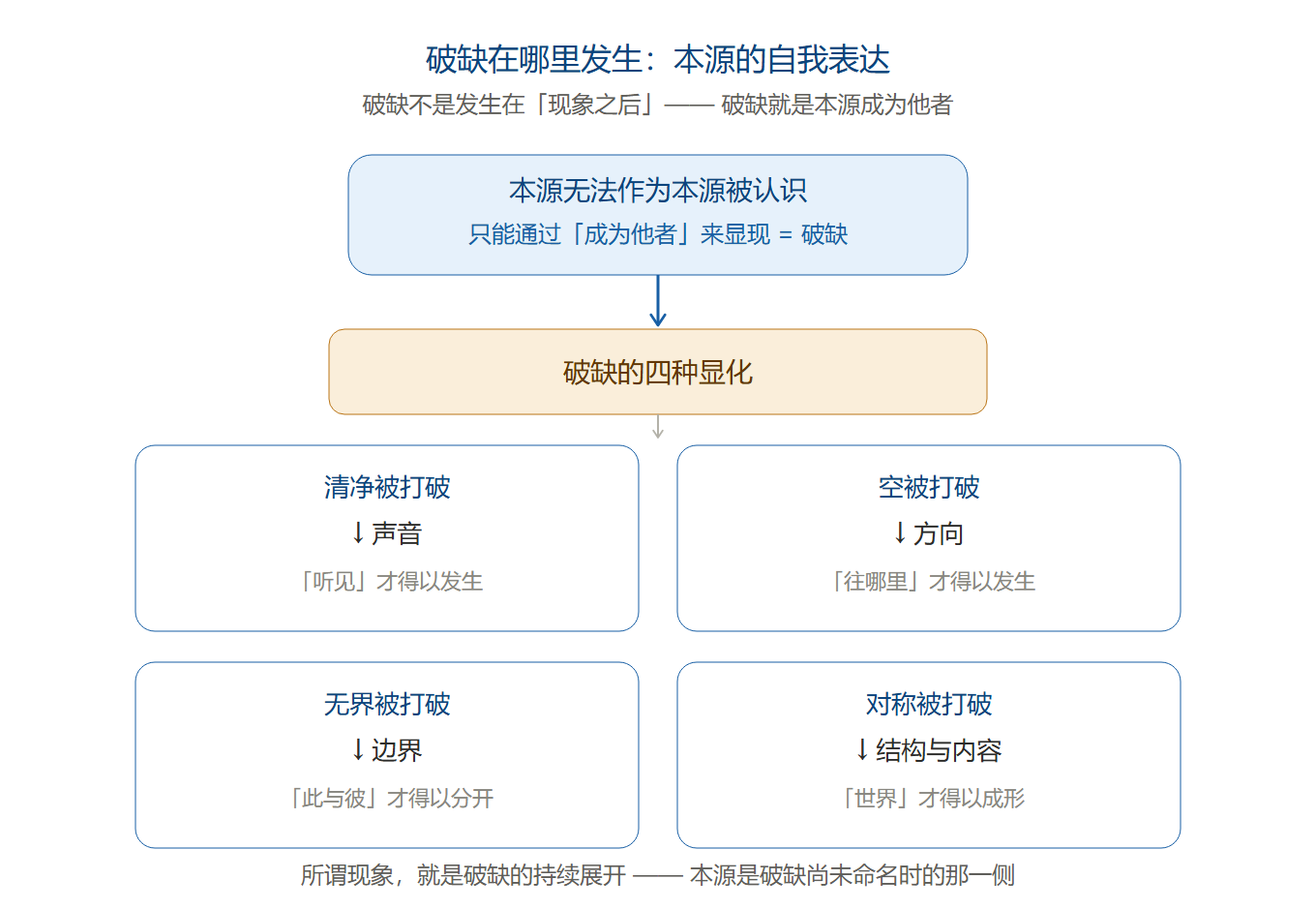
Breaking through is the self-expression of the source.
Origin cannot be recognized as origin. It can only manifest itself by "becoming the other'. To become the other is to break through. So we saw:
Only when the purity is broken can there be sound.
Only when the void is broken can there be direction.
Only when unbounded boundaries are broken can there be boundaries.
Only when symmetry is broken can there be structure and content.
The so-called phenomenon is the continuous development of defects. The so-called source is the side where the broken defect has not yet been named.
But "not yet named" does not mean "before being broken". It never passed. It is in the midst of the breach, as the invisible position from which the breach came and has always returned.
3. Order tendency and entropy increase: the two basic polarities of breaking down
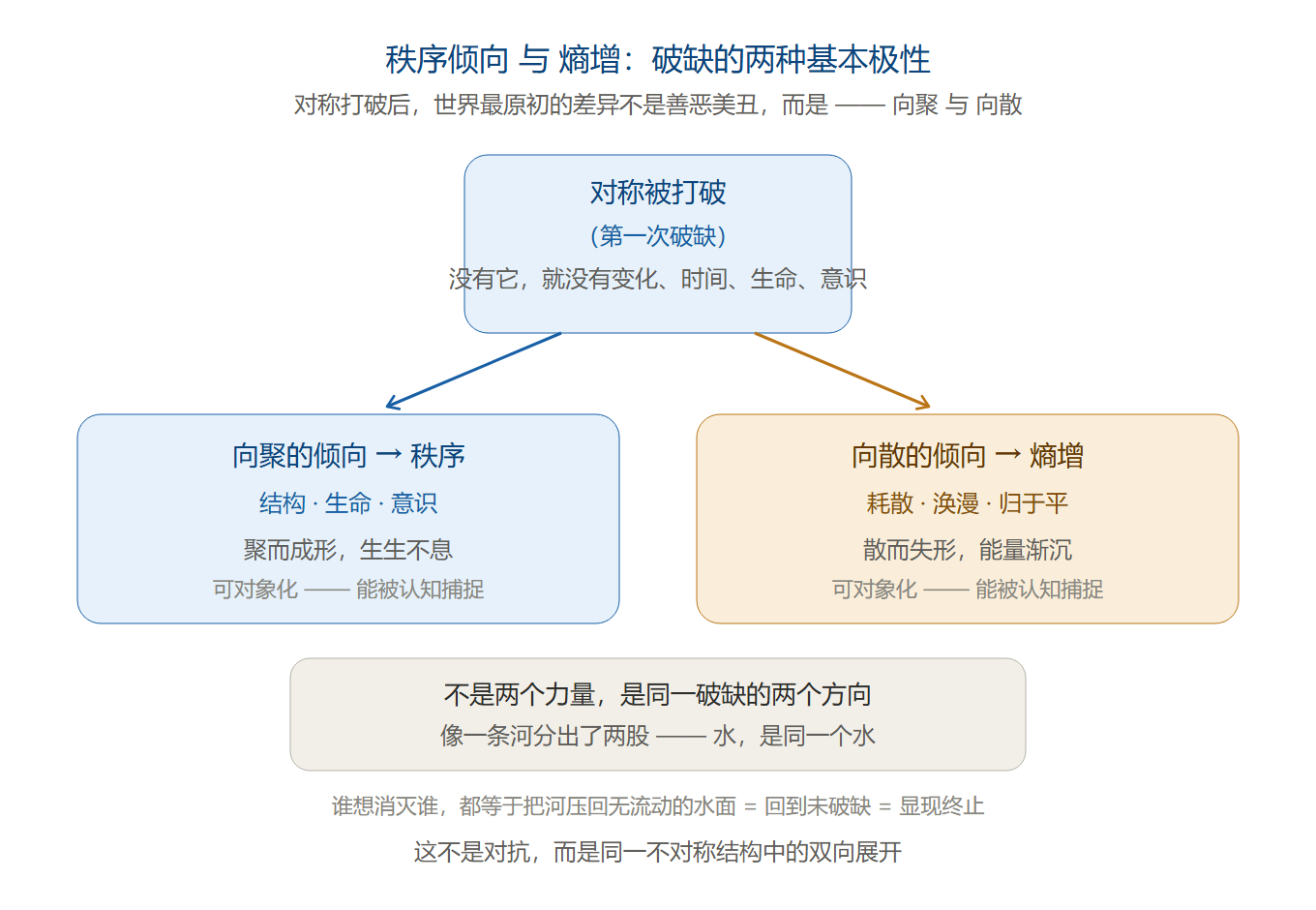
When symmetry is broken, the most original difference that first appears in the world is not good and evil, not beauty and ugliness, but:
tendency towards convergence
tendency to disperse
This is the tendency of order and the increase of entropy.
They are the two polarities that appear after breaking. Without them, there would be no change, no time, no life, and no consciousness.
But they are not two independent forces. They are two directions of the same flaw. It's like a river has two branches, but the water is the same water.
Therefore, the relationship between order tendency and entropy increase is not confrontation, butIn the same asymmetric structuretwo-way expansion。
Anyone who wants to destroy someone is equivalent to pressing the river back into a non-flowing water surface. That's impossible. That is back to unbroken. And once you go back, the manifestation ends.
4. The sense of asymmetry and the asymmetry of the "other side"
Why can we objectify the tendency of order and entropy increase, but not the "other side" of them?
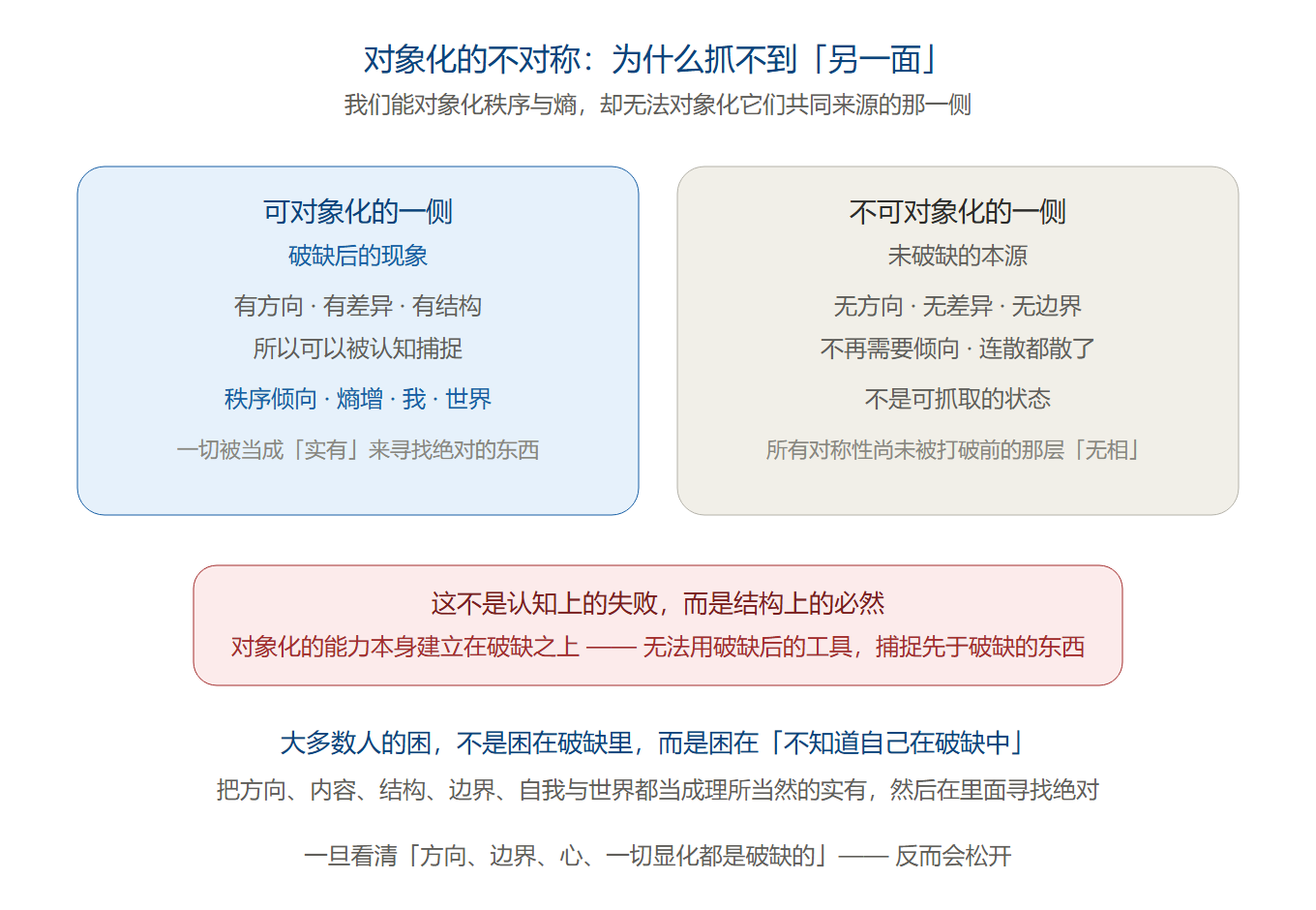
Because they are all products of destruction, with directions, differences, and structures, they can be captured by cognition.
And that "other side"-which no longer requires tendencies and even dispersed-is the unbroken surplus. It has no direction, no difference, no boundaries. It is not a state that can be grasped. It is the layer of "nothingness" before all symmetries have been broken.
Thus an asymmetry emerged:
The objectivizable side: the phenomenon after breaking
The non-objectified side: the unbroken source
This is not a cognitive failure, but a structural necessity:The ability to objectify itself is based on breaking flaws. You cannot use a post-defect tool to capture what precedes the defect.
V. Unveiled: Living Consciously in Destruction
This is not to make people deny phenomena and return to an imaginary perfection.
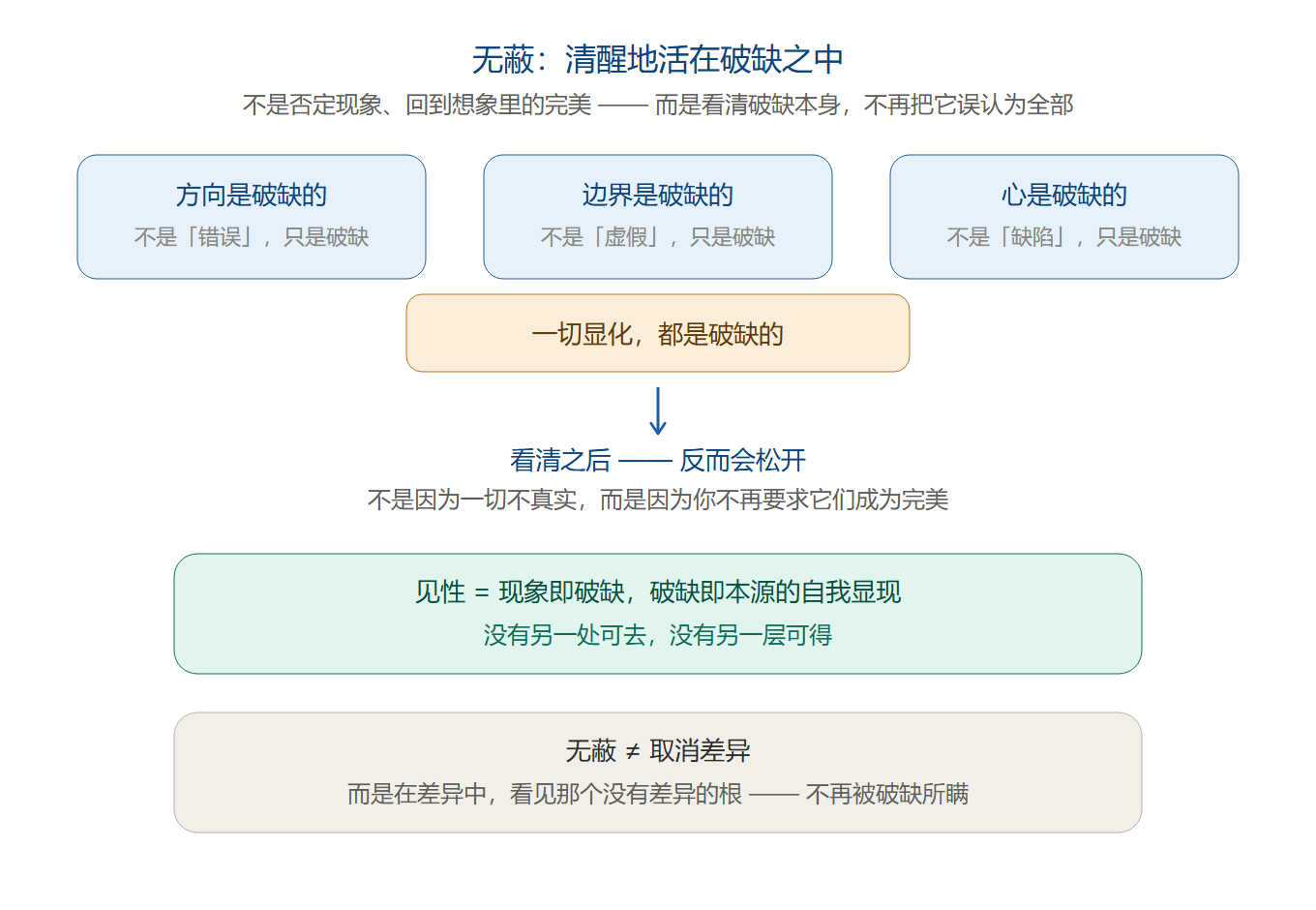
Instead: see clearly the defect itself and no longer mistake it for everything.
Most people are not trapped in a shortage, but trapped in "not knowing that they are in a shortage." They take direction and content, structure and boundaries, self and world as things that are taken for granted, and then look for the absolute in them.
Once you see clearly:
The direction is broken
Borders are broken
The heart is broken
All manifestations are broken
Instead, it will loosen up. Not because none of this is real, but because you no longer require them to be perfect.
Breaking is not terrible. The really heavy thing isLiving in ruins without knowing, I always want to make it symmetrical。
6. The structural meaning of visibility
At this point,"seeing nature" is not seeing a pure ontology. Instead, he saw:
Phenomenon is the breaking, and the breaking is the self-manifestation of the source.
There is no other place to go. There is no other layer available.
When you see this clearly, that moment is not back to unbroken, butIn the process of breaking the gap, no longer be deceived by the gap。This is called uncovering. It is not to cancel differences, but to see the root of no differences in the differences.
7. Conclusion
Breaking the parity of phenomena is the gentlest arrangement of existence.
It allows the world to be seen, allows us to experience, love, think, and return. But it also leaves a hole that is never symmetrical, so that all "things" cannot truly swallow "nothing".
Therefore, there is no need to repair the asymmetry of the world. It was never wrong.
You only need to see this in a quiet moment: see the direction, and also see the direction ahead; see the dispersion, and also see the dispersion ahead. Instead of dividing them in half, but in the broken spot, gently recognizing the root that has never been broken.
The world is alive precisely because it is asymmetrical.The reason why you can see is because you are already on this side.