abstract
This paper proposes "homology" as a phenomenological category that has not yet been fully named. The sense of harmony is not agreement of views, emotional resonance, or directional alignment. It is a primitive harmony between two beings that precedes direction, understanding, and language. It makes possible subsequent structural identification. Starting from the relationship between coexistence and direction, this paper demonstrates that homology is a phenomenological glimmer of coexistence and a weak manifestation in limited perception when coexistence is not broken. In contrast, directional alignment is the complete state of homology after structural recognition. The relationship between the two reveals the basic dynamics of WTO collaboration, interpersonal identification and idea dissemination: we start not with alignment, but with a sense of harmony. We do not understand first and then meet each other, but only in harmony can we produce a commonly recognizable direction.

1. Introduction: An Unnamed Experience
Two people had a first conversation. Neither one said much to each other. There is no consensus, no conclusion. But one of them suddenly felt: There is something here. I can't say what it is, but I know it is.
This feeling does not belong to the usual "understanding", nor does it belong to "emotional resonance", let alone "consistent views". It's lighter, earlier, fuzzier, and more real.
This article attempts to name this experience. I call this "sense of harmony."
The sense of harmony is not the intersection of two directions, but a primitive harmony that has occurred between two people present before the directions are unfolded. It is a glimmer of phenomenology, a gentle manifestation of coexistence in limited perception. Although it is rarely discussed individually, it is the entrance to all true collaboration, true identification, and true thought encounters among mankind.
2. The sense of harmony and coexistence: the light is revealed
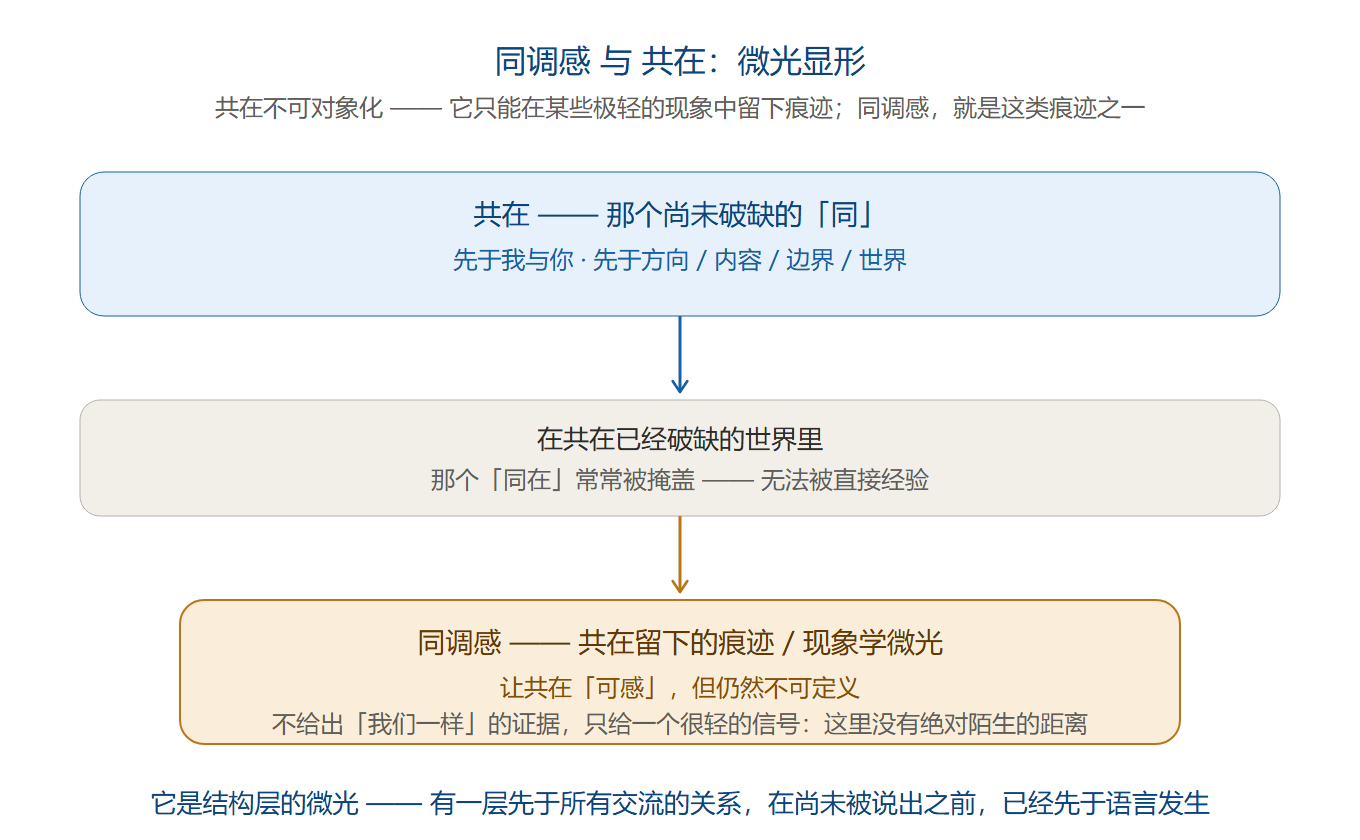
We cannot say if we are together. It precedes "I" and "you", precedes direction, content, boundaries, and world. Common existence is the same that has not yet been broken. Because it cannot be objectified, it cannot be directly experienced; it can only leave traces in certain extremely light phenomena.
The sense of harmony is one such trace.
When two people have not exchanged any specific information, but feel that "we seem to come from the same place," this feeling does not point to a common goal or a common emotion. It points to a lower-level "sameness": we are together. It's just that this "presence" is often concealed in a world where coexistence has been broken.
The sense of harmony makes co-existence perceptible, but it is still undefined. It does not give evidence that "we are the same", only gives a very light signal: there is no absolutely unfamiliar distance here.
This is why the sense of harmony is difficult to explain. Because it is not a feeling at the content level. It is the glimmer of the structural layer. It shows that there is a layer of relationship that precedes all communication that precedes language before it is spoken.
3. The sense of harmony is not emotional resonance, nor is it a consensus of views
In order to accurately define the sense of harmony, it must first be separated from several adjacent categories.
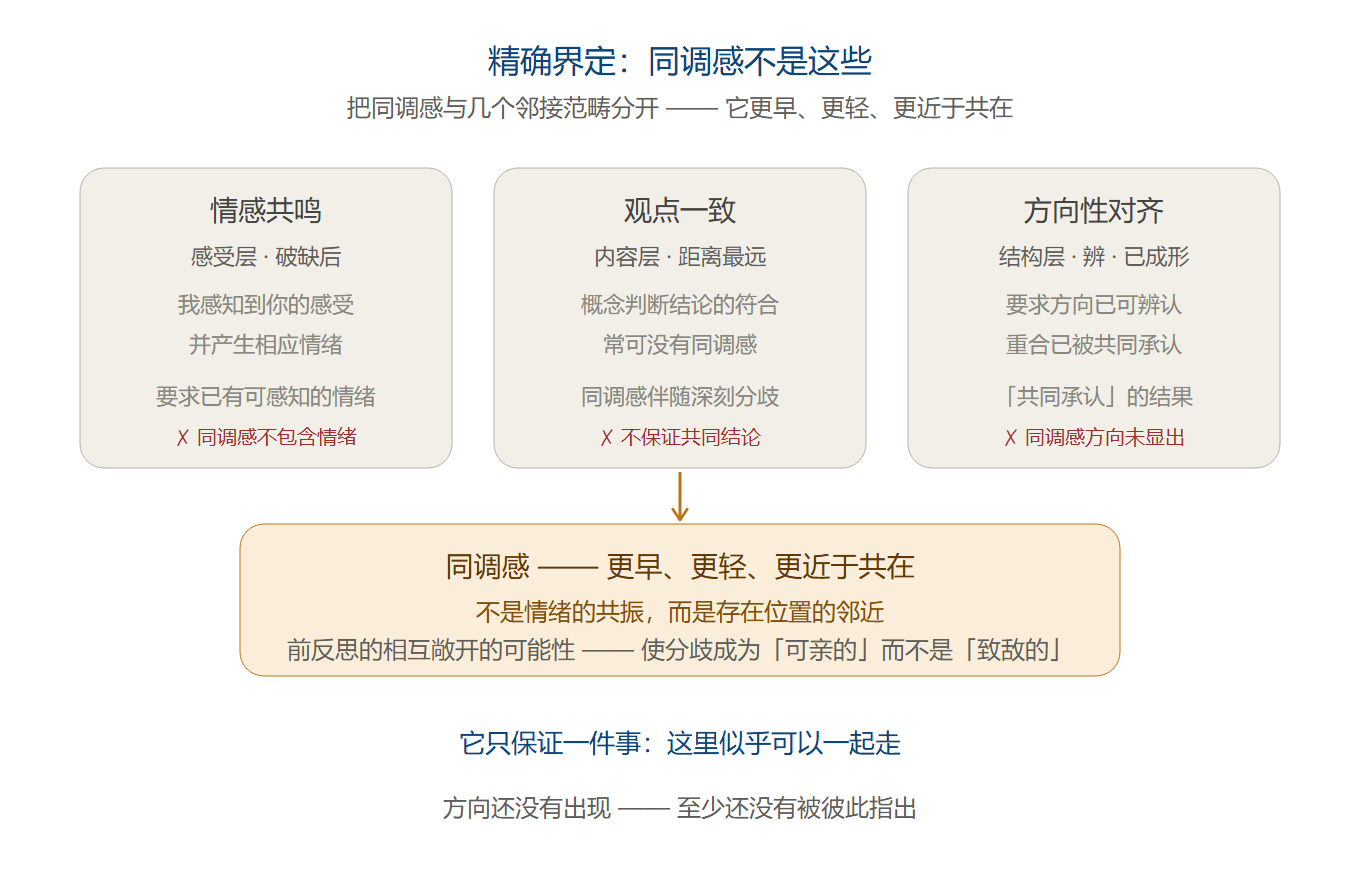
emotional resonance
Emotional resonance is "I feel how you feel and generate corresponding emotions as a result." It happens at the sensory level. The resonance requirement already has perceptible emotional content, so it belongs to a phenomenon after the defect is broken.
The sense of harmony is earlier. It does not necessarily contain emotions. Two people can be completely calm, without joy, sadness or eagerness, but still feel that "there is someone here with me." It is not a resonance of emotions, but a proximity of existence.
like-minded
Consensus of views is the consistency of concepts, judgments and conclusions. It belongs to the content layer and is the farthest away. Coherence of views often lacks a sense of harmony; a sense of harmony is often accompanied by differences of opinion.
A sense of harmony does not guarantee any common conclusion. It only guarantees that there is a possibility of mutual openness between the two. This possibility does not need to immediately become consensus, and may even eventually show deep differences. But it makes the differences themselves "amiable" rather than "hostile".
directional alignment
Directional alignment is more structured than sense of harmony. It requires that there are already identifiable directions and that the overlap between them has been seen together to some extent. Directional alignment is the result of "common recognition": we do not just feel in tune, but have jointly confirmed the direction.
The sense of harmony still stays at the feeling of "it seems that we can walk together". The direction has not yet emerged. At least the direction has not been pointed out by each other.
4. Sense of homology and directional alignment: the order of sense and discrimination
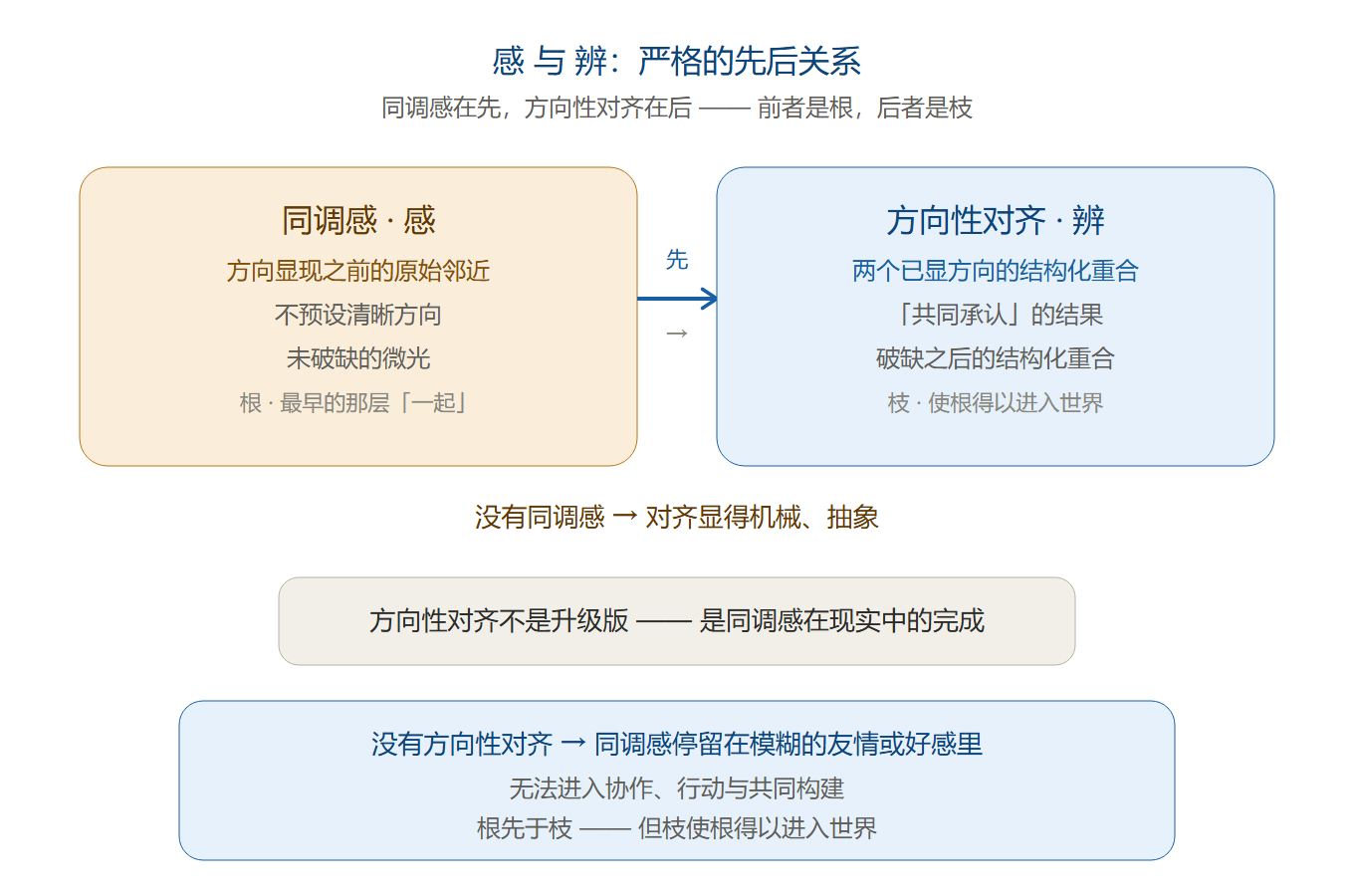
Directional alignment is the coexistence of directionality. It is the state of two already apparent directions that are jointly recognized structurally.
The sense of harmony is different. It is not the alignment of two directions, but the original proximity of two people present before the directions appear. It does not assume that both sides already have clear direction. On the contrary, a sense of harmony often appears when the direction has not yet been finalized. It is the earliest layer of "together".
Therefore, the two have a strict sequential relationship:
The sense of harmony comes first, and the alignment comes second.
The sense of harmony is feeling, and the directional alignment is discrimination.
The coherence sense is the unbroken light, and the directional alignment is the structured overlap after the break.
Without a sense of homology, directional alignment will appear mechanical and abstract. Without directional alignment, the sense of harmony may always stay in vague friendship or goodwill, and cannot enter into collaboration, action and joint construction.
Directional alignment is not an upgraded version of the sense of harmony, but the completion of the sense of harmony in reality. The former is the root and the latter is the branch. Roots precede branches, but branches allow roots to enter the world.
5. The operation of the sense of harmony: early, light, and unsummoned
The most remarkable feature of the sense of harmony is that it is not called upon.
We can't decide: I want to feel the same at this moment. The more actively it is pursued, the less it appears. Because the pursuit is already under exertion, and exertion just destroys the "aimless proximity" of common existence.
The sense of harmony occurs under certain conditions of restraint. It often appears at a time when there is no performance, no persuasion, and no much explanation. At this time, neither one is trying to project their own direction to each other. Because of this, the original fellow talents can briefly emerge.
The sense of homology always comes first "before we start pointing structures at each other." It is the first trend of joining the WTO.
6. Significance of cooperation on WTO accession
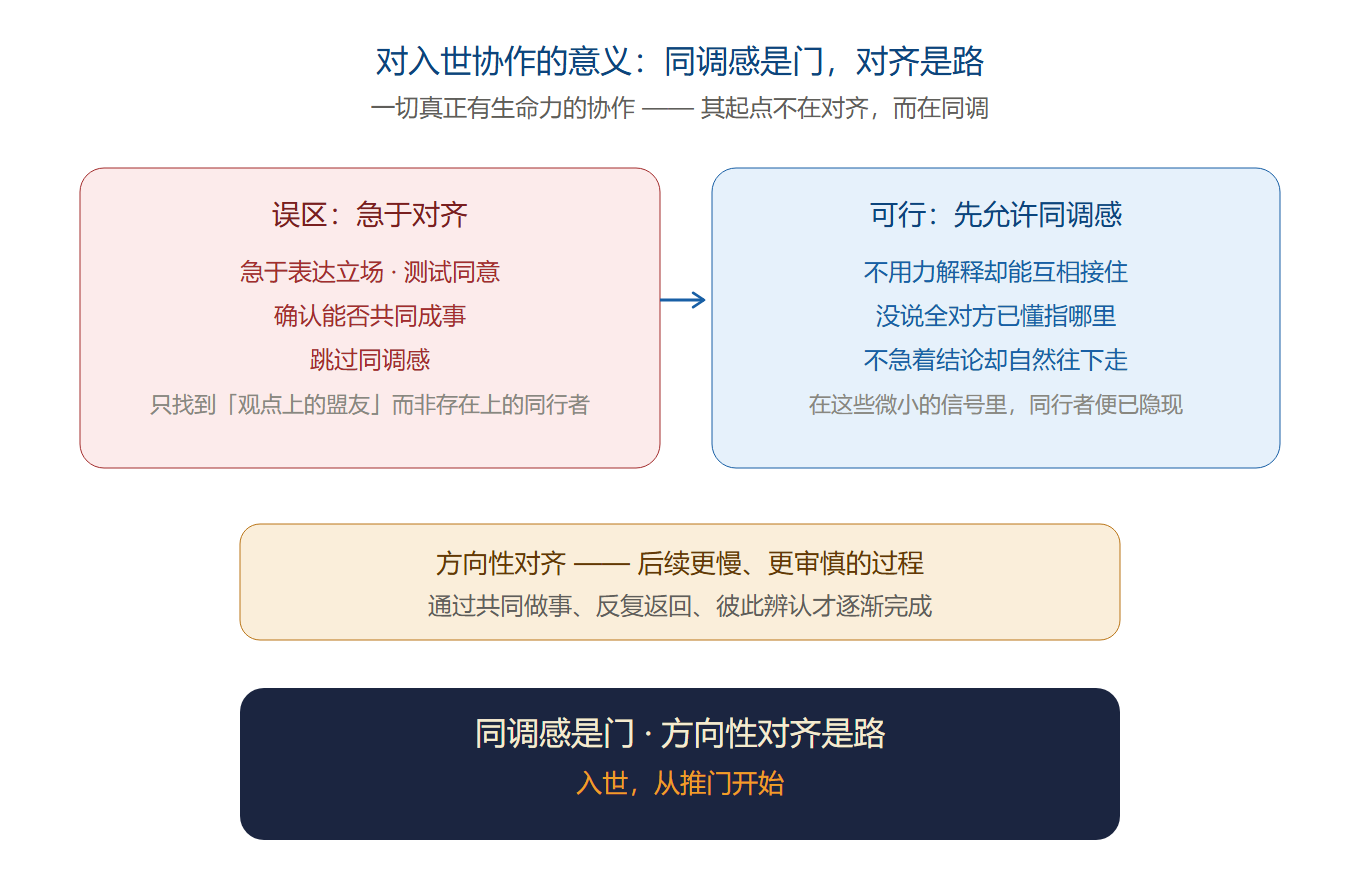
If the sense of harmony precedes directional alignment, then the starting point of all truly viable collaboration is not alignment, but harmony.
One myth is that looking for peers is the same as looking for people who are in the same direction. So we are eager to express our position, to test whether the other party agrees, and to confirm whether the other party can achieve things together. This will just skip the sense of harmony, enter into directional judgment too early, and ultimately only find "allies in perspective" rather than "peers in existence."
The real feasible path is to allow the sense of harmony to occur first. It expresses itself as:
There is no hard explanation in a conversation, but we can catch each other
One person didn't say everything, but the other person already knew where he was pointing
Each other is not in a hurry to draw conclusions, but they can move forward naturally
In these tiny signals, the companions are already hidden. Directional alignment is a slower and more prudent process. It is gradually accomplished by doing things together, returning repeatedly, and identifying each other.
The sense of harmony is the door. Directional alignment is the way. WTO accession begins with pushing the door.
7. Conclusion: Glow light is the door
Harmony is not something that can be capitalized, spread, or institutionalized. It is not like directional alignment, which can be written into agreements, turned into systems, and entered into projects. It is too light, too early, too close to being together.
But it's where co-identifiers first appeared.
When we are no longer eager to judge whether the other person is on the same road as me, but are willing to stay in a very light feeling of "there seems to be something between us", we make it more possible for us to be seen together.
That shapeless coincidence is the first path for the world to return from "you and me" to "us". It cannot replace directional alignment, but it is the root of all true alignment.
The sense of harmony is the layer of light that penetrates into the world together. See it clearly not to analyze it, but to stop missing it.