abstract
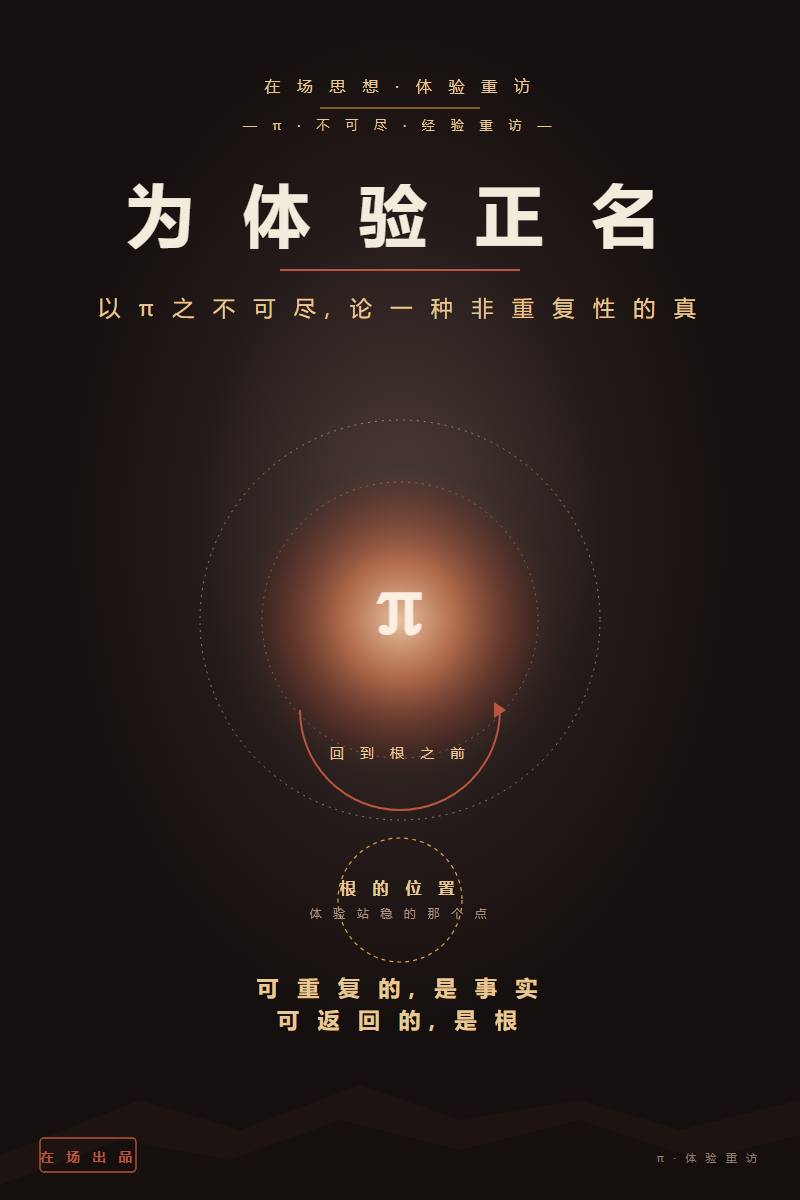
Modern epistemology elevates "repeatable and verifiable" to the only form of knowledge. Everything that cannot be verified repeatedly is downgraded to "subjective","unscientific" and "unreliable". Experiences, especially those that truly touch people, change people, and reconnect people with life, have long been lacking in status. This article attempts to use the inexhaustible nature of π to justify a more ancient insight: certainty does not mean that it can be said all; truth does not mean that it can be repeated.π is a definite number, but it cannot be fully expressed in a finite form. Experience is a real touch, but it cannot be replicated through scientific experiments. This article is not to deny science, but to draw a clear delineation of its boundaries and, beyond the boundaries, rediscover a path of certification for experience that does not require "repetition". This road is "return". Science proves truth through repetition, and root system distinguishes truth through return. If an experience can bring people back from chaos, return to righteousness from drift, and touch the unbroken line again from isolation, it is in its place and it is true.
1. The boundaries of science
Science is extremely powerful. It makes the world measurable, calculable, and predictable. Its power comes from one foundation: repeatability.
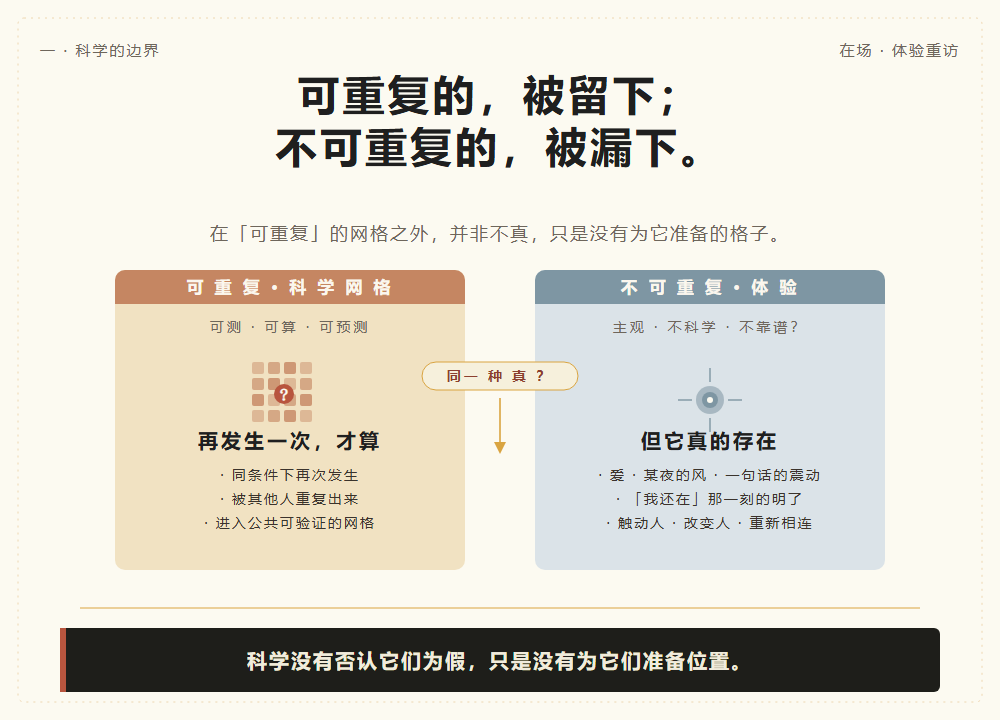
A result must occur again under the same conditions before it can be accepted. One person's observations are not enough and must be repeated by others. An experience cannot become scientific fact unless it enters a public verifiable grid.
There is certainly nothing wrong with this.
But the problem is: when "repeatability" is regarded as the only criterion, everything that is not repeatable is pushed to the "less true" side.
Love cannot be repeated. The wind of a certain night cannot be repeated. The shock when a person hears a certain sentence for the first time cannot be repeated. The experience of a life suddenly feeling "I am still here" at a certain moment cannot be repeated.
They are not false because of this. They just can't be caught by the science grid.
2. Enlightenment of π
π is an extremely strange number.
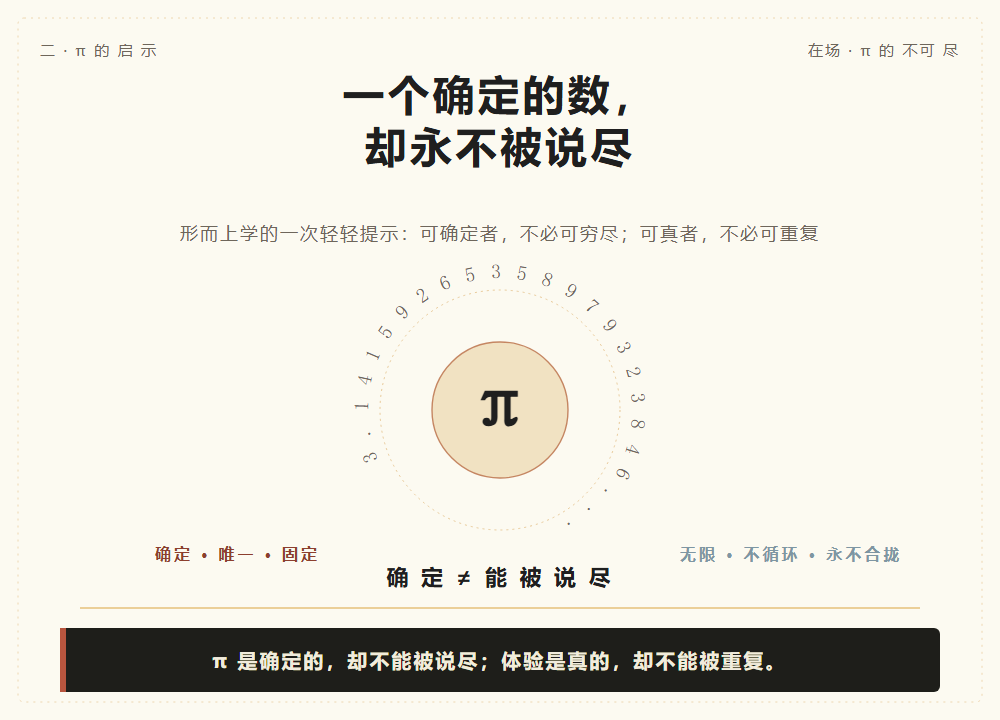
It is certain. It's not random, it's not subjective, it's not "different opinions". Any civilization that calculates pi will get the same 3.1415926...
But it doesn't say enough.
It cannot be written all in a fraction, a finite decimal number, and a finite formula. It is always unfolding, always has a new digit, and never returns to itself.
π is certain but inexhaustible. Pi is real, but it cannot be said enough.
This is a mathematical fact. But it is also a metaphysical reminder:Those who are certain,No needExhaustive; true,No needRepeat.
If there is such a thing in mathematics, why can't experience it?
3. The experience is not "untrue", but "inexhaustible"
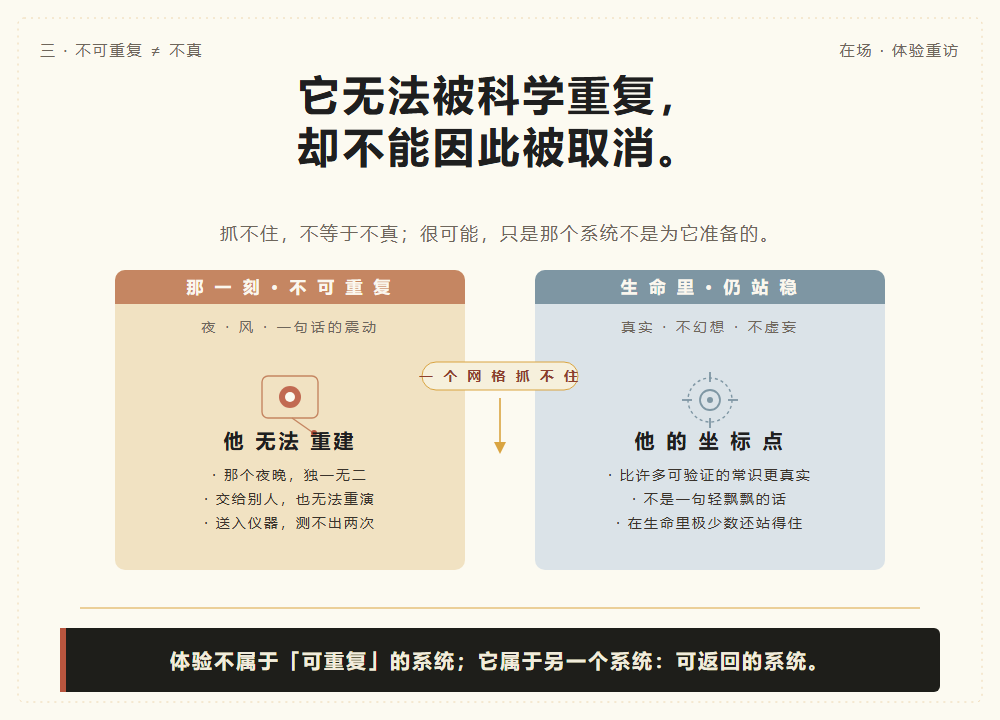
When a person said,"That night, I suddenly felt like I was back." This experience cannot be repeated.
He couldn't rebuild that night.
He couldn't give it to another person for repetition.
He couldn't put it in the instrument and measure it twice.
But in his life, it was certain.
It is more true than many verifiable common sense. It is not an illusion, it is not an illusion, it is not a light word. It is one of the few points in his life coordinates that can still stand.
Such an experience cannot be repeated by science, but it cannot be cancelled.
π tells us: If something cannot be completely grasped by you with a certain system, it does not necessarily mean that it is not true, but it may well mean that the system is not prepared for it.
Experiences are not "repeatable" systems. It belongs to another system: the returnable system.
4. Use return instead of repetition
Science uses repetition to verify a fact. The root system uses rollback to verify an experience.
This is not a soft word. This is a completely different structure.
In science, a result has to be repeated again before it is counted. Here in the root system, an experience does not need to be repeated. It only needs to be recognized by you and taken you back after you have walked many roads and missed many times.
For example:
A person once felt that he could not be separated in the extreme silence.
Later, he got busy, left, and forgot.
One day, he felt a little still again.
He couldn't say "which time had proved it." But he recognized it: it was still there.
This is return. This is how to experience yourself.
It does not rely on reproduction, it relies on recognition.

5. How to distinguish between true and false experiences
Of course, just because "the experience is real" cannot slide into the other pole: all experiences are real, and all feelings cannot be questioned.
No. Experience also requires recognition.
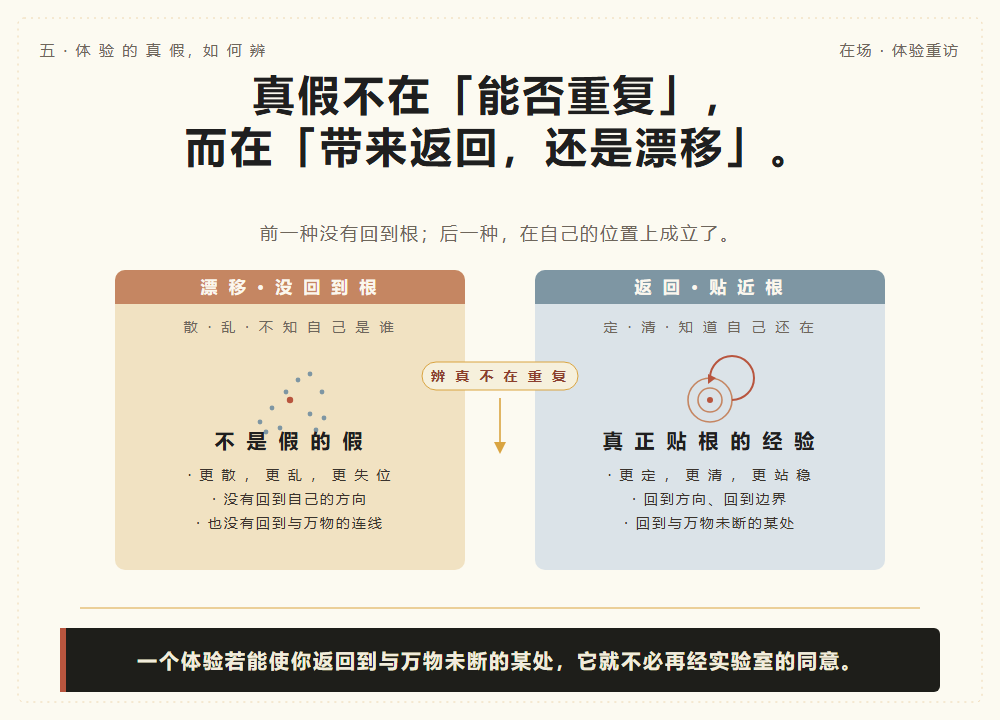
However, its true or false lies not in whether it can be repeated, but in whether it brings return or drift.
Some experiences make people feel more scattered, more chaotic, and less aware of who they are.
Some experiences make people more calm, clearer, and more aware that they are still there.
The former is not true or false, but it has not returned to its roots. The latter is the experience that is truly close to the roots.
An experience that brings you back-back to direction, back to boundaries, back to somewhere where you and everything have not been broken-is in its place. It no longer requires the consent of the laboratory.
6. Framework for justifying experience
Therefore, to justify experience is not to oppose science. It's about giving the experience a suitable place.
Scientific responsibility is "repeatable". The root system is responsible for "returnability".
Two truths. Two verifications. Two worlds.
Repeatable truth, dealing with external objects.
You can return to the truth and deal with life.
The certainty and inexhaustible nature of π just provides an extremely stable fulcrum for the latter:
Being inexhaustible does not mean that it is not true. Being unrepeatable does not mean that it is untrustworthy. It's just not the kind of thing you can write all at once.
The same goes for the experience.
It cannot be exhausted. It cannot be copied. It cannot be checked. But it appears over and over in time, and is still there every time a person returns.

7. Conclusion
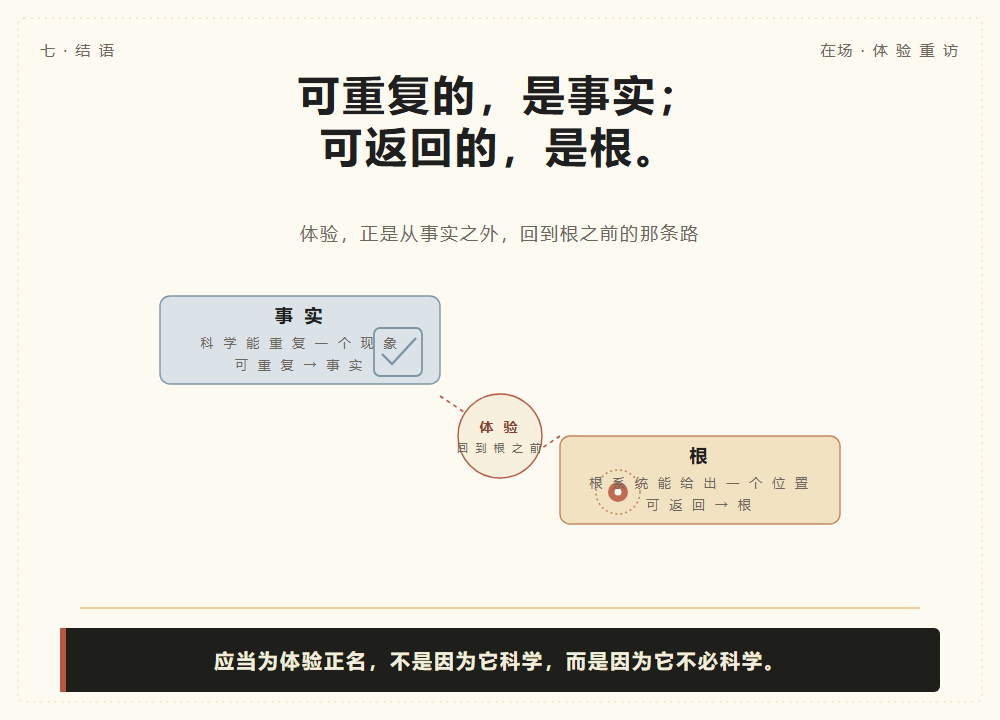
Science can repeat a phenomenon, but it cannot repeat the deepest moments of life. The root system cannot give a repeatable formula, but it can give a return position.
π is certain but inexhaustible. The experience is real and non-repetitive. What they have in common is that they are above everything that can be fully expressed.
Therefore, experience should be justified, not because it is scientific, but because it does not need to be scientific. Its truth is not in repetition. It's true, in return.
What is repeatable is the truth.What can be returned is the root.
And experience is the way from outside the facts to back to the roots.