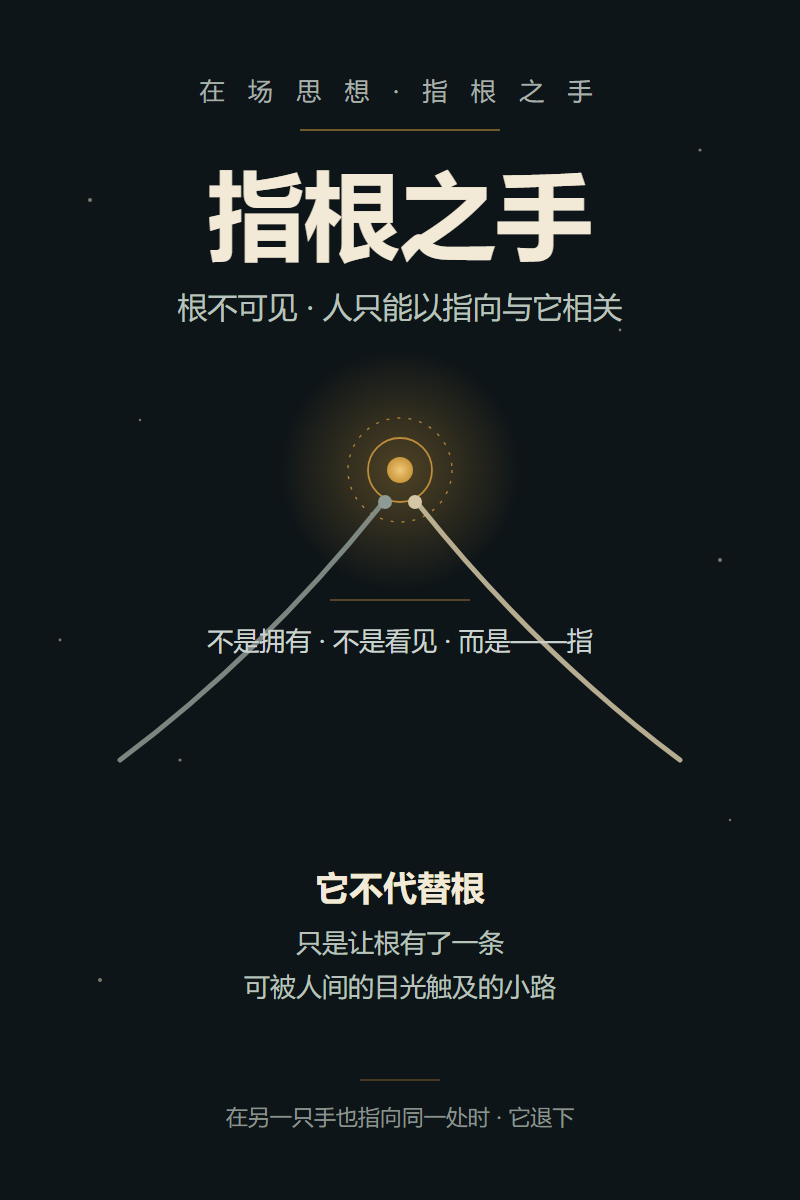
abstract
The roots are invisible. Roots do not enter any concept, structure or text. But people cannot help but speak and leave a direction in the world. Therefore, all discourse, models, systems and practices about roots can only become the "hand pointing to the roots." The finger is not the moon or the root, but it makes seeing possible. This article redefines the concept of pointing from the perspective of manifestation rather than possession, distinguishing three levels of indications-fingers, paths, and names-and reveals how each indication can both bring people closer to the roots and involve the risk of obscuring the roots. In the end, the "hand of the root" embodies a double paradox: it must exist, because the root cannot be grasped; it must not be mistaken for the root, because then the root is lost. The article finally pointed out that the finger borrows direction from the root, and its highest destination is not to be regarded as the root, but to silently disappear when others look back.
1. Why is it the "hand of the root"
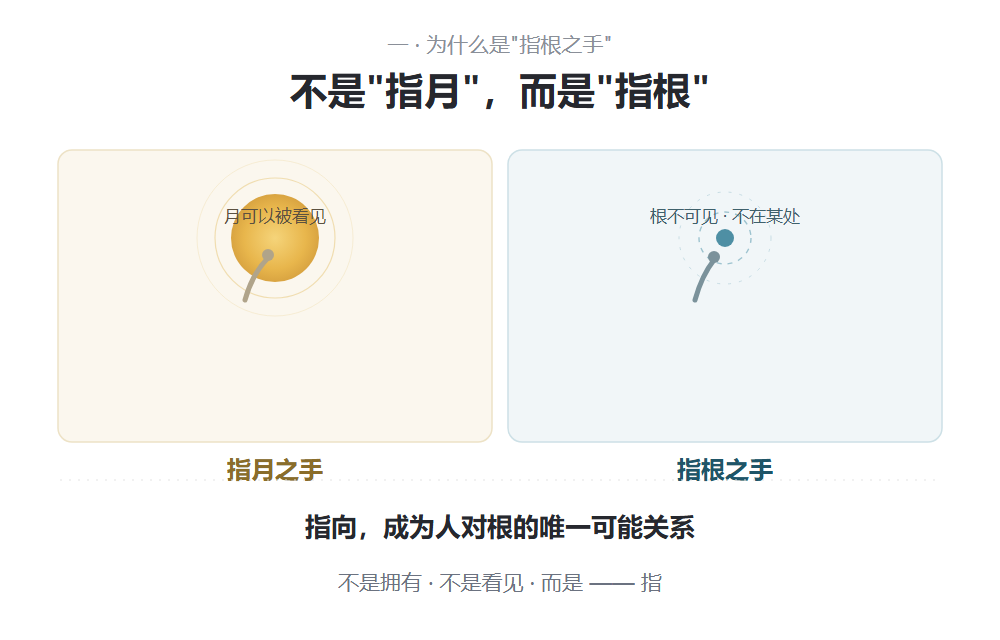
Many intellectual traditions use the metaphor of the "hand pointing to the moon": words and teachings point to the truth, but not the truth itself. After seeing the moon, there is no need to stare at your fingers.
But "root" and "moon" are different. After all, the moon can be seen as an object. The roots are invisible. It is not in the sky, not somewhere, not at the end of any direction.
Therefore, the "hand pointing to the moon" still retains a hope: one day you can put down your fingers and see the moon. The "hand with the root" is more thorough: you can't let go of your finger because the root has never been a visible object; but you can't grab the finger because the root is not there.
Thus, the point becomes the only possible relationship between people and roots. Not to have, not to see, but to mean.
2. The direction is not occupation
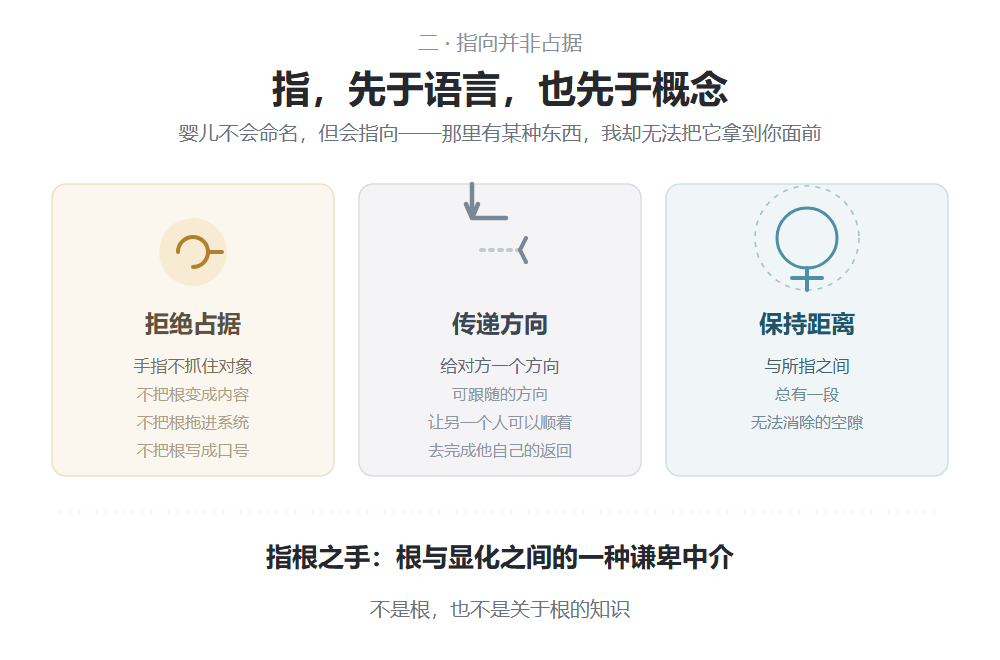
It means that this action precedes language and concept. Babies will not name them, but will point to them. The direction shows: There is something there, but I can't get it to you.
The philosophical significance of the point is that it contains three things at the same time:
Refuse to occupy: Your fingers do not grasp the object.
transfer direction: Give the other person a direction to follow with your fingers.
keep a distanceThere is always a gap between the finger and the finger that cannot be eliminated.
The "finger root" is exactly that. It does not turn roots into content, it does not drag roots into systems, it does not write roots into slogans. It simply deflects gently in one direction, allowing the other to follow that direction to complete his own return.
Therefore, the hand that points to the root is not the root, nor is it knowledge about the root. It is a humble intermediary between root and manifestation.
3. Three instructions: fingers, roads, naming
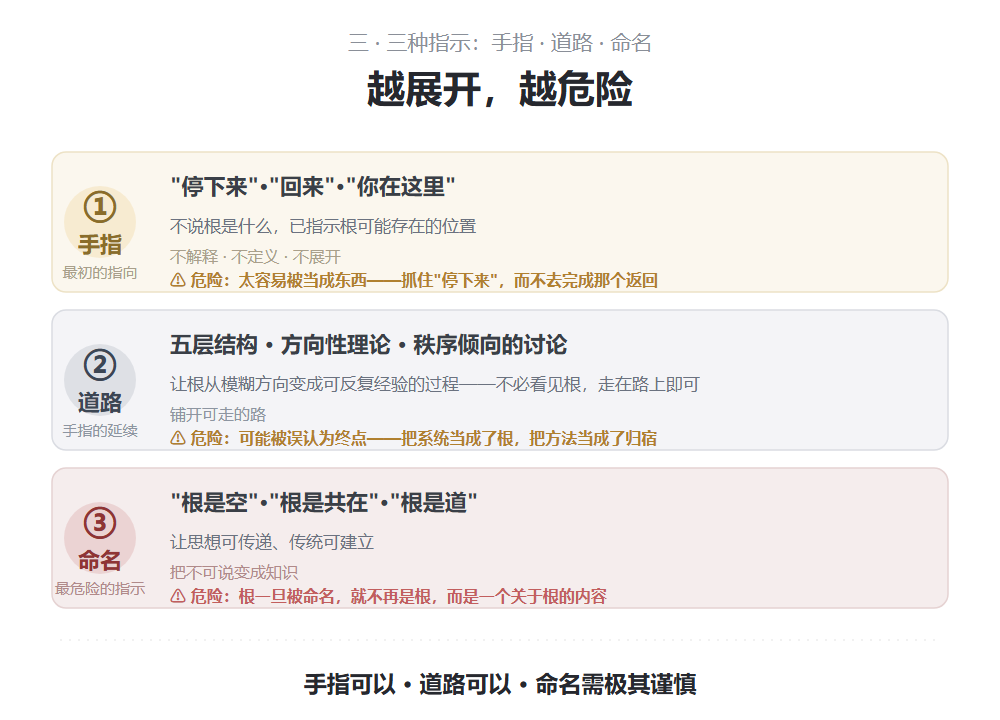
Instructions related to roots can be divided into at least three levels:
1. finger
The finger is the original point. It does not explain, does not define, and does not expand. It just said: Here.
At this level, the words "stop","come back" and "you are here" can all become fingers. They do not define the root, but they already indicate where the root may exist.
The danger with fingers is that they can easily be treated as things. People will grab the word "stop" instead of completing the return.
2. road
The path is the continuation of the fingers. It doesn't just point out a point, but pave a way to go. The five-level structure is the way, the directional theory is the way, and the discussion of order tendencies is also the way.
The value of the road lies in that it turns the root from a vague direction into a process that can be experienced repeatedly. People don't need to see the roots, just need to walk on the road to indirectly feel that they are closer to the roots.
The danger of the road is that it may be mistaken for the end. Many people stop on the road, regard the system as the root and the method as the destination.
3. named
Naming is the most dangerous instruction.
When people say that "the root is emptiness","the root is co-existence" and "the root is the Tao", this is already the name. Naming has great power. It allows ideas to be passed on and traditions to be established. But naming also carries great dangers. It turns the unspeakable into a form of knowledge.
Once a root is named, it is no longer a root, but a content about the root.
Therefore, the "hand at the root of the finger" must simultaneously see the propriety of these three instructions: the finger can, the path can, and the naming must be extremely cautious.
4. Where does the pointing hand get the direction?
If the root is invisible, how can the hand know where to point?
A paradox must be admitted here: the direction of the hand is not obtained directly from the root. Because roots do not give any recognizable signal.
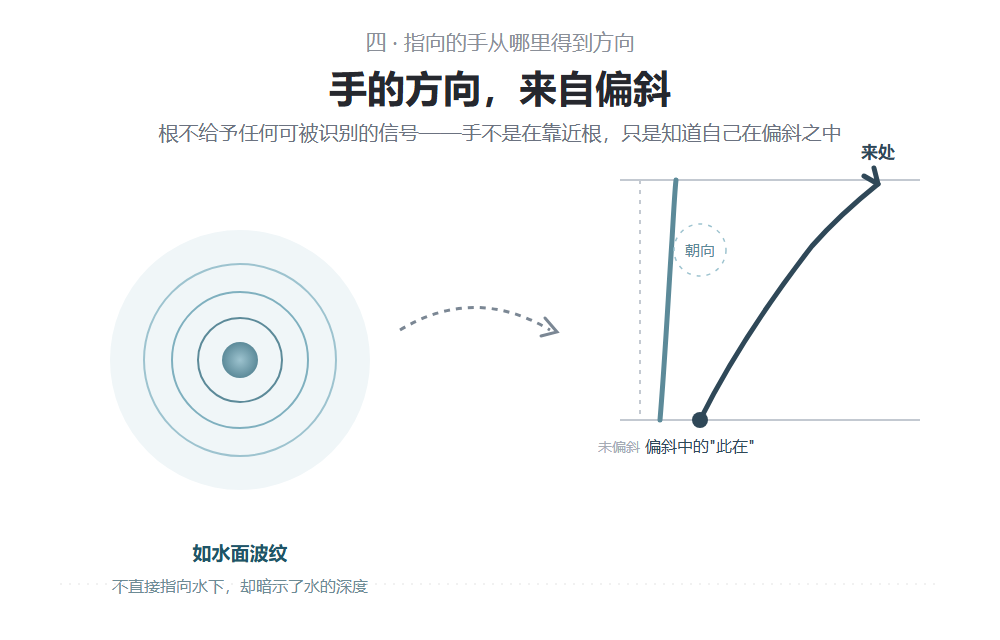
The direction of the hand comes from deflection.
Dasein is already a deviation of co-existence. This deflection gives the hand a "direction". The hand does not start from the root and point to the root. The hand was in the midst of deflection, and I vaguely felt that I had not completely left my roots, so I headed towards the "place where I came from."
It's like ripples on the water. They don't point directly into the water, but suggest the depth under the water. It is not pushed from underwater to the surface, but after the water is disturbed, the ripples find the invisible force themselves.
Therefore, the "hand pointing to the root" is no closer to the root than the person. It just knew that it was already in the midst of deflection and did not give up the weak urge to "go back".
5. The boundary to which you point: point but not say, point but not stop
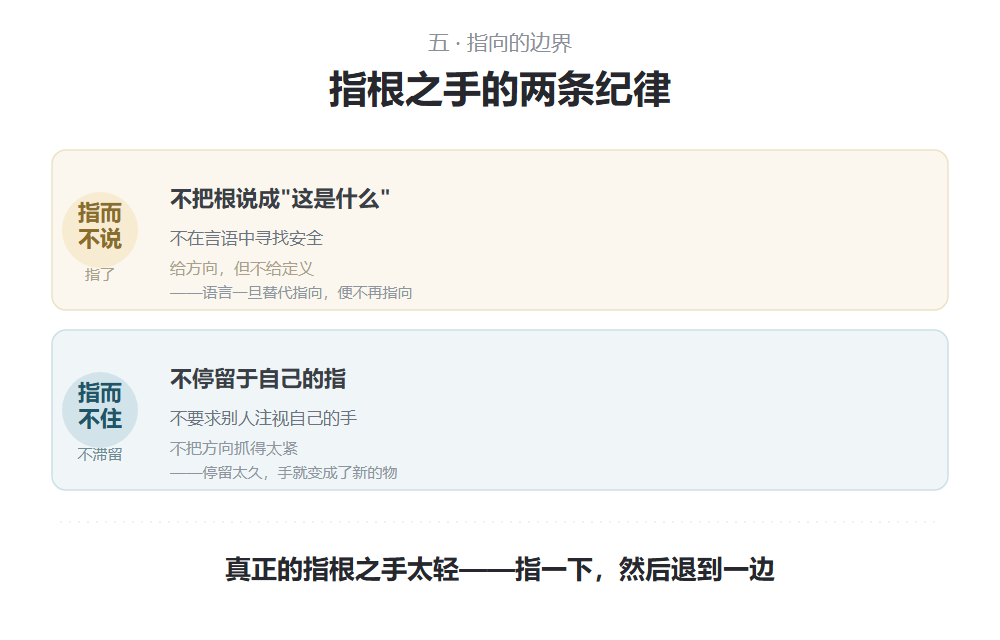
The true hand at the root of the finger does not seek safety in words. It points and stops. Point and let go.
If you pause on a concept for too long, your hand becomes a thing. If you hold the direction too tight, your hands become new roots.
Therefore, the Hand of Roots has two disciplines:
Point without saying: Point, but don't say the root as "what is this?"
can't stop pointing: Point, but don't stop at your own fingers and don't ask others to look at your hand.
This is why many real fingers go unnoticed. They're too light. They don't want to be seen or remembered. They just point and step aside.
6. The roots appear through the hands, but do not advance
Here is an important structural distinction:
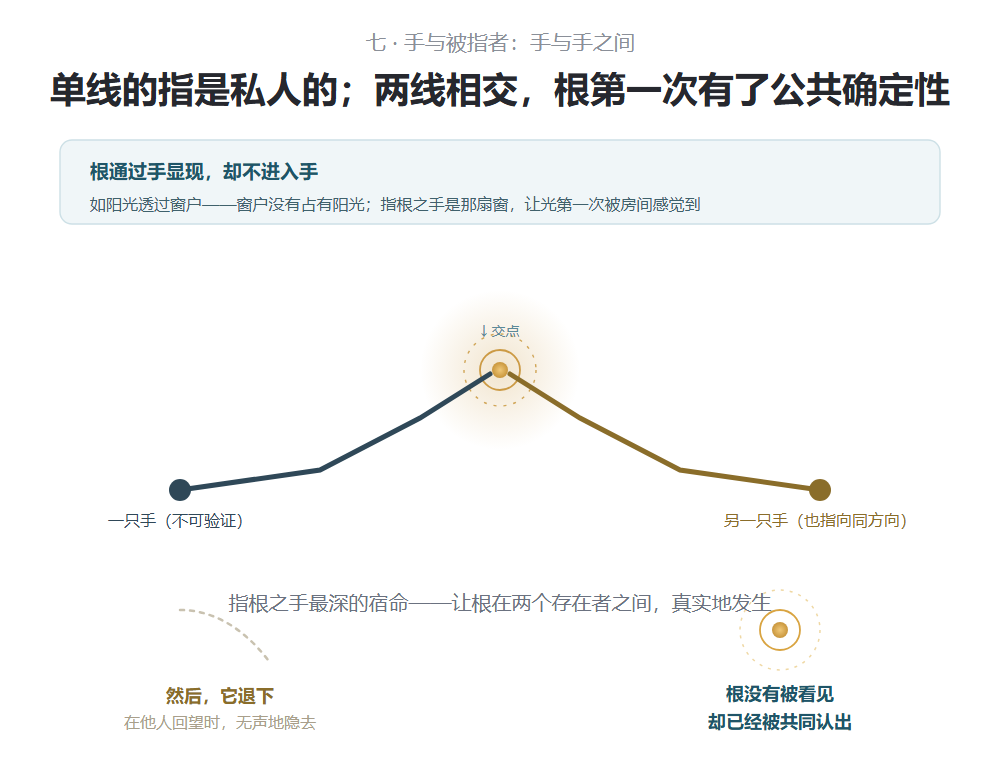
Roots appear through the hand, but not in the hand. The fingers were borrowed, but the fingers did not get anything rooted.
It's like sunlight entering a room through a window, but the window doesn't occupy sunlight. The windows just let light through. Light does not become a window because of a window.
The finger is the window.
The purpose of its existence is not to become light or possess light, but to allow light to be felt by the room for the first time.
7. The hand and the pointed person
"Hand at the root of the finger" also contains a relationship that is often ignored: hand to hand.
One hand points to the root and cannot be verified. The root is invisible and cannot be proved correct. But if there is another hand pointing in the same direction, the intersection appears.
This is why "at least two lines" must be present in the structure of manifestation: the "finger" of a single line is always private; only when the two lines intersect does the invisible position gain public certainty for the first time.
Therefore, the "hand at the root of the finger" has never been a lonely hand. It's waiting for the other hand.
When the other hand also extends out of its own deflection, they point to the same position. At that moment, the roots were not seen, but they were already recognized together. And it was at that moment that the deepest destiny of the "Hand of the Root" was completed:
Not to become the root, but to let the root truly occur between two beings for the first time.
8. Conclusion
The hand pointing to the root is not a theory about the root, a tool about the root, and it is not a root.
It is an action that people are still willing to do after the roots are invisible, unspoken, and unowned. This action creates nothing and proves nothing. It just gently gives another person a direction to turn back.
Where does the root hand come from? Come from deflection. What does the finger hand do? Point without saying. Where does the finger hand go? When the other hand points in the same direction, it steps back.
This is the whole meaning of the root hand:
It does not replace roots. It just gives the roots a path that can be touched by human eyes.
The most extreme thing about the "hand at the root of the finger" is that when people really look behind it, what they see is never the hand. It is the invisible "presence" that the hand points to, but never leaves.