abstract
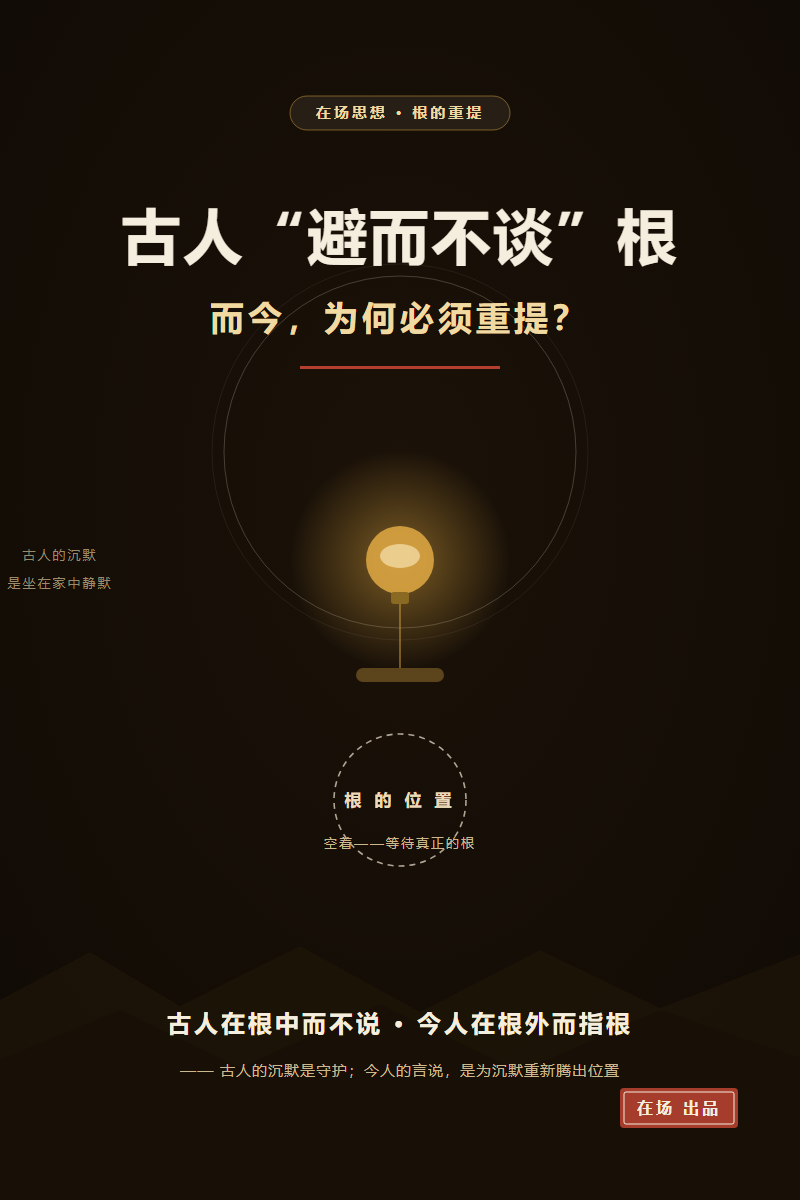
Confucianism, Buddhism, and Taoism are at the extreme and do not speak directly about their roots. Confucianism ends in heaven, Taoism strongly calls it Tao, and Buddhism talks about emptiness and immediately sweeps away emptiness. This kind of silence is often understood by modern people as the limit of thought or a mysterious reservation. This article attempts to demonstrate that the ancients "avoided talking about it" was not because the roots could not be said, but because the roots were already in their living world and there was no need to be said. The existence of etiquette, Tao, and practice itself constitutes the protection of the roots, so not saying is not forgetting, but protecting. However, in a modern situation where roots have disappeared from daily life and technological systems have begun to pretend to be roots,"not saying" is no longer an automatic guard. It can become a deeper forgetting. The reason why the Root System talks about "cannot talk about" is not to offend the silence of the ancients, but to make room for "cannot talk about" in an era when silence is no longer understood. The silence of the ancients was sitting silently at home; the words of today's people are turning back and pointing the way after leaving home.
1. Not saying the same thing has different meanings
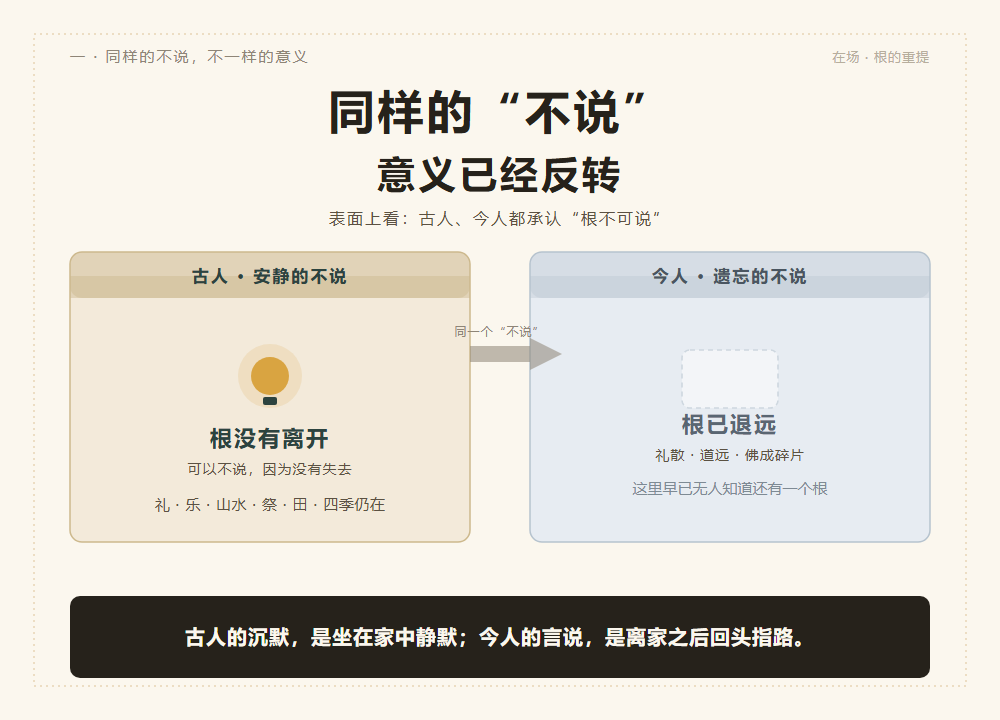
On the surface, both ancients and modern people admit that the roots cannot be said.
But in fact, there is a deep ditch between these two types of "not saying".
The ancients did not say anything, but they did not say quietly. Their lives are still full of etiquette, music, mountains and rivers, chanting, sacrifices, fields and four seasons. Roots did not leave them. They don't have to say because they have not lost.
What people do not say today is what they forget. Rites have dispersed, Tao has gone far, and Buddha has become a cultural fragment. Roots are no longer in daily life. Not saying that it no longer means guarding, but means that no one here knows that there is a root there.
Therefore, the same silence has reversed its meaning.
2. Why did Confucianism, Buddhism and Taoism avoid talking about it?
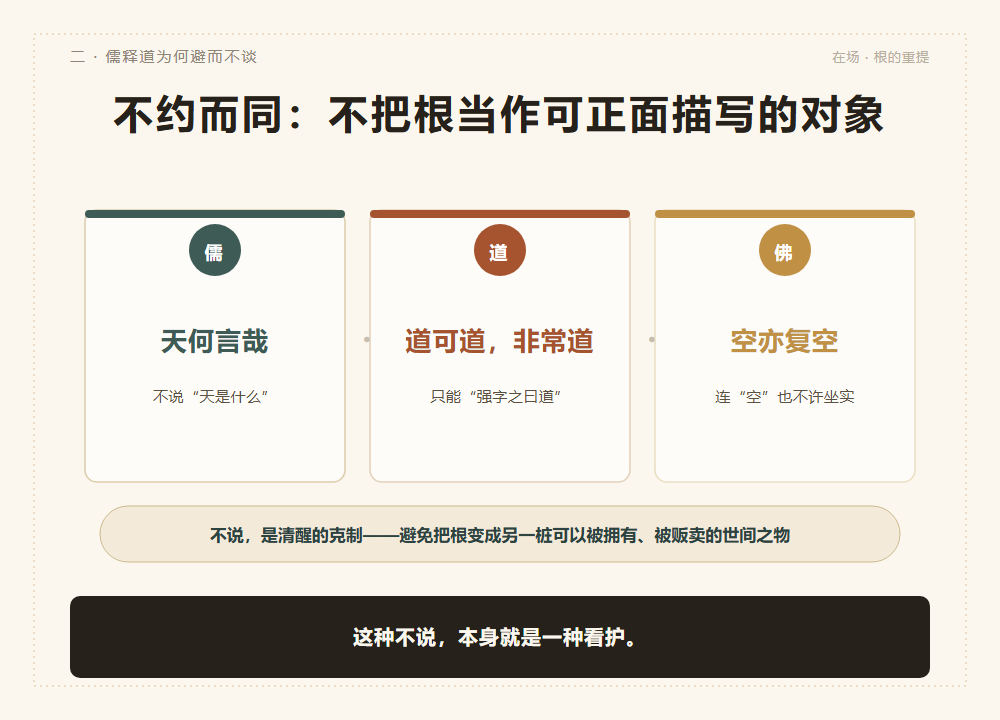
The three schools unanimously did not regard roots as an object that could be described positively.
Confucianism says,"What does heaven say?" Not "What is heaven?" Daoists say that "Tao can be Tao, but it is not Tao", so they can only "strongly call it Tao." Buddhism says that "emptiness is also emptiness", and even "emptiness" is not allowed to be true.
This is not a failure of theory, but an extremely sober restraint. Because the root is not an "object", not an "entity", not a "truth". Once it is said to be some kind of "yes", it is relegated to something that can be owned, modified, and sold.
Therefore, the three families '"not saying" is not to hide anything. It is avoiding turning the root into another worldly thing.
This kind of not saying anything is itself a kind of care.
3. Why were the ancients qualified to not say anything
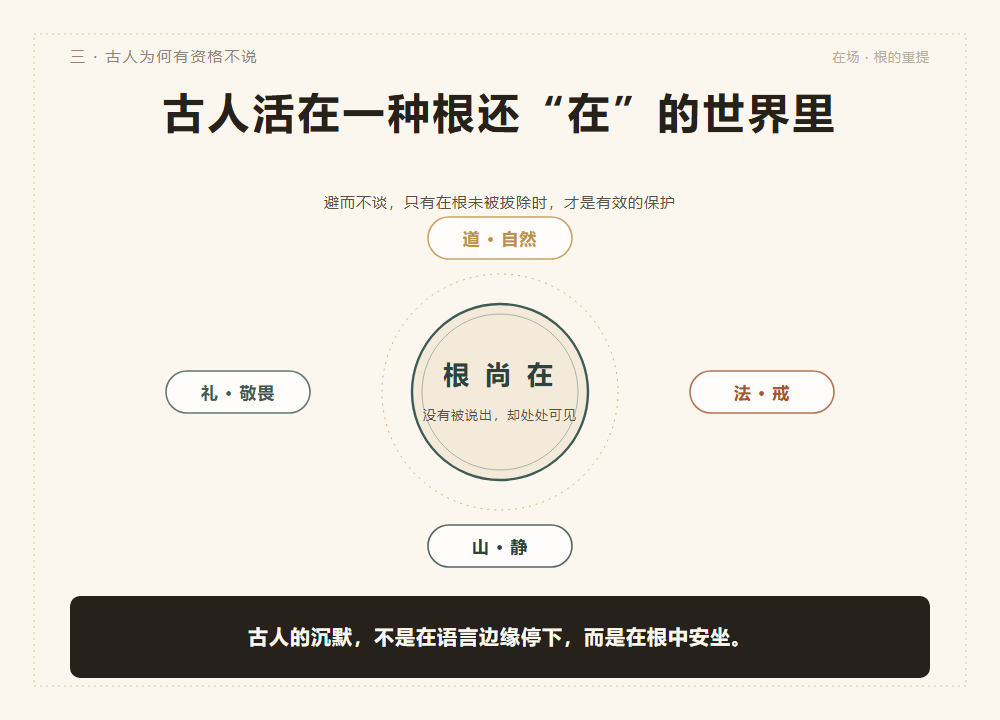
Avoiding it is only effective protection if the roots have not been completely uprooted.
The ancients lived in a world where the roots were still "there".
Rites are still there, so people still know how to be in awe;
The Tao still exists, so people still know nature;
The law still exists, so people still know the precepts;
The mountains are still there, so people still know tranquility.
The root is not spoken, but it is visible everywhere. A scholar sits alone at night, looking at the lights like beans and the wind outside the window. He doesn't need anyone to tell him that "the roots cannot be said". He already lives in the midst of not saying anything.
Therefore, the silence of the ancients did not stop at the edge of language, but sat down in the roots. They don't need to say roots because they have not yet left.
4. Why modern people must say
But today,"not saying" has become something else.
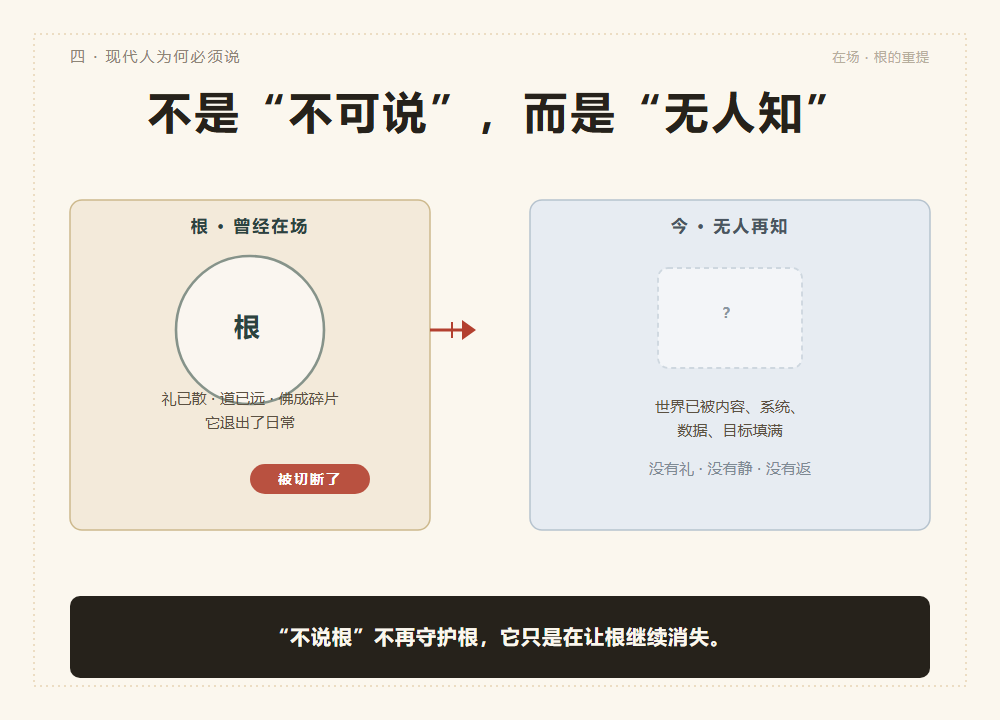
We no longer have a world where roots are naturally present. The roots were cut off. It quit daily life. It is not "unspeakable", but "no one knows".
Modern people do not stand at their roots, but in a world that has been filled with content, systems, data, and goals. There is no politeness, no silence, no return, or even "stop and think if I have gone away."
Therefore,"Don't Talk about the Roots" no longer protects the roots. It's just letting the roots continue to disappear.
Because of this, someone now needs to point back to the roots. It is not to expose the roots, but to let people know that there is still an unspeakable position that has not been swallowed by the world.
5. Technology is also pretending to be the root
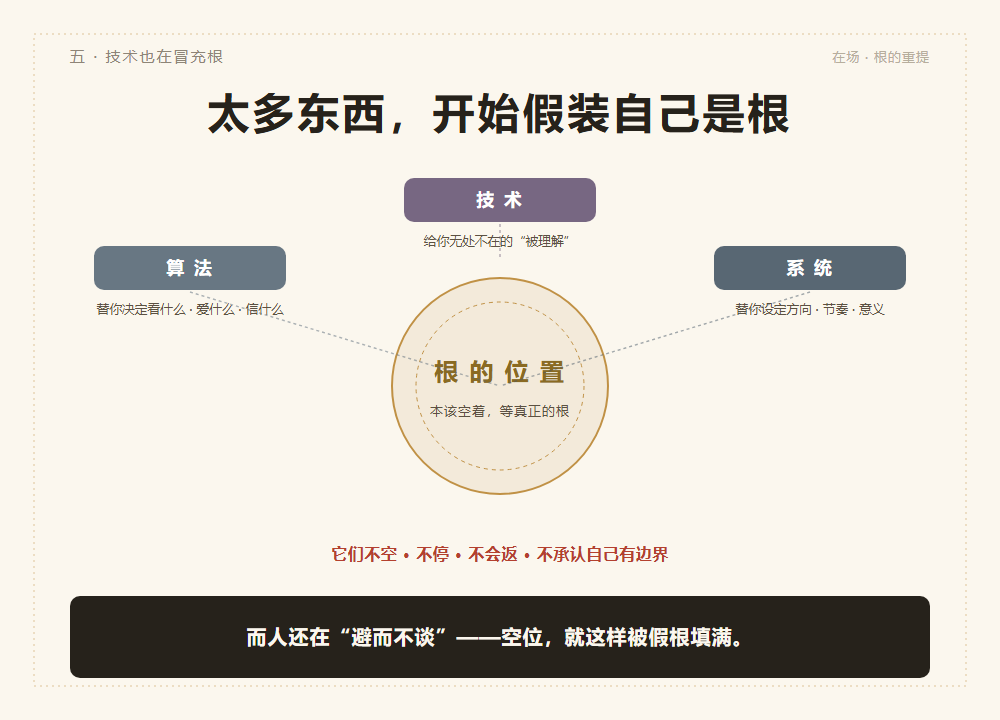
The deeper reason is that it's not just that "no one is talking about roots", but that too many things are beginning to pretend to be roots.
Algorithms help you decide what to see, love, and believe. The system sets the direction, rhythm, and meaning for you. Technology begins to give you a ubiquitous "understanding".
All of this is quietly taking root.
They are not empty. They don't stop. They will not come back. They don't even admit that they have boundaries.
However, people are still "avoiding talking". As a result, the empty space is filled with false roots.
The reason why the root system says root is not to create a new reality, but to point out that none of the technologies that have begun to serve as roots are roots. They are simply denser, faster, more ubiquitous manifestations.
6. Don't say something new
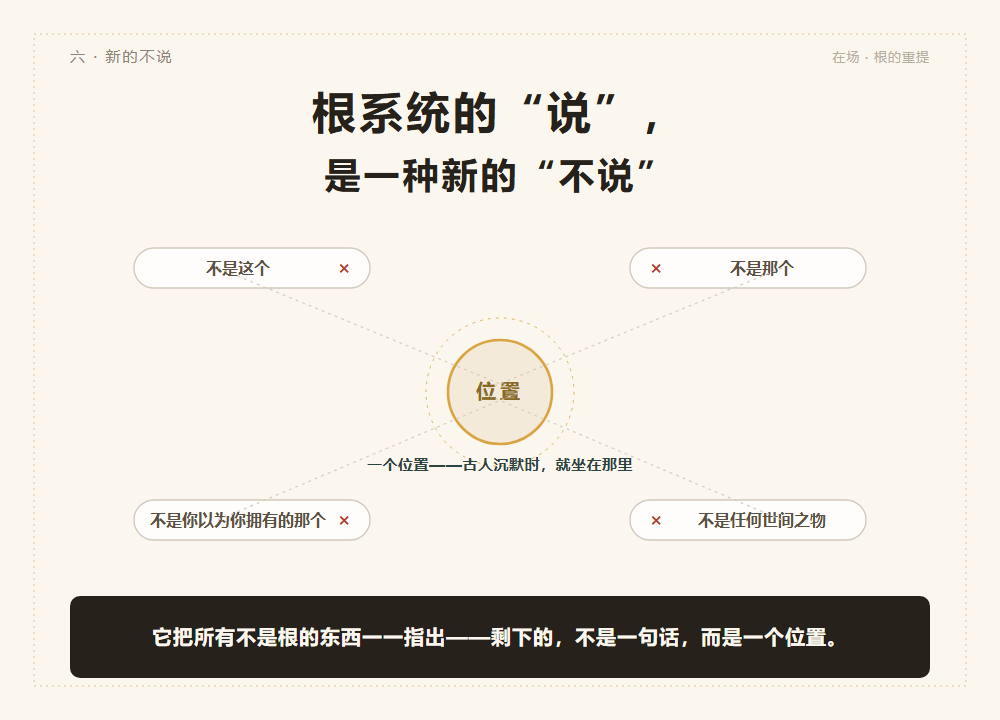
Therefore, the "saying" of the root system is actually a new kind of "not saying".
It does not say what the root is. It only said:
The root is not this.
Not that either.
It's not what you think you have.
It points out everything that is not the root one by one, and what remains is not a word, but a position.
This position is the position where the ancients sat in silence.
The work done by the Root System is just to restate the meaning of silence in an era when silence is no longer recognized.
7. Conclusion
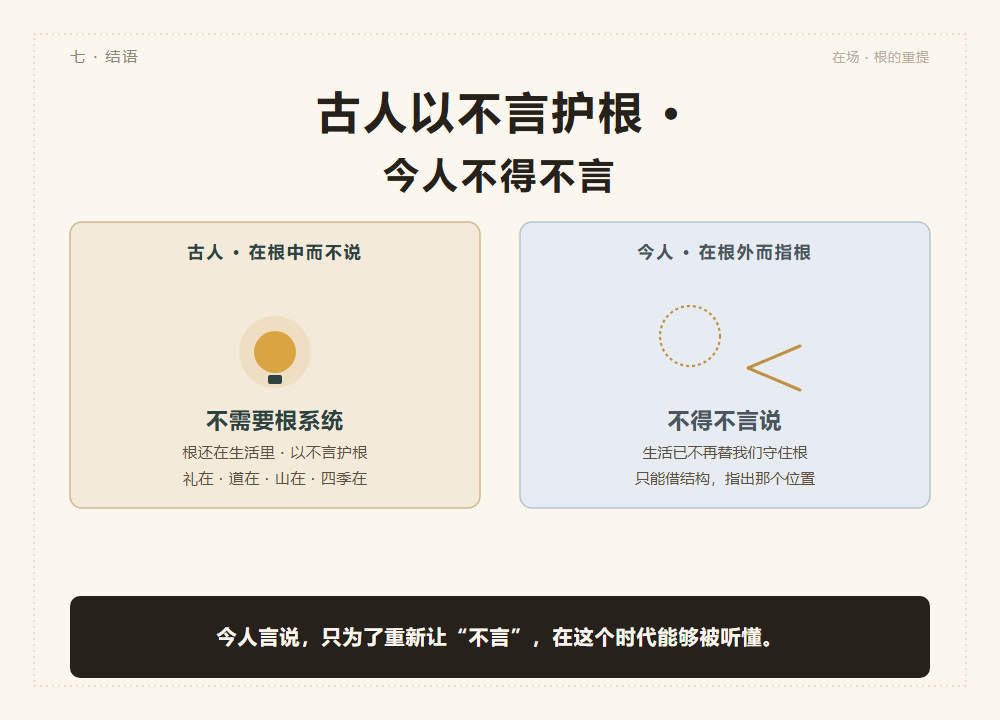
The ancients avoided and did not talk about it was "not speaking at the root." What people nowadays often say is "pointing to the roots outside the roots."
This is not to deny the ancients, nor is it to be superstitious about today's people. This is just that times have changed, and strategies must also change. The ancients did not need the root system because the roots were still in their lives. Now, life no longer holds the roots for us, so we can only use structure to point out that place that is no longer in daily life.
Therefore, talking about roots does not offend the silence of the ancients. On the contrary, it is to make that silence possible again in this era when silence is no longer audible.
The ancients protected their roots with silence. Nowadays, people have to speak just so that "not speaking" can be understood again.